The reign of the philosopher-emperor Marcus Aurelius (161–180 CE) was defined by a profound paradox. Though he was a devoted student of Stoicism who craved a life of quiet contemplation and philosophical study, fate forced him to spend the final two decades of his life on the brutal, freezing northern frontier, commanding the legions against an massive coalition of Germanic and Sarmatian tribes.
Following his death, his son and successor, Commodus, immortalized this grueling military campaign by constructing the Column of Marcus Aurelius (Columna Centenaria). Standing proud in Rome's modern-day Piazza Colonna, this monumental stone pillar serves as a stark, cinematic record of total war along the Danube—and a fascinating psychological counter-text to Marcus’s own private writings.
1. Architectural Blueprint: Mirroring Trajan
The Column of Marcus Aurelius was explicitly designed to mimic the legendary Column of Trajan, built some eighty years earlier. Constructed out of 28 massive blocks of Carrara marble stacked precisely on top of one another, the column rises to a towering height of roughly 100 Roman feet ($29.6\text{ meters}$).
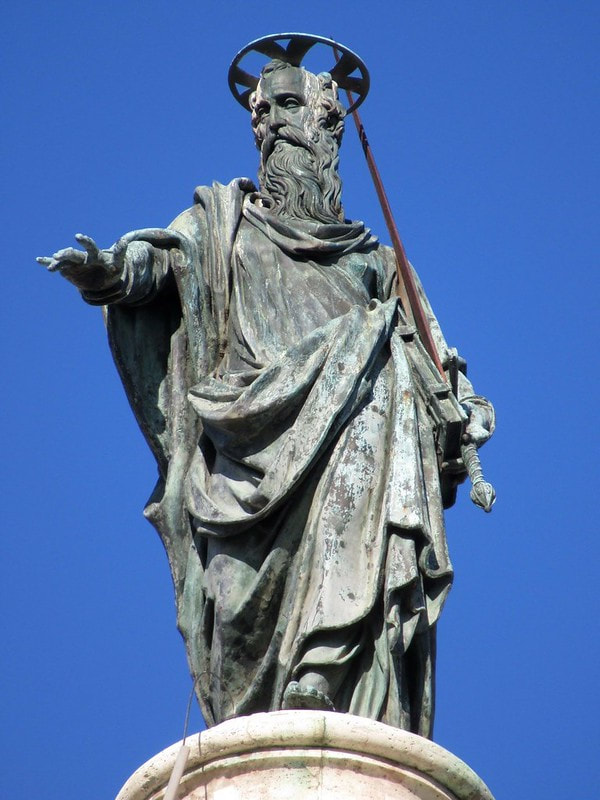
The interior of the column is completely hollow, housing a tight, claustrophobic spiral staircase featuring 190 stone steps. This staircase led to an outdoor viewing platform at the absolute summit, where a colossal bronze statue of Marcus Aurelius once looked out over the city (replaced in 1589 by a statue of Saint Paul on the orders of Pope Sixtus V).
The exterior of the column is completely wrapped in a continuous, 360-degree helical frieze that climbs the pillar from base to summit, narrating the chronology of the Marcomannic Wars across more than 2,500 meticulously carved human and horse figures.
2. Artistic Style: The Shift to Severe Realism
While Marcus’s column shares the exact scale and format of Trajan’s Column, its artistic style represents a radical, tectonic shift in the history of Roman relief sculpture. Trajan’s reliefs are characterized by classical balance, subtle proportions, and shallow, elegant carvings. Marcus’s column abandons this restraint in favor of a raw, deeply emotional expressionism:
Deep Undercutting: The sculptors carved much deeper into the stone, creating heavy shadows and high-contrast lines. This technique ensured that the scenes were highly visible and legible to a viewer standing far below on the street level.
The Expression of Trauma: Unlike the stoic, calm faces found in classical art, the figures on Marcus’s column display intense human emotion. Roman soldiers look exhausted, and captured Germanic women stare out with vivid expressions of profound grief, horror, and despair.
3. The Graphic Reality of Frontier War
The frieze does not sanitize the realities of imperial expansion. It functions as a gritty, unvarnished documentary of Roman military logistics, scorched-earth tactics, and systemic violence.
The scenes are organized into brutal, repeating narratives of conquest:
The Execution Lines: The frieze repeatedly illustrates Roman soldiers systematically de-capitating bound Germanic chieftains while their families watch.
The Destruction of Villages: In multiple bands of the relief, Roman infantrymen torch native thatched-roof huts with torches, driving out livestock and dragging crying children away into slavery.
The March of the Legions: Interspersed between the acts of violence are the monotonous, grueling realities of campaign life: legions constructing log bridges over the Danube, building fortified turf camps, and marching through dense, marshy forests.
4. The Miracle of the Rain
The most famous individual scene on the entire monument is The Miracle of the Rain (Scene 16), which illustrates a dramatic historical event that occurred around 173 CE.
According to Roman historical accounts, a detachment of the Twelfth Legion was completely surrounded by a massive force of Quadi warriors. Cut off from their supply lines, the Roman soldiers were on the verge of surrendering due to intense heat, exhaustion, and a catastrophic lack of water.
The relief panel illustrates a sudden, miraculous intervention: a colossal, winged rain divinity (Jupiter Pluvius) emerges from the sky, his hair and outspread arms dissolving into torrential sheets of water.
Below him, the artistic narrative splits into a dual reality: the parched, dying Roman soldiers tilt their helmets upward to catch the life-saving rain, while directly adjacent, a sudden flash flood drowns the enemy barbarians, overturning their horses and shattering their chariots in a display of divine imperial protection.
5. The Philosopher vs. The Monument
The Column of Marcus Aurelius presents a fascinating psychological contrast when read alongside the Emperor’s private philosophical journal, the Meditations.
Marcus wrote his diary by candlelight in his military tents along the very battlefields depicted on the column. In those pages, he routinely expressed a profound weariness of war, writing that the fame of military triumphs is nothing more than "a spider catching a fly," and urging himself to view his imperial power not as a source of pride, but as a heavy, tragic duty.
Yet, the monument erected by his family and the Senate completely strips away this internal philosophical nuance. The stone column celebrates the exact opposite of Stoic humility: it glorifies absolute geopolitical dominance, the raw destruction of enemies, and the merciless imposition of Roman order over chaos—proving that while Marcus Aurelius wished to be remembered as a citizen of the cosmos, the Roman state insisted on immortalizing him as a ruthless conqueror of the world.