For the ancient Egyptians, death was not the absolute end of existence, but a dangerous, transformative pause before the ultimate journey. Their entire religious infrastructure—from the construction of monumental pyramids to the complex science of mummification—was engineered to secure safe passage into the Afterlife (Duat).
At the absolute center of this spiritual journey sat a single, vital organ: the heart (Ib). While the brain was viewed as a useless organ and routinely discarded during mummification, the heart was revered as the seat of human intelligence, emotion, memory, and the ultimate moral record of a person's life.
1. The Anatomy of the Soul: The Heart as the Ib
The ancient Egyptians divided the human persona into multiple spiritual layers. To survive in the afterlife, a person needed their name (Ren), their shadow (Sheut), their life-force (Ka), and their personality (Ba) to remain intact.
Crucially, all of these elements relied on the Ib—the heart.
Because the heart held the unedited record of every deed, thought, and word a person had committed on earth, it could not be removed from the body during mummification like the lungs, liver, stomach, and intestines. While those organs were extracted and placed into protective canopic jars, the heart was carefully left inside the chest cavity.
To ensure the heart did not betray its owner during the upcoming divine judgment, embalmers placed a heavy, green stone Heart Scarab amulet directly over the organ. This amulet was inscribed with a powerful magical spell from the Book of the Dead (Chapter 30B), explicitly commanding the heart: "Do not rise up against me as a witness... do not tell lies against me in the presence of the great god."
2. Navigating the Underworld: The Book of the Dead
Before the deceased could present their heart for judgment, their spirit had to navigate the treacherous landscape of the Duat (the underworld). This subterranean realm was a terrifying obstacle course filled with lakes of fire, boiling rivers, cavernous gates guarded by grotesque demons, and venomous serpents.
To survive, wealthy Egyptians were buried with a custom-compiled papyrus scroll known today as the Book of the Dead (originally titled the Spells for Coming Forth by Day).
This scroll functioned as a practical, magical survival guide. It contained a cheat sheet of specific spells, secret passwords, and the exact names of the underworld demons, allowing the deceased to disarm monsters and pass through the guarded gates safely on their way to the ultimate destination: The Hall of Ma'at.
3. The Climax of Judgement: The Weighing of the Heart
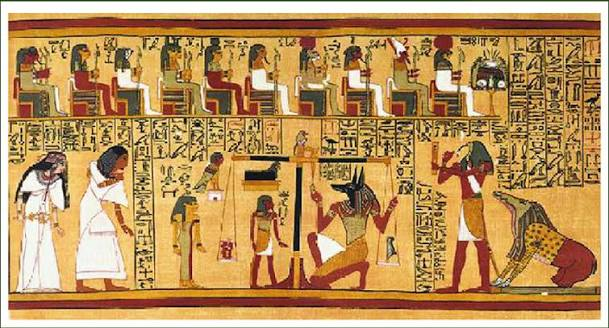
Once the soul reached the Hall of Ma'at (the goddess of truth, balance, and cosmic order), they faced the supreme trial of their eternal existence: The Weighing of the Heart ceremony. The trial was overseen by a divine tribunal of gods and captured in vivid detail in funerary papyri.
The trial proceeded in a strict, dramatic sequence:
The Negative Confession
The deceased stood before forty-two divine judges and recited the "Negative Confession." To prove their moral purity, they had to declare aloud that they had not committed specific sins on earth, stating: "I have not stolen," "I have not told lies," "I have not defiled the waters of the Nile," and "I have not caused pain to any man."
The Scales of Justice
Following the confession, the jackal-headed god Anubis led the deceased to a massive, golden scale set in the center of the hall. Anubis placed the traveler's physical heart onto one side of the scale. On the opposite side, he placed the Feather of Ma'at—an ostrich feather symbolizing pure truth, cosmic balance, and absolute righteousness.
       [ The Heart / Ib ]  ◄─────── (Balances) ───────►  [ Feather of Ma'at ]
      (Record of Actions)                               (Truth & Righteousness)
               │                                                   │
               ├─────────────────► IF EQUAL ◄──────────────────────┤
               │                                                   │
               ▼                                                   ▼
     [ Justified / True of Voice ]                         [ Heavy with Sin ]
               │                                                   │
       (Led by Horus to)                                   (Dropped to floor)
               │                                                   │
               ▼                                                   ▼
     [ Paradise / Field of Reeds ]                          [ Devoured by Ammit ]
                                                           (The Second Death)
The Witnesses
As the scales tipped, two gods stood vigilant by the scales:
Thoth: The ibis-headed god of wisdom and writing stood ready with a reed pen and a papyrus palette, meticulously recording the final verdict for the eternal archives.
Ammit: Crouching directly beneath the scales was a terrifying, composite demon known as the Devourer of Souls. Ammit possessed the head of a crocodile, the front torso of a leopard, and the hindquarters of a hippopotamus—the three deadliest man-eating predators known to the Egyptians.
4. The Two Verdicts: Paradise or Non-Existence
The mechanical balance of the scale determined the final destiny of the human soul:
The Heavy Heart (Condemnation): If the deceased had lived a life of cruelty, deceit, and sin, the heart would be heavy with guilt, causing the scale to plunge downward. Anubis would instantly drop the heart to the floor, where it was snapped up and eaten by Ammit. By losing their heart, the deceased suffered the Second Death. They were completely wiped out from existence, denied eternity, and condemned to wander forever in a state of chaotic, unmade oblivion.
The Balanced Heart (Justification): If the person had lived a righteous life in alignment with Ma'at, the heart would balance perfectly with the feather. Thoth would declare the verdict, pronouncing the deceased Maa Kheru ("True of Voice"). The falcon-headed god Horus would then step forward, take the justified soul by the hand, and lead them past the throne of Osiris into the Field of Reeds (Aaru).
5. The Destination: The Field of Reeds
The Egyptian vision of paradise was not an abstract, ethereal cloudscape; it was a perfected, divinely mirrored version of the Nile Delta itself.
In the Field of Reeds, there was no sickness, no hunger, and no death. The crops grew to supernatural heights, the waters were pristine, and the justified dead were reunited with their lost loved ones, pets, and ancestral gods. They lived an eternal, blissful existence of farming, hunting, and feasting—proving that for the ancient Egyptians, the ultimate reward for a virtuous life was simply the continuation of earthly joy, guarded forever by the perfect balance of a light heart.