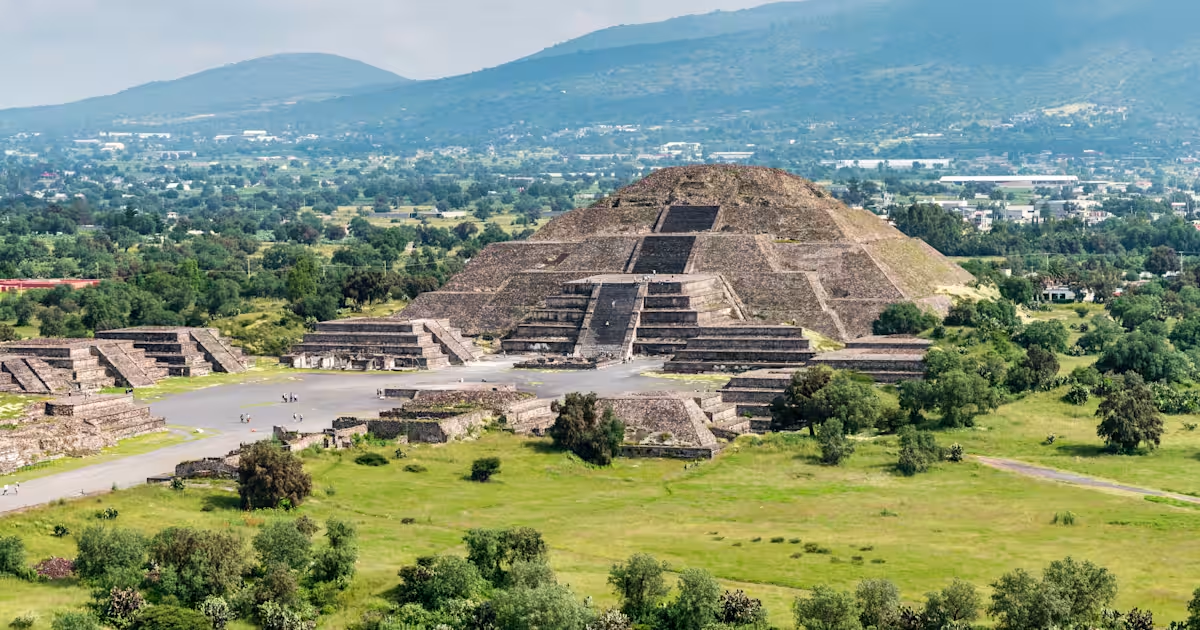
The mystery of Teotihuacan is one of the most significant "black holes" in Mesoamerican archaeology. Located just 30 miles northeast of modern-day Mexico City, it was once the largest city in the Americas, with a population reaching 125,000 to 200,000 at its peak (c. 1 CE – 550 CE).
Yet, when the Aztecs discovered the city centuries after it had been abandoned, it was already a ruin. They were so awestruck by its scale that they named it Teotihuacan—the "Place Where the Gods Were Created." To this day, we do not know the original name of the city, the language its citizens spoke, or the names of its rulers.
1. The Multi-Ethnic Melting Pot
Early theories suggested the city was built by the Toltecs, but we now know the Toltecs rose much later. Current archaeological evidence points to Teotihuacan being a multi-ethnic metropolis.
The Refugees: Evidence suggests the city’s rapid growth was spurred by volcanic eruptions (specifically Popocatépetl). Thousands of displaced people from across the Valley of Mexico likely migrated to the site, bringing diverse traditions that fused into a new "Teotihuacano" identity.
The Neighborhoods: Excavations of apartment compounds like Tlailotlacan have revealed distinct ethnic enclaves. Isotope analysis of bones proves that Zapotecs from Oaxaca and Maya from the lowlands lived in the city for generations, maintaining their own burial customs while participating in the city's economy.
2. The Master Plan: Sacred Geography
Whoever the architects were, they possessed an advanced understanding of geometry and astronomy. The city is laid out on a precise grid oriented 15.5 degrees east of true north.
The Avenue of the Dead: This 1.5-mile-long central axis connects the major monuments.
The Pyramid of the Sun: Built over a natural cave (which the inhabitants likely viewed as the "womb" of the earth), its alignment is synchronized with the setting sun on specific days of the solar calendar.
The Pyramid of the Moon: Situated at the north end of the Avenue, it mirrors the silhouette of Cerro Gordo, the sacred mountain behind it, creating a "built landscape" that harmonized with nature.
3. The Political Mystery: A Corporate State?
Unlike the Maya or the Aztecs, who obsessed over individual kings and their lineages in art and inscriptions, Teotihuacan is strangely silent about its leaders.
The "Corporate" Theory: Some archaeologists argue that Teotihuacan was not a monarchy but a collective or corporate state. Power may have been shared among several high-ranking lineages or councils.
Public over Private: The city’s art focuses on deities (like the Great Goddess or the Storm God) and generic figures in ritual processions rather than specific named rulers. The investment in high-quality apartment compounds for the middle class suggests a society that prioritized collective stability over the glorification of a single king.
4. The Feathered Serpent and the Tunnel
In 2003, a massive discovery was made beneath the Temple of the Feathered Serpent (Quetzalcoatl). A secret tunnel, sealed for 1,800 years, was found containing thousands of ritual objects.
The Underworld: The tunnel was filled with mercury, pyrite (fool's gold) to represent stars, and carvings of jaguars. It was a physical recreation of the underworld.
Mass Sacrifice: Around the temple, the remains of over 200 warriors were found, many with their hands tied behind their backs. They wore necklaces of human jawbones, suggesting that the city’s early foundation was tied to large-scale, state-sponsored military sacrifice.
5. The Violent Collapse
Teotihuacan did not fade away; it burned. Around 550 CE, the city’s monumental center was systematically torched and looted.
An Internal Revolt? Because the fire was focused on the elite palaces and temples along the Avenue of the Dead—rather than the residential neighborhoods—most archaeologists believe this was an internal uprising.
Resource Depletion: Overpopulation, deforestation (needed to create the lime plaster that covered the city), and a possible drought likely led to a collapse of the social contract, causing the lower classes to turn on the elite.
6. The Legacy: The Aztec Inheritance
The Aztecs viewed Teotihuacan as a sacred blueprint. They adopted the city’s gods (like Tlaloc and Quetzalcoatl) and attempted to mirror its architecture in their own capital, Tenochtitlan. For the Aztecs, Teotihuacan was the "First World"—a lost golden age of order and divinity.
Given that we have found DNA and artifacts from all over Mesoamerica within the city, do you think Teotihuacan’s lack of "king-centered" art means it was a rare ancient democracy, or was the state religion simply so powerful that it erased the identity of the individuals in charge?