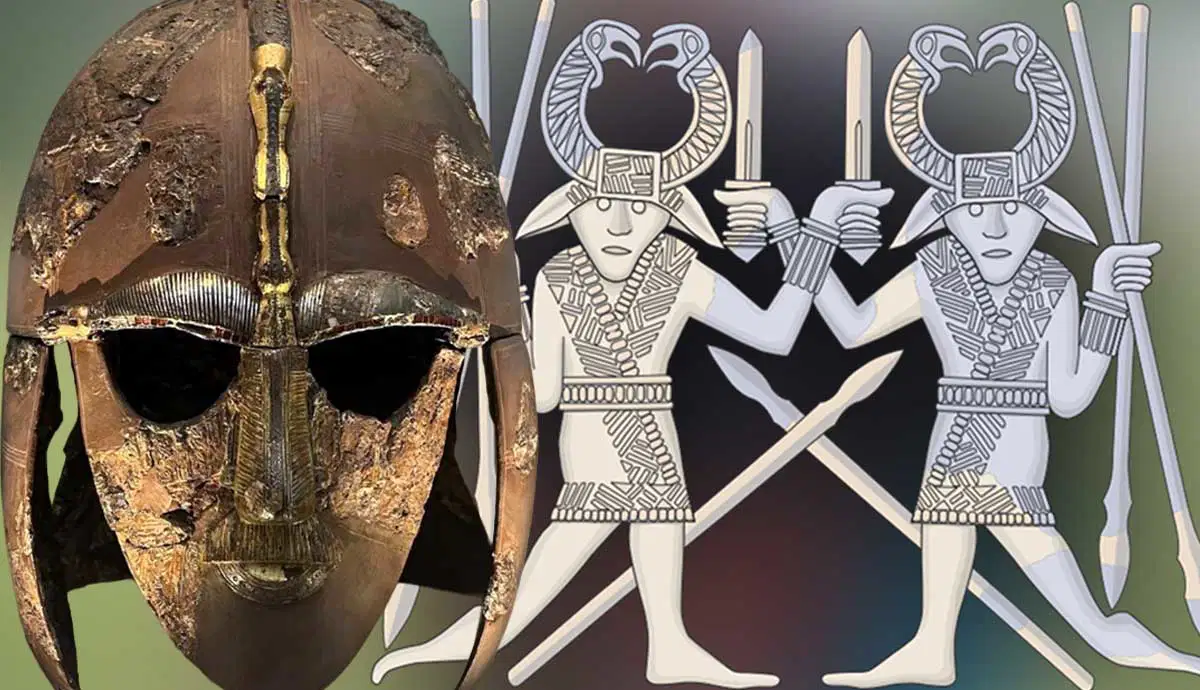
In 1939, on a quiet estate in Suffolk, England, the ground gave up a secret that would rewrite British history. The Sutton Hoo ship burial was the final resting place of a 7th-century king, likely Rædwald of East Anglia. Among the treasures was a shattered iron object that, after years of reconstruction, became the Sutton Hoo Helmet. More than just armor, this mask is a "visual manifesto" of a culture that sat at the edge of the world but was connected to its furthest reaches.
The Mask of the Dragon: A Dual Reality
The most striking feature of the helmet is its face-mask. To the casual observer, it depicts a stern, mustachioed warrior. However, it is designed as a visual puzzle. The nose, mustache, and eyebrows form the body and wings of a flying dragon. The "mustache" is the dragon’s tail, and its head meets another dragon head rising from the crest of the helmet.
In the shield-wall of a 7th-century battlefield, this imagery would have been terrifying. The wearer didn't just look like a king; they looked like a supernatural being. This dual-identity—man and beast—reflects the heroic poetry of the era, such as Beowulf, where the lines between the human hero and the monsters they fight are often blurred. The helmet was a piece of "psychological armor," meant to grant the wearer the power of the dragon.
A Global Power in the "Dark Ages"
The Sutton Hoo helmet and its associated treasures (gold buckles, garnet-inlaid clasps, and Byzantine silver) destroyed the Victorian concept of the "Dark Ages." This wasn't a time of cultural decay after the fall of Rome. Instead, it was a period of vibrant internationalism.
The garnets in the helmet's eyebrows came from Sri Lanka or India. The silver bowls in the grave came from the Middle East. The craftsmanship of the helmet itself combines Roman military tradition with Scandinavian "Vendel" art styles. This proves that the Anglo-Saxon kings were major players in a global economy. They were "barbarians" in name only; in reality, they were sophisticated diplomats and patrons of an art form that was as complex and intricate as any in the Mediterranean.
The Tension of Faith
The Sutton Hoo burial occurred at the exact moment England was transitioning from Paganism to Christianity. The helmet represents the old Germanic world—one of warrior-kings, fate (Wyrd), and ancestral spirits. Yet, the grave also contained silver spoons with the names "Saulos" and "Paulos" (St. Paul).
This tension is what makes the helmet so iconic. It is the face of a society in flux, holding onto the fierce symbols of its past while reaching toward a new, unified religious future. It is a symbol of state-building. By wearing such a mask, the king wasn't just defending his head; he was projecting a unified identity for a new kingdom called "England." The Sutton Hoo helmet is not just an artifact; it is the birth certificate of a nation.