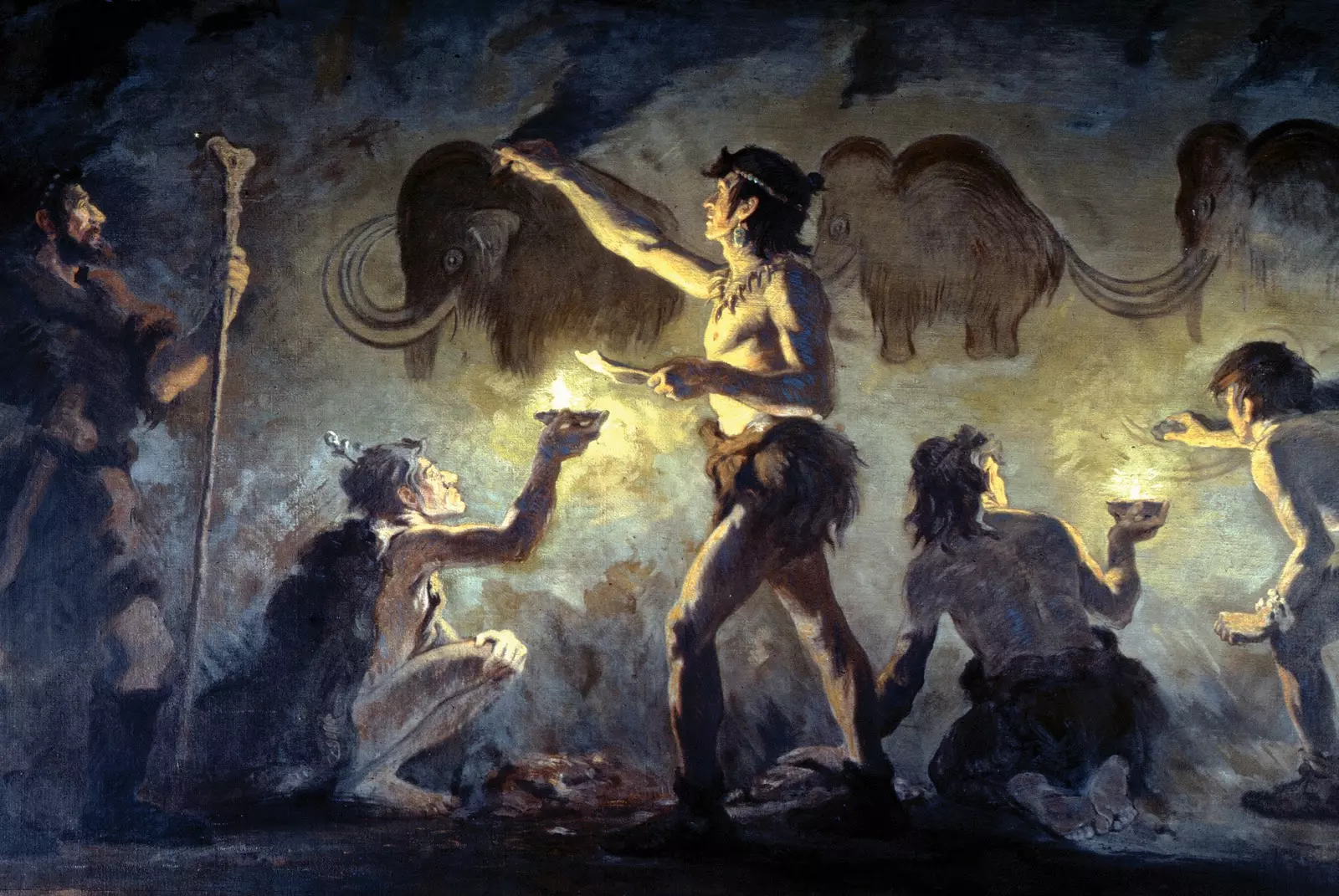
For over 150 years, the term "Neanderthal" has been a synonym for a brutish, unintelligent caveman—an evolutionary failure that was rightfully replaced by the superior Homo sapiens. This "human exceptionalism" has been shattered by a series of revolutionary archaeological finds in Europe. We now have irrefutable evidence that Neanderthals were artists, musicians, and thinkers who possessed a capacity for symbolic thought that was previously thought to be uniquely "human."
The Spanish Cave Paintings: A Paradigm Shift
The "smoking gun" for Neanderthal intelligence came in 2018 from three caves in Spain: La Pasiega, Maltravieso, and Ardales. Researchers used a technique called uranium-thorium dating to analyze the carbonate crusts formed over cave paintings of hand stencils and geometric shapes. The results were staggering: the paintings were at least 64,800 years old.
At this time, Homo sapiens were still largely confined to Africa. This means the only possible artists were Neanderthals. The creation of a hand stencil—placing a hand on a wall and blowing pigment over it—is a profound act of self-awareness. It says, "I am here; I exist." This symbolic expression is the foundation of all human culture, from cave paintings to the internet.
Beyond the Cave: Esthetics and Ritual
Art wasn't limited to walls. Neanderthals were also "fashionable." At sites like the Grotte du Renne in France and Krapina in Croatia, archaeologists have found eagle claws and shells that were clearly used as jewelry. These items were notched, polished, and painted with red ochre.
Furthermore, the discovery of the Bruniquel Cave structures in France reveals a level of social organization that is nearly modern. Over 176,000 years ago, Neanderthals went deep into a cave—where there was no natural light—and constructed two large rings out of broken stalagmites. This was not a domestic site; it was a site of ritual. They had mastered fire, coordinated labor, and felt the need to create a space for something other than survival.
The Genetics of Creativity
We now know that Neanderthals didn't truly "go extinct." Instead, they were absorbed. Most modern humans of non-African descent carry between 1% and 4% Neanderthal DNA. This interbreeding suggests that when our ancestors met Neanderthals, they didn't see "brutes"—they saw fellow humans. They recognized each other’s art, shared each other's fires, and merged their cultures.
The realization that Neanderthals were artists forces us to redefine what it means to be "human." If creativity, music, and symbolic thought weren't unique to Homo sapiens, then they are perhaps a fundamental trait of the entire Homo lineage. Our "primitive" cousins weren't a failed experiment; they were a different way of being human, and their artistic legacy still flows through our veins today.