The Viking colonization of the Faroe Islands—long considered a straightforward story of 9th-century Norse migration—has been fundamentally reshaped by recent archaeological and genetic research. We now understand the settlement of these islands to be a complex, multi-phase process that began centuries before the arrival of the famous Viking longships.
The Myth of the First Settlers
It was traditionally believed that the Faroe Islands were uninhabited until the arrival of Norse Vikings, possibly preceded by a brief presence of Irish hermits (the papar) in the 7th and 8th centuries. However, modern science has challenged this narrative:
Pre-Viking Evidence: Radiocarbon dating of peat ash and barley grains has confirmed human activity as early as the 4th–6th centuries CE, and again in the 6th–8th centuries.
Genetic and Biological Traces: DNA analysis of sheep bones found in sediment layers dates to as early as 500 CE, suggesting that these pre-Viking settlers—likely Celtic or Gaelic in origin—were already practicing animal husbandry on the islands long before the Norse arrived.
Toponymy: The Faroese landscape retains linguistic "fossil" evidence of this earlier population. Place names containing the element "ergi" (derived from the Gaelic airge, meaning a summer pasture or shieling) indicate that Gaelic speakers were active in the islands’ agricultural life before the Norse took full control.
The Norse Transformation (9th Century CE)
While they were not the first, the Vikings did orchestrate the most significant demographic and cultural shift in the islands' history. Starting around 800–850 CE, a wave of settlers from western Norway established a more permanent, state-like society.
The Færeyinga Saga: This 13th-century Icelandic text identifies Grímur Kamban as the first permanent Norse settler. While often viewed as semi-legendary, his arrival aligns with the archaeological evidence of a rapid increase in permanent Norse farmsteads during the 9th century.
State Formation: The Vikings introduced their traditional social and legal structures, most notably the Løgting (Parliament) in Tórshavn. Established around 825 CE, it remains one of the world’s oldest parliamentary institutions, demonstrating the Viking focus on structured governance and law.
Daily Life and Archaeological Findings
Excavations at sites like Kvívík and Toftanes have provided a vivid picture of the Viking-age economy, which blended traditional Norse methods with the unique demands of the North Atlantic environment:
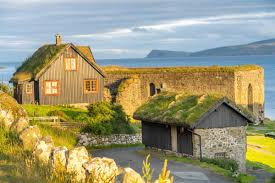
Architecture: Viking farmsteads typically consisted of longhouses built with thick walls of stone and turf—an adaptation to the islands' lack of timber. These houses often included an attached byre (cowshed) to protect livestock through harsh winters.
Material Culture: Findings such as spindles, cod-liver oil lamps, and fishing gear reveal an economy heavily reliant on maritime resources. Interestingly, archaeologists have found items like imported slate millstones and even a woman's shoe of a style found in contemporary Paris, proving that these "isolated" settlers were part of a sophisticated, wide-reaching trade network.
Children and Recreation: Excavations have recovered wooden toys, including miniature ships and horses, as well as chess pieces, suggesting that Faroese Viking life allowed for leisure and community connection.
Legacy and Cultural Identity
The Viking influence proved resilient, primarily because it was built on a foundation of communal sustainability:
Language: The Faroese language remains one of the closest modern living languages to Old Norse, having evolved in relative isolation and resisted total assimilation by Danish or other mainland influences.
Ritual Landscape: Place names in areas like Suðuroy, such as Hov ("temple") and Hørg ("sacrificial mound"), still mark the sites of pagan ritual centers that predate the islands' conversion to Christianity around the year 1000 CE.
Enduring Traditions: Cultural markers like the chain dance (kvæði), performed to epic ballads, are considered a rare, living link to the medieval period, having survived precisely because the islands' remote geography shielded them from the religious and social prohibitions that eradicated similar traditions elsewhere in Europe.
The settlement of the Faroe Islands was not a single event, but a layering of cultures. The Vikings "re-colonized" a landscape already touched by earlier settlers, ultimately fusing their own political and social structures with the existing agricultural practices to create the distinct Faroese identity that persists today.
Since you are interested in the evolution of these societies, would you like to compare how the Viking settlement of the Faroe Islands differed from their approach to colonizing the more challenging environments of Iceland or Greenland?