The reign of Akhenaten (c. 1353–1336 BCE) stands as the most disruptive and enigmatic period of the Egyptian New Kingdom. By abandoning the traditional pantheon in favor of the sole worship of the sun-disk, the Aten, Akhenaten triggered a social, political, and religious revolution that nearly dismantled the established order of the Egyptian state.
The Religious Revolution
Atonism: Akhenaten declared the Aten—the physical disk of the sun—to be the only god. This was not merely a shift in worship; it was an act of extreme centralization. All previous deities, including the powerful Amun-Ra, were stripped of their influence, and their temples were forcibly closed.
Divine Intermediary: In traditional Egyptian religion, priests acted as intermediaries between the gods and the people. Akhenaten abolished this hierarchy, asserting that he and his queen, Nefertiti, were the only individuals capable of communicating directly with the Aten. This effectively consolidated all religious, political, and economic power into the hands of the Pharaoh.
The Sun Temple Architecture: Departing from the dark, labyrinthine sanctuary design of traditional temples, the temples of the Aten were open-air structures built to maximize exposure to sunlight. This architectural change symbolized the "open" nature of the new faith, where the light of the sun could directly touch the king and his subjects.
The Move to Amarna (Akhetaten)
A New Capital: Akhenaten abandoned Thebes, the traditional religious capital, and founded a brand-new city in the desert: Akhetaten (modern-day Amarna). Built at an unprecedented speed, the city was designed to be the earthly seat of the Aten.
Geopolitical Isolation: Excavations at Amarna have revealed that while the city was a hub for the royal court, it was largely cut off from the traditional power centers of the empire. This isolation allowed Akhenaten to pursue his radical social experiments without the interference of the powerful Theban priesthood.
The Amarna Letters: Archives found at the site contain the "Amarna Letters," a collection of diplomatic correspondence written on clay tablets. These letters offer a rare, unfiltered look at the decay of Egyptian foreign policy during his reign, showing that while Akhenaten was preoccupied with his religious vision, Egypt’s influence over its vassal states in the Levant began to falter.
The Amarna Style: A Radical Artistic Shift
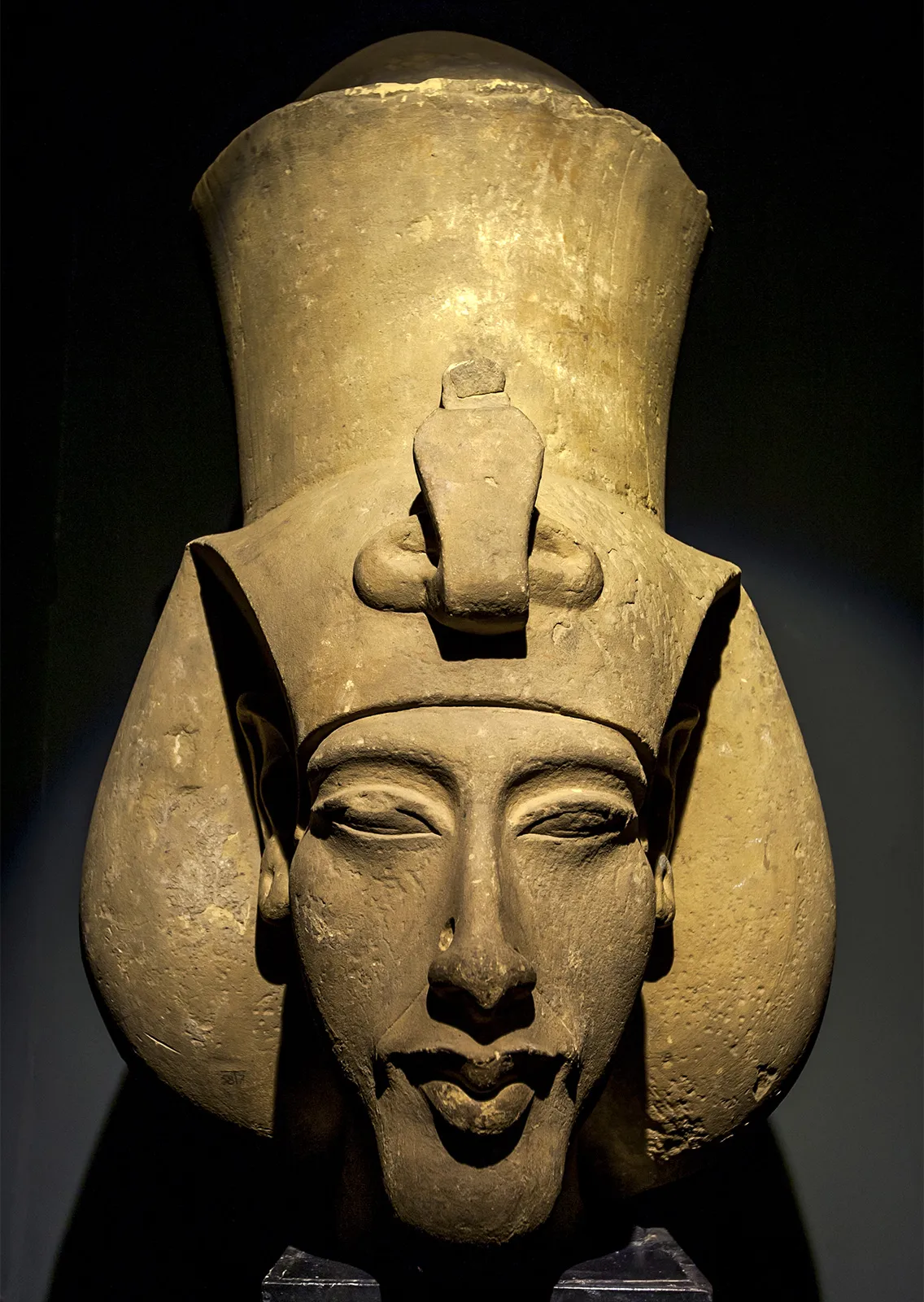
The "Deformed" Ideal: Artistic representations from this period represent a dramatic departure from the rigid, idealized conventions of Egyptian art. Akhenaten is depicted with a long face, heavy eyelids, narrow shoulders, a protruding belly, and wide hips.
Humanizing the Divine: Historians debate whether these features were symbolic or a literal representation of a medical condition (such as Marfan syndrome or Froehlich’s syndrome). Regardless of the intent, the art became more informal and intimate, often depicting the royal family in candid, affectionate moments—a sharp contrast to the detached, stoic portrayals of earlier Pharaohs.
Naturalism: The "Amarna Style" emphasized naturalism, flowing lines, and a sense of movement. This artistic rebellion was a visual reinforcement of his religious rebellion, stripping away the old aesthetics that were tethered to the traditional gods.
The Reaction: Damnatio Memoriae
The Restoration: After Akhenaten’s death, the establishment—led by his successors Tutankhamun, Ay, and eventually the military general Horemheb—moved quickly to restore the old order. Amarna was abandoned and systematically dismantled.
Erasing the Heretic: The subsequent dynasties engaged in a massive damnatio memoriae (condemnation of memory). Akhenaten’s name was hacked out of monuments, his temples were torn down to fill the foundations of later buildings, and his reign was officially classified as a period of chaos and divine displeasure.
Archaeological Paradox: Ironically, the systematic destruction of Amarna by later kings is exactly what allowed the city to be so well-preserved for modern archaeologists. Because the city was abandoned so suddenly and subsequently left untouched by later urban development, it provides a "time capsule" of domestic and administrative life during the 18th Dynasty that is unmatched in Egyptology.
Historical Significance
Akhenaten remains a polarizing figure. To some, he is a visionary monotheist and a champion of individual spiritual connection; to others, he is a dangerous autocrat whose obsession with a single dogma nearly ruined the prosperity of the New Kingdom. Ultimately, his reign serves as a stark warning about the fragility of state power when it becomes untethered from tradition and focuses entirely on the whims of a single, absolute ruler.
Given your interest in historical sites and engineering, would you like to delve deeper into the specific construction techniques used for the rapid, mud-brick build of Akhetaten, or perhaps the subsequent "Restoration Stela" left by Tutankhamun?