The Sutton Hoo Ship Burial: A King’s Journey to the Afterlife
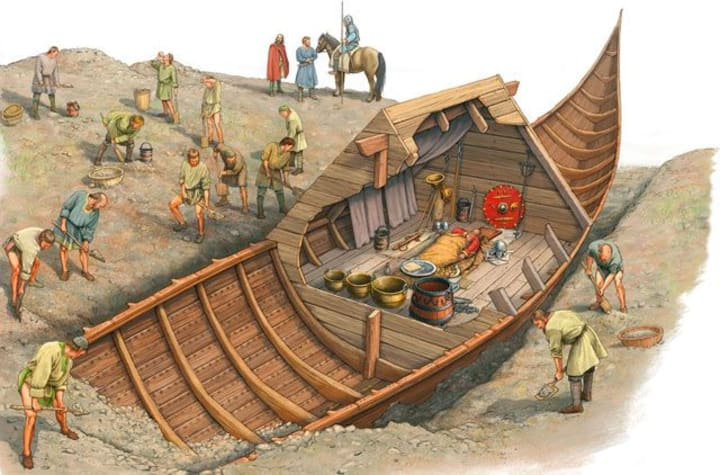
In 1939, on the eve of World War II, an archaeological discovery in Suffolk, England, forever changed our understanding of the "Dark Ages." Excavating a massive earthen mound on the estate of Edith Pretty, archaeologists revealed the ghostly imprint of a 90-foot-long oak ship. This was the Sutton Hoo ship burial, a monumental funeral for a 7th-century Anglo-Saxon king—likely Rædwald of East Anglia.
1. The Ghost in the Sand
Unlike many archaeological finds where the physical wood survives, the acidic soil at Sutton Hoo had completely dissolved the ship's timber.
The Impression: What remained was a "ghost ship"—a perfect impression in the sand where the rotted wood had left its mark, held together by the original iron rivets still in their proper places.
The Structure: The ship was an ocean-going vessel, powered by 40 oarsmen. Its presence inland, dragged up from the River Deben and buried under a mound, signaled the immense wealth and labor at the king's command.
2. The Treasures of a Warrior King
At the center of the ship lay a wooden burial chamber filled with a spectacular hoard of gold, silver, and garnet-encrusted objects. These items revealed that the Anglo-Saxons were not "barbarians," but master goldsmiths with global trade connections.
The Great Gold Buckle: A heavy, solid gold piece decorated with intricate, interlacing snakes and beasts—a hallmark of Germanic art.
The Purse Lid: Featuring masterfully crafted cloisonné enamel, it depicted birds of prey and men standing between wolves.
The Byzantine Silver: The burial included silver bowls and spoons from the Byzantine Empire, thousands of miles away, proving the vast reach of 7th-century trade networks.
3. The Iconic Helmet
The most famous find from the site is the Sutton Hoo Helmet. When discovered, it had been crushed by the collapsing roof of the burial chamber into hundreds of tiny fragments.
The Reconstructed Face: It took years for conservators to piece it back together. The helmet features a "masked" face with eye sockets, a nose, and a mustache.
Visual Puns: The helmet is a masterpiece of symbolism. The nose and mustache, when viewed with the eyebrows, form the shape of a flying dragon. Its surface was originally tinned to look like shining silver.
4. A Transition of Faiths
The burial occurred during a pivotal moment in English history: the transition from Paganism to Christianity.
Pagan Tradition: The ship burial itself and the inclusion of grave goods for the afterlife are deeply pagan practices, reminiscent of the descriptions in the epic poem Beowulf.
Christian Hints: Among the treasures were two silver spoons inscribed with the names "Saulos" and "Paulos" (Saul and Paul), likely baptismal gifts. This suggests that while the king may have been baptized, his court still honored the old, heroic funeral traditions.
5. The Legacy of the Find
Sutton Hoo proved that the early Anglo-Saxon period was a "Golden Age" of craftsmanship and sophisticated political structure. It moved the era out of the shadows of the "Dark Ages" and into the light of a complex, vibrant heroic society.