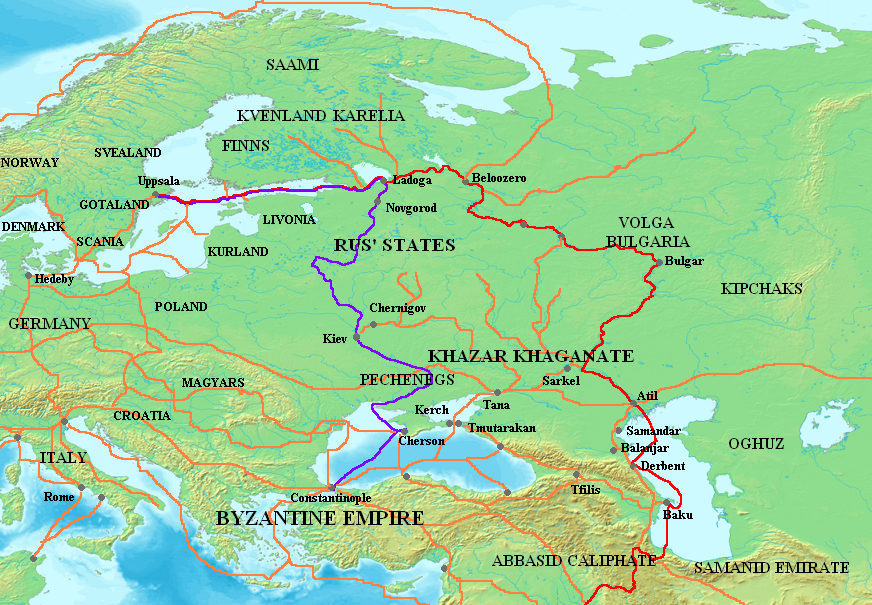
While popular history often focuses on the Viking expansion westward to the shores of Britain, France, and North America, a massive, economically revolutionary expansion occurred simultaneously to the east.
Driven by an insatiable hunger for silver, Scandinavian Norsemen—primarily from modern-day Sweden—penetrated deep into the vast river networks of Eastern Europe. Known in the East as the Rus, these intrepid merchants and warriors established the Volga Trade Route, creating a colossal commercial highway that linked the icy waters of the Baltic directly to the wealthy markets of the Islamic Abbasid Caliphate in Baghdad and the Silk Road.
1. The Gateway to the East: The Riverine Superhighways
The geographic challenge of the eastern expansion was immense. Unlike the open-ocean sailing of the Atlantic, the eastern routes required navigating dense forests, treacherous river rapids, and expansive marshlands.
The Rus utilized two primary river systems cutting through modern-day Russia, Ukraine, and Belarus:
The Dnieper Route: Led south to the Black Sea, terminating at the glittering Byzantine capital of Constantinople.
The Volga Route: Led southeast to the Caspian Sea, opening the door to Persia, the Silk Road, and the heart of the Islamic world.
To traverse these waters, the Rus adapted their maritime technology. They abandoned their massive, deep-hulled ocean warships in favor of smaller, shallow-draft oak or pine longships and log boats (monoxyla). These agile vessels could navigate shallow rivers and, crucially, could be hauled overland by hand or on rollers—a grueling process known as portage—from one river system to the next when the waterways didn't connect.
2. Key Trading Hubs of the Rus
As trade intensified during the 8th to 11th centuries, the Rus established a network of fortified trading posts that eventually evolved into the powerful medieval state of Kievan Rus'.
Staraya Ladoga (Aldeigjuborg): Located near Lake Ladoga, this was the absolute gateway for the entire enterprise. It was here that Scandinavian traders first intermingled with Slavic and Finno-Ugric populations, repairing their ships, trading furs, and preparing for the long voyage south.
Novgorod (Holmgard): Positioned further south along the Volkhov River, this massive fortress city became a central administrative and military clearinghouse for eastern merchandise.
Bulghar: Located at the confluence of the Volga and Kama rivers, this was the capital of the Volga Bulgars. It served as a highly vibrant, multi-cultural border market where Christian Rus merchants directly met Muslim traders from Central Asia and the Middle East.
3. The Currency of the Route: Furs, Slaves, and Dirhams
The mechanics of the Volga trade route relied on a highly lucrative exchange of commodities. The Rus brought raw, high-value wilderness luxury goods from the northern forests to swap for the highly refined manufactured wealth of the Orient.
Northern Exports
Furs: Sable, marten, fox, and beaver pelts were highly prized status symbols among the elite in Baghdad and Constantinople.
Slaves: Captured Western Europeans, Slavs, and Finno-Ugric peoples were trafficked down the rivers in massive numbers. The word "slave" itself derives directly from the ethnonym "Slav" due to the scale of this medieval human trafficking.
Walrus Ivory and Amber: Used extensively in the East for luxury carvings and jewelry.
The Ultimate Import: Islamic Silver
What the Rus desired above all else was silver. The Abbasid Caliphate was experiencing a golden age, minting millions of incredibly pure silver coins known as dirhams.
The Norsemen did not use these coins as fiat currency based on face value; instead, they operated on a bullion economy. Coins were valued strictly by their weight and purity of silver. If a transaction required a smaller amount of currency, the Rus would casually chop a dirham coin or a silver arm ring into fragments, creating what archaeologists call hack-silver.
The scale of this silver influx was breathtaking. To date, hundreds of thousands of Islamic dirhams have been unearthed in archaeological hoards across Scandinavia, with the highest concentration found on the Swedish island of Gotland, which acted as the central financial vault of the Baltic.
4. Cultural Encounters: The Account of Ibn Fadlan
The most vivid, unfiltered look at the Rus merchants along the Volga comes from an eyewitness account written by Ahmad ibn Fadlan, a 10th-century Arab diplomat sent by the Abbasid Caliph in 921 CE to embassy the Volga Bulgars.
Ibn Fadlan described the Rus as physical giants, noting they were "tall as date-palms, blonde, and ruddy." He observed their bodies covered from fingernails to neck in dark green tattoos of trees and geometric symbols, and noted that every man went armed with a broad axe, a knife, and a sword.
While he admired their physical stature, the highly sophisticated Muslim diplomat was deeply shocked by their hygiene and religious rituals. He detailed how they washed their faces daily in a communal bowl of dirty water, openly fornicated with their slave girls in the public marketplaces, and sacrificed cattle to giant wooden idols to secure good prices for their merchandise.
The Volga Ship Burial
Ibn Fadlan also recorded the only surviving eyewitness description of a grand Viking ship burial. When a prominent Rus chieftain died along the Volga, his people placed him in his longship alongside lavish clothing, weapons, sacrificed horses, hounds, and a volunteer slave girl who was ritually killed to accompany him. The entire ship was then set ablaze and buried under a massive dirt mound, physically recreating a Scandinavian royal funeral on the banks of a foreign Russian river.
5. The Decline of the Route
The Volga trade route flourished intensely until the late 10th century, when it began to decline due to shifting geopolitical landscapes.
The silver mines of the Abbasid Caliphate began running dry, causing a severe "silver famine" across the Muslim world. At the same time, the consolidation of the Kievan Rus' redirected economic priorities further west and south toward the Dnieper Route, making Constantinople and the Byzantine Empire the primary trading partners of the East.
Through the Volga route, the Vikings proved they were far more than simple, illiterate pirates. They were highly sophisticated global macro-traders capable of connecting the sub-arctic forests of Scandinavia to the sophisticated, urbanized centers of the Islamic Golden Age, permanently shaping the ethnic, political, and economic landscapes of Eastern Europe.