• MAIN PAGE
  • LATEST NEWS
    • Lost Cities
    • Archaeology's Greatest Finds
    • Underwater Discoveries
    • Greatest Inventions
    • Studies
    • Blog
  • PHILOSOPHY
  • HISTORY
  • RELIGIONS
    • Africa
    • Anatolia
    • Arabian Peninsula
    • Balkan Region
    • China - East Asia
    • Europe
    • Eurasian Steppe
    • Levant
    • Mesopotamia
    • Oceania - SE Asia
    • Pre-Columbian Civilizations of America
    • Iranian Plateau - Central Asia
    • Indus Valley - South Asia
    • Japan
    • The Archaeologist Editor Group
    • Scientific Studies
    • Aegean Prehistory
    • Historical Period
    • Byzantine Middle Ages
    • Predynastic Period
    • Dynastic Period
    • Greco-Roman Egypt
  • Rome
  • PALEONTOLOGY
  • About us
Menu

The Archaeologist

  • MAIN PAGE
  • LATEST NEWS
  • DISCOVERIES
    • Lost Cities
    • Archaeology's Greatest Finds
    • Underwater Discoveries
    • Greatest Inventions
    • Studies
    • Blog
  • PHILOSOPHY
  • HISTORY
  • RELIGIONS
  • World Civilizations
    • Africa
    • Anatolia
    • Arabian Peninsula
    • Balkan Region
    • China - East Asia
    • Europe
    • Eurasian Steppe
    • Levant
    • Mesopotamia
    • Oceania - SE Asia
    • Pre-Columbian Civilizations of America
    • Iranian Plateau - Central Asia
    • Indus Valley - South Asia
    • Japan
    • The Archaeologist Editor Group
    • Scientific Studies
  • GREECE
    • Aegean Prehistory
    • Historical Period
    • Byzantine Middle Ages
  • Egypt
    • Predynastic Period
    • Dynastic Period
    • Greco-Roman Egypt
  • Rome
  • PALEONTOLOGY
  • About us

An ancient Chinese text reveals more on how early astronomers studied solar eclipses.

What can ancient Chinese texts teach us about solar eclipses and Earth's rotation?

December 5, 2025

A team of international researchers has uncovered new information about the world's first recorded solar eclipse using ancient Chinese texts. These findings could shed light on the progression of the Earth's rotation over the centuries.

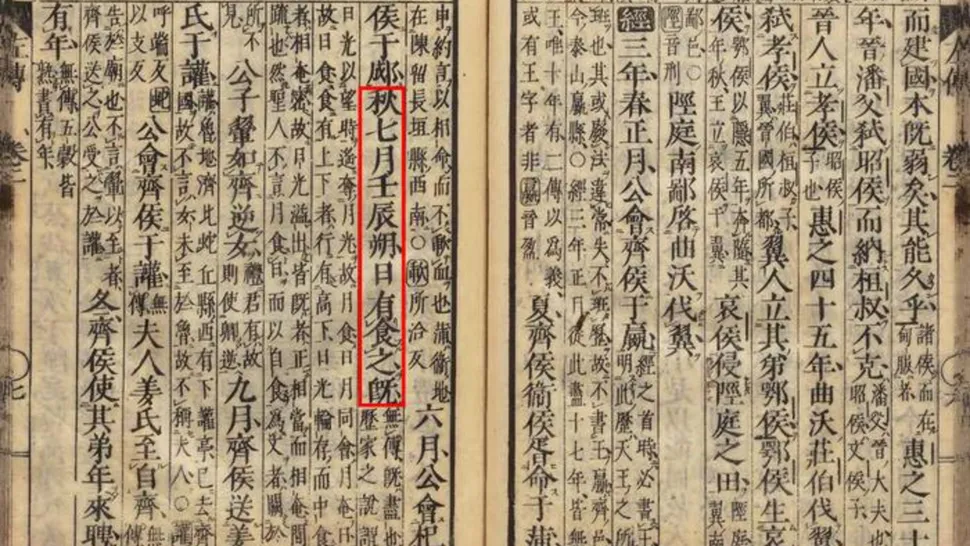
The eclipse occurred on July 17, 709 BCE, according to the chronicle Spring and Autumn Annals, compiled around two or three centuries after the event. The record originates from the court of the Lu Duchy, a vassal state during the Zhou dynasty.

A later addendum in the Hanshu (Book of Han), written seven centuries after the eclipse, describes the eclipsed sun as "completely yellow above and below." This description has historically been linked to a solar corona the outermost layer of the sun, visible around the edges of the moon during an eclipse. If accurate, it would represent one of the earliest surviving written descriptions of the solar corona.

Researchers attempted to verify the eclipse by modeling the Earth’s rotation speed at the time but determined that the eclipse would not have been visible from Qufu, the capital of the Lu Duchy, where the chronicle was compiled.

A photograph of the text in question.

The researchers examined historical geography and archaeological reports, discovering that previous studies had used coordinates about 4.79 miles (8 kilometers) away from the ancient capital. Correcting this location allowed them to accurately measure the Earth's rotation during the total eclipse, calculate the orientation of the Sun's rotation axis, and simulate the corona's appearance.

This improved dataset also fixes errors in earlier studies of the Earth's rotation and enhances the accuracy of dating and reconstructing historical astronomical events.

The existence of this centuries-old eclipse record reflects an ancient belief that celestial events carried omens tied to political affairs. People thought unusual phenomena in the sky signaled wrongdoing by rulers, motivating careful observation of eclipses, auroras, and other astronomical events.

The study also supports solar cycle research derived from radiocarbon dating of tree rings, which provides data on cosmic ray levels from this period. Combining careful ancient observations with modern computational methods and historical evidence may reveal new insights about the Earth and the Sun from thousands of years ago.
Human history could be rewritten after boffins find bizarre 4,000-year-old burial site →
Featured
image_2025-12-05_234812480.png
Dec 5, 2025
What can ancient Chinese texts teach us about solar eclipses and Earth's rotation?
Dec 5, 2025
Read More →
Dec 5, 2025
image_2025-12-05_234313849.png
Dec 5, 2025
Human history could be rewritten after boffins find bizarre 4,000-year-old burial site
Dec 5, 2025
Read More →
Dec 5, 2025
image_2025-12-05_233815974.png
Dec 5, 2025
Celebrated Rutland mosaic depicts ‘long-lost’ Troy story connecting Roman Britain to the ancient classical world
Dec 5, 2025
Read More →
Dec 5, 2025
image_2025-12-05_232843168.png
Dec 5, 2025
Exploring landscapes of power in early medieval East Anglia
Dec 5, 2025
Read More →
Dec 5, 2025
image_2025-12-05_232711121.png
Dec 5, 2025
Archaeologists Uncovered an Ancient Roman Funeral Pyre—And a Treasure Trove of Gold
Dec 5, 2025
Read More →
Dec 5, 2025
image_2025-12-05_232053508.png
Dec 5, 2025
Researchers Discover the Shocking Age of the Mysterious Pecos River Rock Art
Dec 5, 2025
Read More →
Dec 5, 2025
read more

Powered by The archaeologist