Ancient Handaxes in Israel Reveal Early Human Creativity
A remarkable archaeological discovery in the Sakhnin Valley is offering new insight into the minds of early humans. Researchers from Tel Aviv University, alongside a local resident, have uncovered hundreds of ancient stone tools that shed light not only on survival—but also on early human creativity and thought.
A Discovery Sparked by Curiosity
The breakthrough began when Muataz Shalata, a self-taught enthusiast from the city of Sakhnin, noticed unusual stone fragments scattered across the landscape. Recognizing their potential importance, he reached out to Ran Barkai, an expert in early human cultures.
Together, they identified a series of Paleolithic sites containing hundreds of handaxes—large, carefully shaped stone tools associated with Homo erectus, who lived in the region hundreds of thousands of years ago.
A Center of Ancient Human Activity
The large number of handaxes suggests that the Sakhnin Valley was once a major center of human activity. Rich in natural resources such as water, wildlife, and high-quality flint, the area would have repeatedly attracted early human groups over long periods.
Handaxes were essential tools used for over a million years across Africa, Asia, and Europe. They played a crucial role in tasks like cutting meat, processing plants, and crafting other tools.
A Unique and Unusual Feature
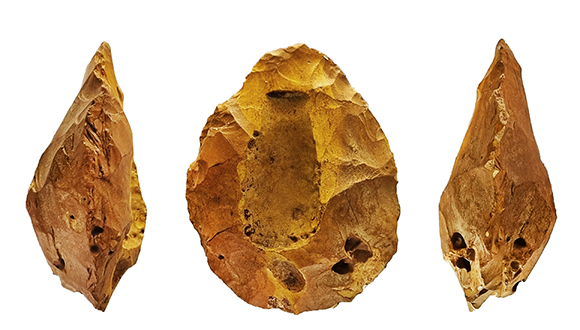
What makes this discovery truly extraordinary is the presence of handaxes deliberately shaped around fossils and unusual geological formations.
The valley is rich in geodes—rounded stones filled with crystals—and flint containing fossil remains. Researchers found more than ten handaxes where these natural features were intentionally preserved at the center of the tool.
This is highly unusual, as such features make it more difficult to shape the stone precisely. Their presence suggests that early humans specifically selected these materials for a reason.
Beyond Function: Signs of Aesthetic Thinking
According to the research team, these tools reveal something profound: early humans were not driven by survival alone. The inclusion of fossils and striking patterns did not improve the tool’s usefulness—in fact, it may have made them less efficient.
This suggests that Homo erectus had a sense of aesthetics or symbolic thinking. By shaping tools around visually distinctive features, they were highlighting and preserving natural beauty.
This behavior points to advanced cognitive abilities, including perception, intention, and possibly even early forms of meaning-making.
Tools for Survival—and More
The Sakhnin Valley lies near ancient migration routes of elephants, which were a key food source for early humans. Similar to findings at Gesher Bnot Ya‘akov, these handaxes were likely used to process large animals, extracting meat and fat.
However, the unusually high number of aesthetically shaped tools found here sets this site apart from all others discovered so far.
A Glimpse Into the Ancient Mind
Researchers believe the unique environment of the Sakhnin Valley influenced how early humans interacted with their surroundings. Fossils and unusual stones may have been seen as meaningful or even powerful elements of nature.
By incorporating these features into their tools, early humans may have been expressing a deeper connection to the world around them.
Redefining Early Human Behavior
This discovery challenges the idea that early humans were focused solely on survival. Instead, it suggests they were already capable of appreciating beauty, assigning meaning to natural objects, and engaging with their environment in complex ways.
The findings place the Sakhnin Valley at the center of global discussions about the origins of human thought, creativity, and culture—offering a rare and fascinating glimpse into the inner world of our ancient ancestors.