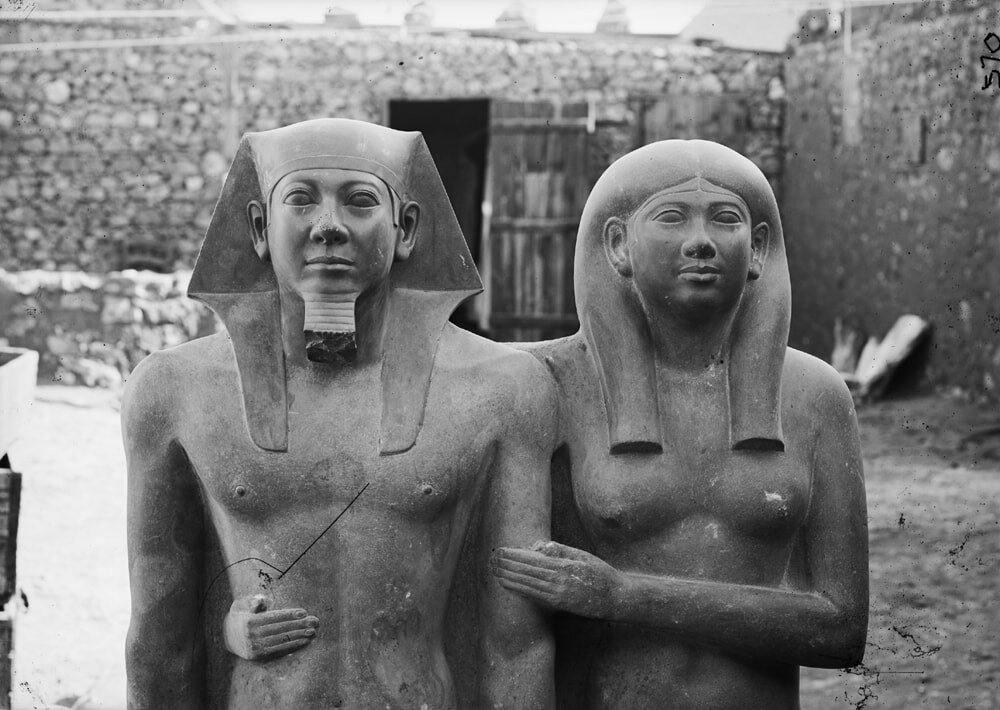
1910: The Discovery Moment of King's Menkaure and his Queen's Khamerernebty Statue

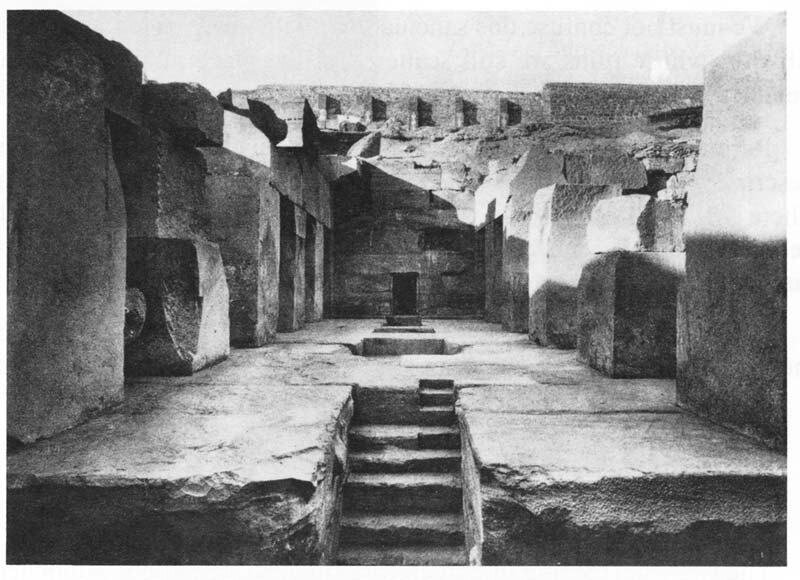
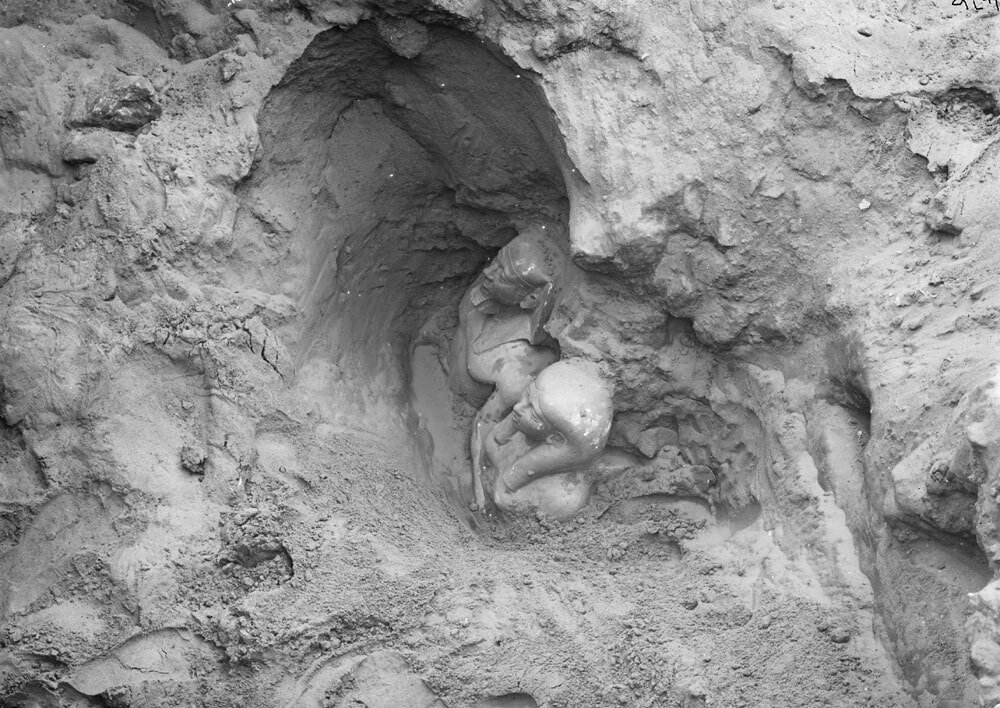
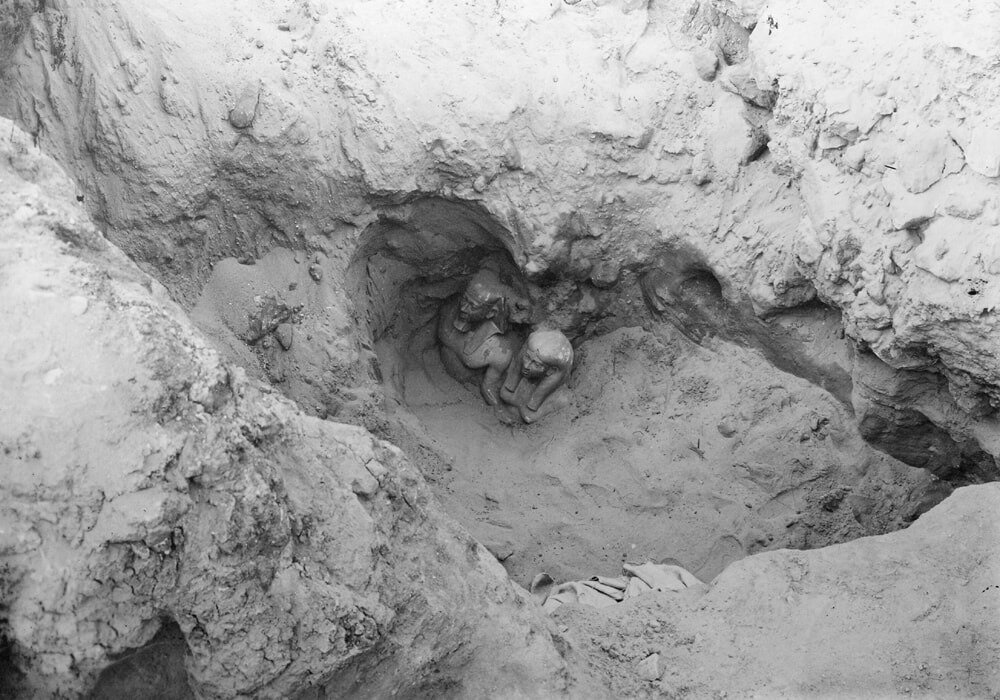
The moment of the great discovery of statue of King Menkaure (Mycerinus) and his wife Khamerernebty in the Temple of the King Menkaure Valley in Giza.
136958556_1869699266527977_9178742295682590326_n.jpg

Serene ethereal beauty, raw royal power, and evidence of artistic virtuosity have rarely been simultaneously captured as well as in this breathtaking, nearly life-size statue of the pharaoh Menkaure and a queen. Smooth as silk, the meticulously finished surface of the dark stone captures the physical ideals of the time and creates a sense of eternity and immortality even today.

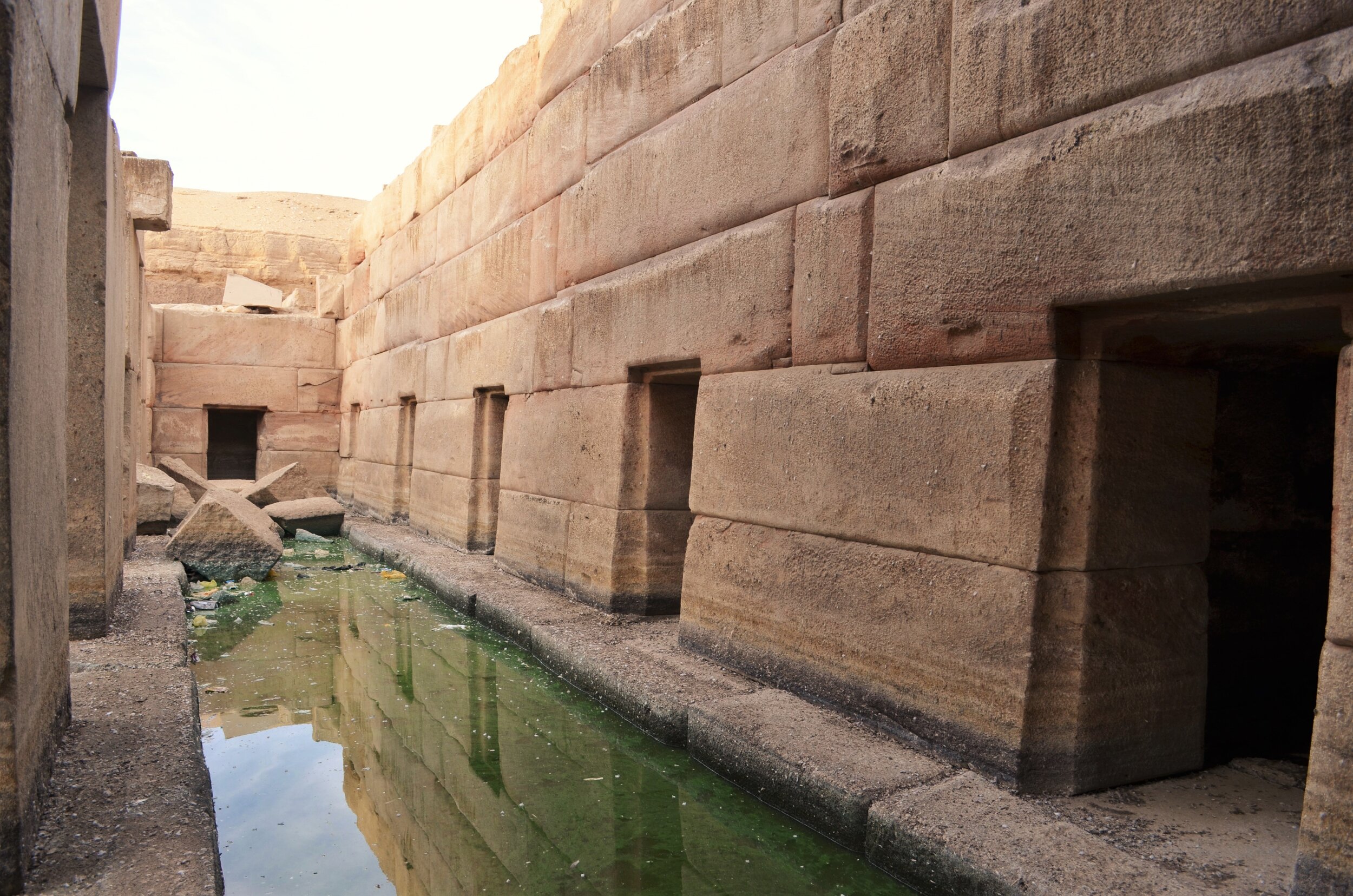
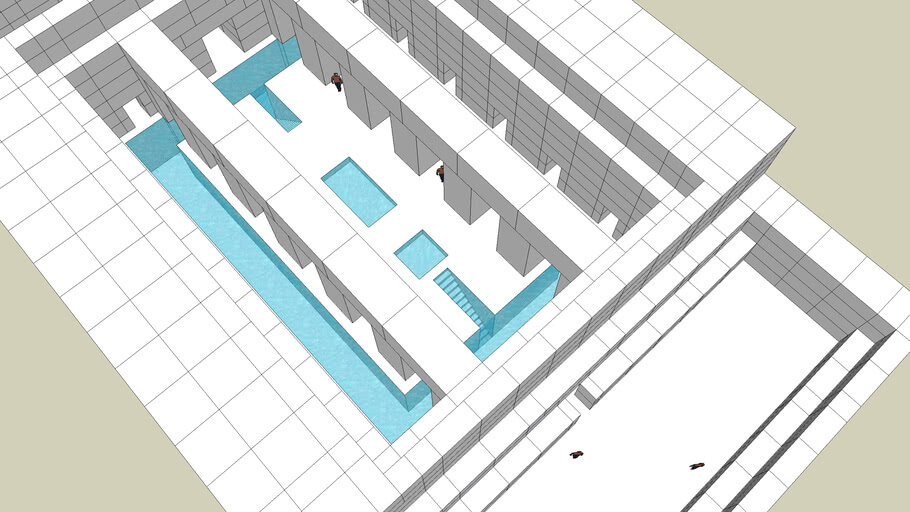
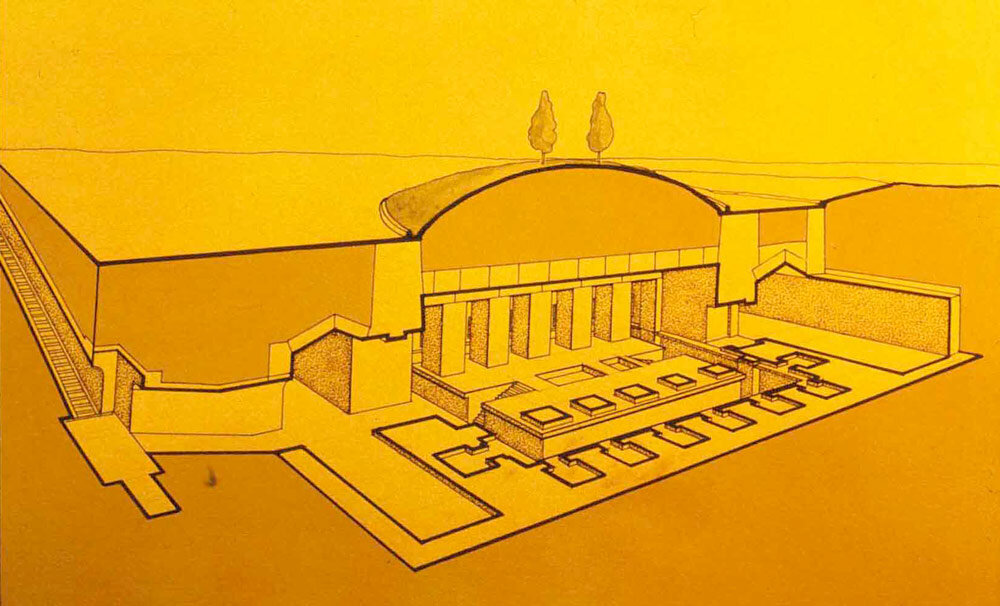
Pyramids are not stand-alone structures. Those at Giza formed only a part of a much larger complex that included a temple at the base of the pyramid itself, long causeways and corridors, small subsidiary pyramids, and a second temple (known as a valley temple) some distance from the pyramid. These Valley Temples were used to perpetuate the cult of the deceased king and were active places of worship for hundreds of years (sometimes much longer) after the king’s death. Images of the king were placed in these temples to serve as a focus for worship—several such images have been found in these contexts, including the magnificent seated statue of Khafre, now in the Egyptian Museum in Cairo.

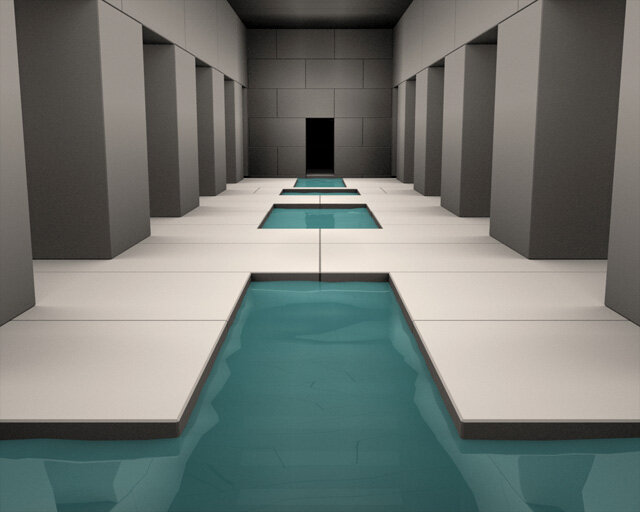
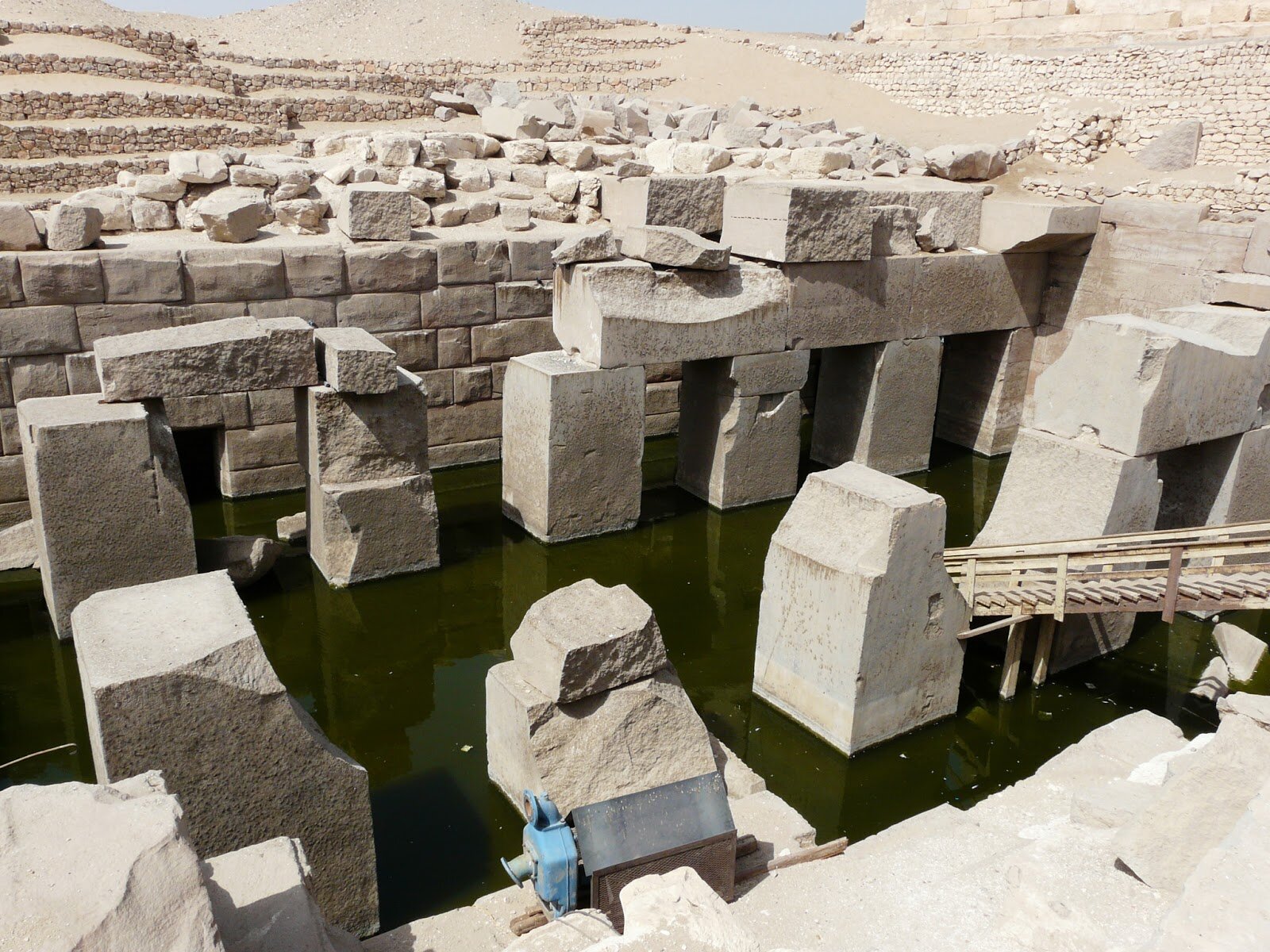
Menkaure's Pyramid Complex.

Menkaure's Pyramid Complex.

On January 10, 1910, excavators under the direction of George Reisner, head of the joint Harvard University-Museum of Fine Arts, Boston, Expedition to Egypt, uncovered an astonishing collection of statuary in the Valley Temple connected to the Pyramid of Menkaure. Menkaure’s pyramid had been explored in the 1830s (using dynamite, no less). His carved granite sarcophagus was removed (and subsequently lost at sea), and while the Pyramid Temple at the base was in only mediocre condition; the Valley Temple, was—happily—basically ignored.

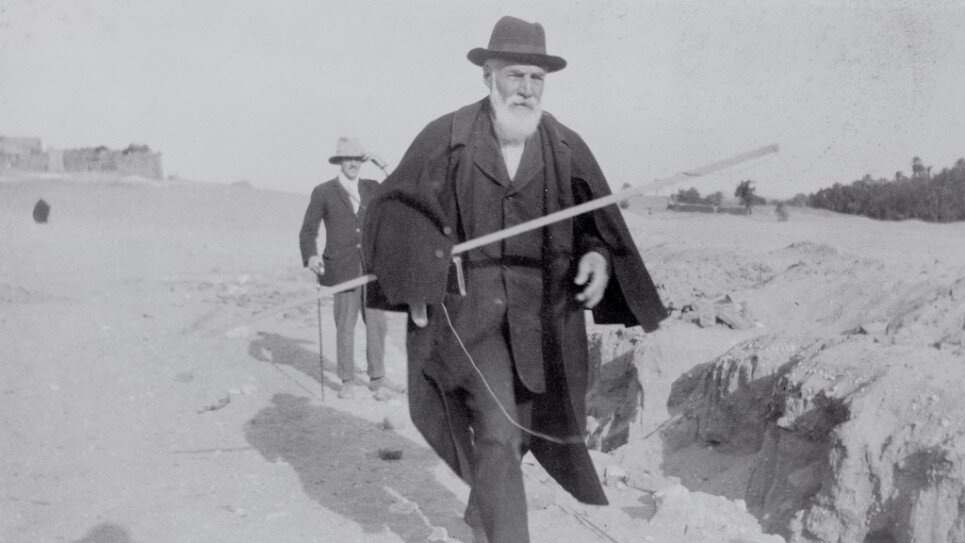
Reisner had been excavating on the Giza plateau for several years at this point; his team had already explored the elite cemetery to the west of the Great Pyramid of Khufu before turning their attention to the Menkaure complex, most particularly the barely-touched Valley Temple.
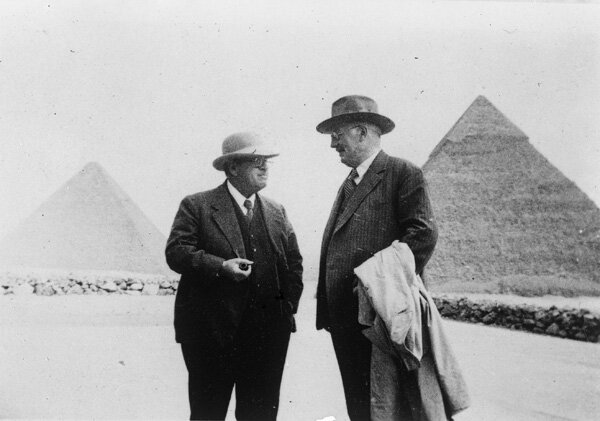
George Reisner and Georg Steindorff at Harvard Camp, looking east toward Khufu and Khafre pyramids, 1935, photo by Albert Morton Lythgoe.

George Reisner and Georg Steindorff at Harvard Camp, looking east toward Khufu and Khafre pyramids, 1935, photo by Albert Morton Lythgoe.

In the southwest corner of the structure, the team discovered a magnificent cache of statuary carved in a smooth-grained dark stone called greywacke or schist. There were a number of triad statues—each showing 3 figures—the king, the fundamentally important goddess Hathor, and the personification of a nome (a geographic designation, similar to the modern idea of a region, district, or county). Hathor was worshipped in the pyramid temple complexes along with the supreme sun god Re and the god Horus, who was represented by the living king. The goddess’s name is actually ‘Hwt-hor’, which means “The House of Horus,” and she was connected to the wife of the living king and the mother of the future king. Hathor was also a fierce protector who guarded her father Re; as an "Eye of Re" (the title assigned to a group of dangerous goddesses), she could embody the intense heat of the sun and use that blazing fire to destroy his enemies.

There were 4 complete triads, one incomplete, and at least one other in a fragmentary condition. The precise meaning of these triads is uncertain. Reisner believed that there was one for each ancient Egyptian nome, meaning there would have originally been more than thirty of them. More recent scholarship, however, suggests that there were originally 8 triads, each connected with a major site associated with the cult of Hathor. Hathor’s prominence in the triads (she actually takes the central position in one of the sculptures) and her singular importance to kingship lends weight to this theory.

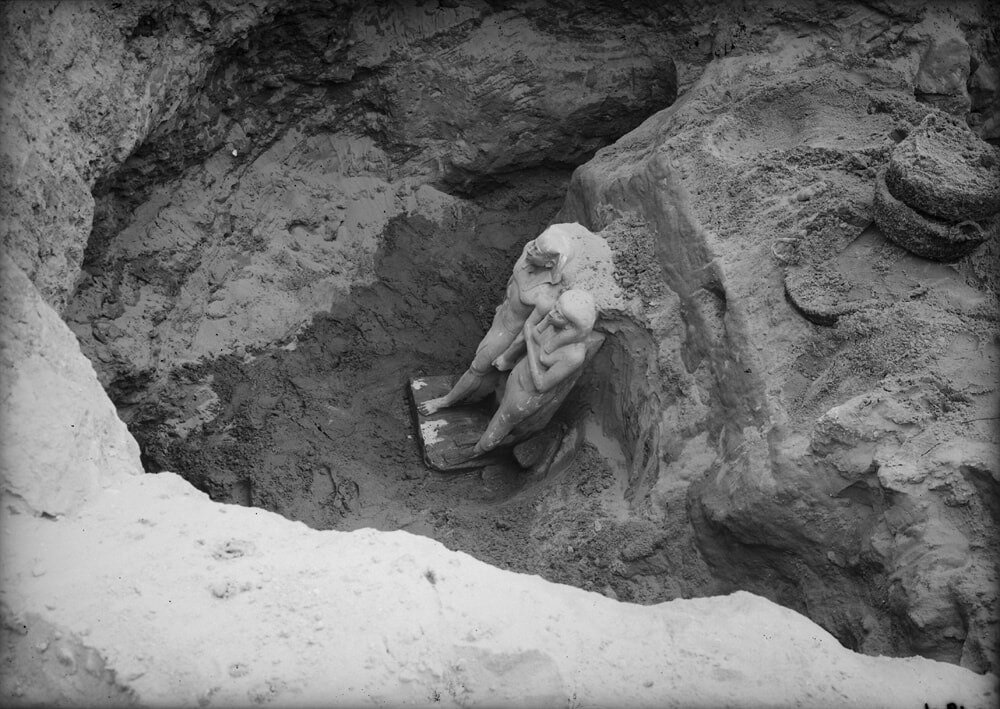
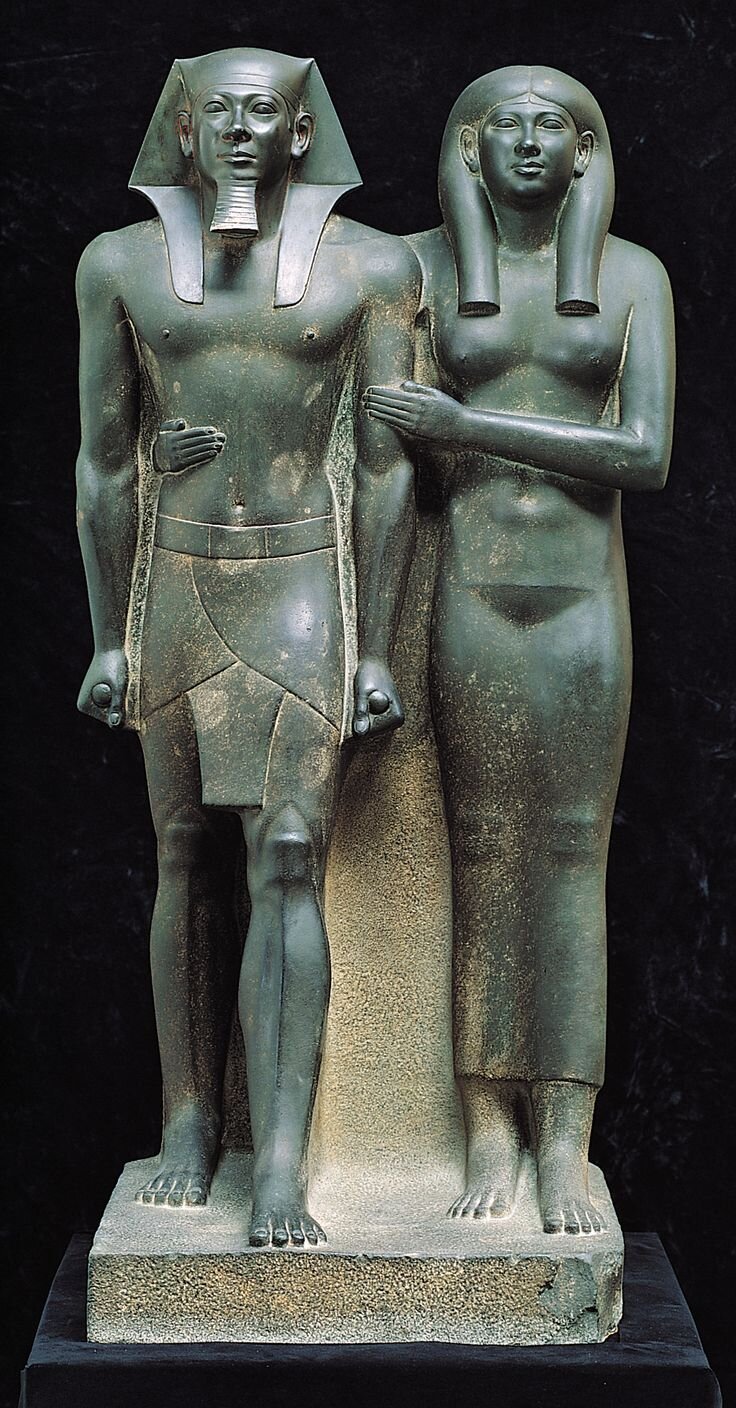
In addition to the triads, Reisner’s team also revealed the extraordinary dyad statue of Menkaure and a queen that is breathtakingly singular.
135533131_1869699146527989_6247584165989219559_n.jpg

The two figures stand side-by-side on a simple, squared base and are supported by a shared back pillar. They both face to the front, although Menkaure’s head is noticeably turned to his right—this image was likely originally positioned within an architectural niche, making it appear as though they were emerging from the structure. The broad-shouldered, youthful body of the king is covered only with a traditional short pleated kilt, known as a shendjet, and his head sports the primary pharaonic insignia of the iconic striped nemes headdress (so well known from the mask of Tutankhamun) and an artificial royal beard. In his clenched fists, held straight down at his sides, Menkaure grasps ritual cloth rolls. His body is straight, strong, and eternally youthful with no signs of age. His facial features are remarkably individualized with prominent eyes, a fleshy nose, rounded cheeks, and full mouth with protruding lower lip.

Menkaure’s queen provides the perfect female counterpart to his youthful masculine virility. Sensuously modelled with a beautifully proportioned body emphasized by a clinging garment, she articulates ideal mature feminine beauty. There is a sense of the individual in both faces. Neither Menkaure nor his queen are depicted in the purely idealized manner that was the norm for royal images. Instead, through the overlay of royal formality we see the depiction of a living person filling the role of pharaoh and the personal features of a particular individual in the representation of his queen.
137028825_1869699113194659_5825547684251382591_n.jpg

Menkaure and his queen stride forward with their left feet—this is entirely expected for the king, as males in Egyptian sculpture almost always do so, but it is unusual for the female since they are generally depicted with feet together. They both look beyond the present and into timeless eternity, their otherworldly visage displaying no human emotion whatsoever.

The dyad was never finished—the area around the lower legs has not received a final polish, and there is no inscription. However, despite this incomplete state, the image was erected in the temple and was brightly painted—there are traces of red around the king’s ears and mouth and yellow on the queen’s face. The presence of paint atop the smooth, dark greywacke on a statue of the deceased king that was originally erected in his memorial temple courtyard brings an interesting suggestion—that the paint may have been intended to wear away through exposure and, over time, reveal the immortal, black-fleshed
"Osiris" Menkaure.
136389011_1869699069861330_2416058506681244352_n.jpg

Unusual for a pharaoh’s image, the king has no protective cobra (known as a uraeus) perched on his brow. This notable absence has led to the suggestion that both the king’s nemes and the queen’s wig were originally covered in precious metal and that the cobra would have been part of that addition.

Based on comparison with other images, there is no doubt that this sculpture shows Menkaure, but the identity of the queen is a different matter. She is clearly a royal female. She stands at nearly equal height with the king and, of the two of them, she is the one who is entirely frontal. In fact, it may be that this dyad is focused on the queen as its central figure rather than Menkaure. The prominence of the royal female—at equal height and frontal—in addition to the protective gesture she extends has suggested that, rather than one of Mekaure’s wives, this is actually his queen-mother. The function of the sculpture in any case was to ensure rebirth for the king in the Afterlife.

Essay by Dr. Amy Calvert
41ef189054f85308292420363f49be40.jpg

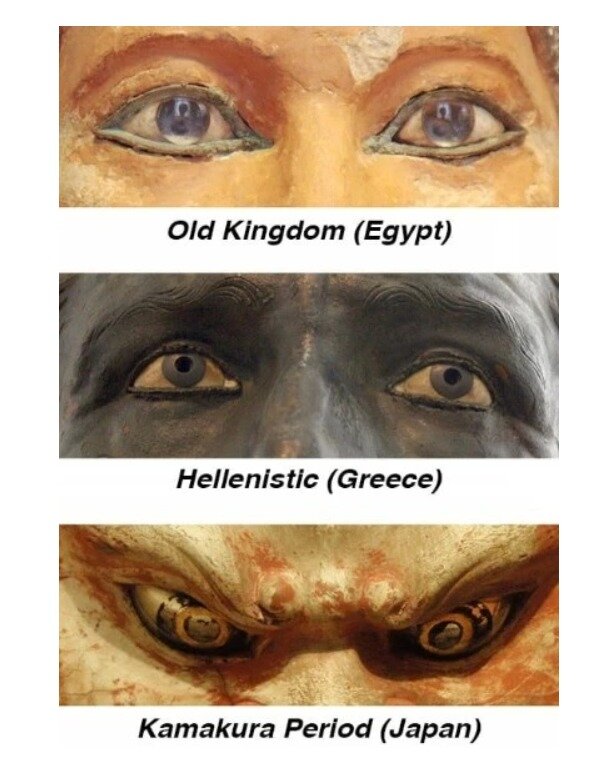
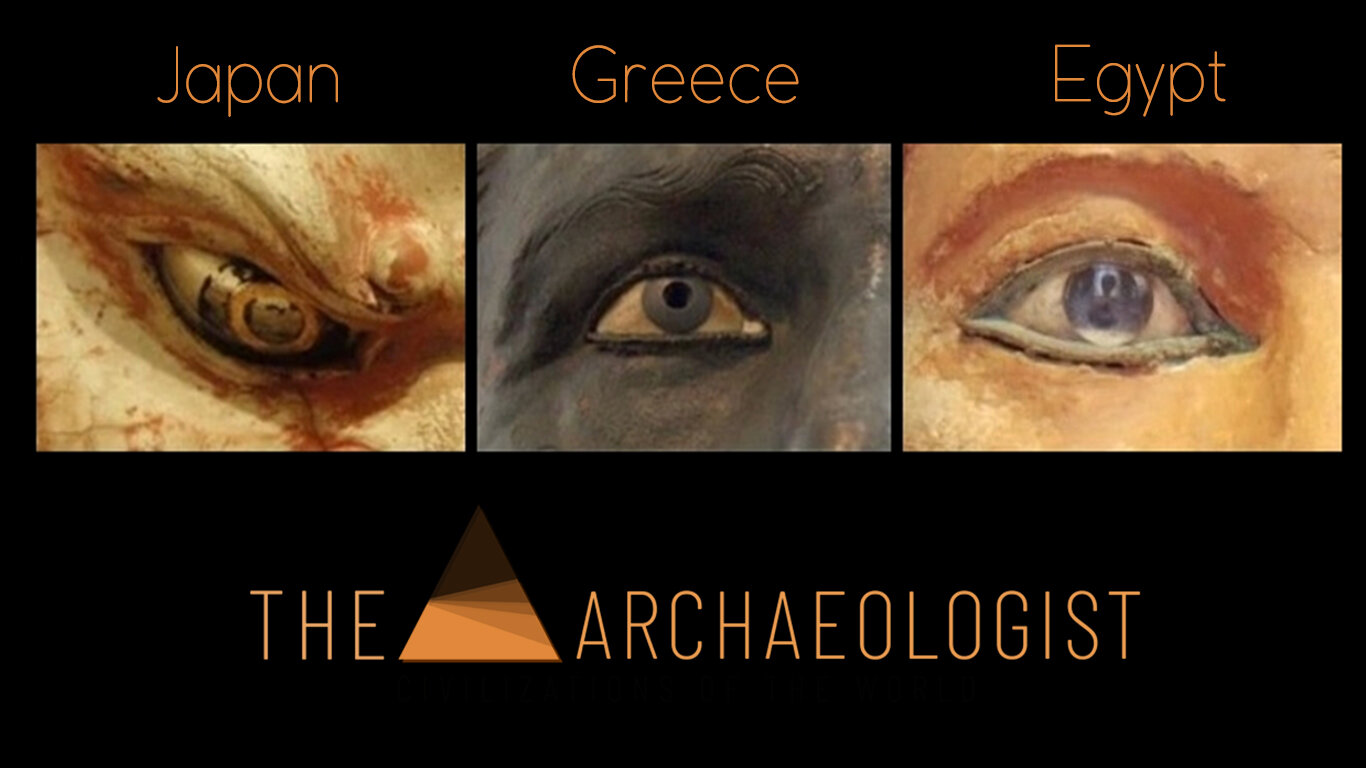
Sculpture Eye-crafting Techniques: The Piercing Gazes that brought life to sculptures

Ιnlaid eyes are found in sculpture in many periods, from ancient times till Middle Ages. The history behind these wonderful innovations is great and dates back centuries.

31-12.jpg

Historically, several cultures have come up with some very ingenious solutions for how to bring more life to the eyes of their sculptures. Ancient Greeks would assemble eyes from copper, glass and/or shell, and anchor them from the inside of a hollow bronze head. Ancient Greek bronzesmiths had a variety of techniques at their disposal to enhance the appearance of their creations. Due to their often fragmentary state of preservation, the modern observer tends to think of early Greek bronzes as monochromatic, but it is clear that the practice of inlaying other materials into bronze started early in ancient Greece.

Inlays appear in a broad variety of bronze object types from weapons and armor to vessels and jewelry to relief-decorated objects and figural sculpture. Many of the finest early Greek bronzes were embellished with inlays that enlivened the sculptural forms and may have added symbolic or even magical qualities. Eyes were often given particular prominence with inlays. Of special interest is a new technical analysis of a Late Geometric statuette of a man and a centaur (Metropolitan Museum of Art, inv. 17.190.2072) in which the eyes of the man were inlaid with silver to contrast with the eyes of the centaur, which appear to have an iron-rich inlay. Although the evidence is frequently incomplete, it is clear that a wide variety of colorful inlays such as gold, silver, iron, bone, ivory, and amber were utilized, and other materials, such as stone and shell, were certainly used as well.

αρχείο λήψης.png

Another great sculpture with eyes tha magnetize everyone who looks at them is Iniochos (Charioteer of Delphi). It has its own room in the museum of Delphi, and a quick glance is not enough to see it. You have to look at it closely from all sides and admire the multitude of details on its body and its bronze tunic. The eyes of Iniochos look alive, and perhaps no other statue gives this unique feeling. White enamel was used for the eyeballs to make them look exactly like a natural human eye. For the iris, brown semi-precious stone was used, while the pupils of the eyes are black. The eyelashes were made of small copper wires, while its lips were made of thin reddish copper plates.

Detail of the Iniochos statue's head, showing the inlaid eyes.

Detail of the Iniochos statue's head, showing the inlaid eyes.

The Egyptians combined materials of alabaster, rock crystal & copper, and inserted them from the outside of the face to bring vitality to their sculptures and busts. There are early examples of Egyptian statues in which the inlaid eyes are either blue or grey in colour. Some epictions of deities such as Horus showed them with eyes that had a blue pupil. A range of materials are known to have been used depending on the desired effect and perhaps the situation, location and purpose for which the eye, and its artifact, were created to represent. Those eyes, for example, include the use of materials such as limestone, quartz, rock crystal, obsidian, bone and ivory, copper alloys, resin, plaster, animal glue and pigments. What is surprising is the recognition of what exquisite craft skill and technology are implied by the use of such crystal for the eyes of these statues.

Ancient Egyptian inlaid eye: (top) view of the eye from below; (bottom) x-radiograph of the eye from the same position, showing some of the technical features.

Ancient Egyptian inlaid eye: (top) view of the eye from below; (bottom) x-radiograph of the eye from the same position, showing some of the technical features.

The sculpture of the Seated Scribe or Squatting Scribe is one of these famous works of ancient Egyptian art. It represents a figure of a seated scribe at work. The sculpture was discovered at Saqqara and dated to the period of the Old Kingdom, from either the 5th Dynasty, c. 2450–2325 BCE or the 4th Dynasty, 2620–2500 BCE. It is now in the Louvre Museum in Paris. It is a painted limestone statue, the eyes inlaid with rock crystal, magnesite (magnesium carbonate), copper-arsenic alloy, and nipples made of wood.

Detail of inlaid eye belonging to the "Seated Scribe”.

Detail of inlaid eye belonging to the "Seated Scribe”.

The Chinese would position small obsidian beads in the center of the eyes, (a technique which was sometimes also seen in Japan during the Asuka and Nara periods (combined 538-974). In the late Heian period (974-1185), however, a new process for infusing a startlingly realistic quality into the eyes of sculpture elevated Japanese Buddhist statuary to new heights.

DoUl0vxUwAA6lwl.jpg

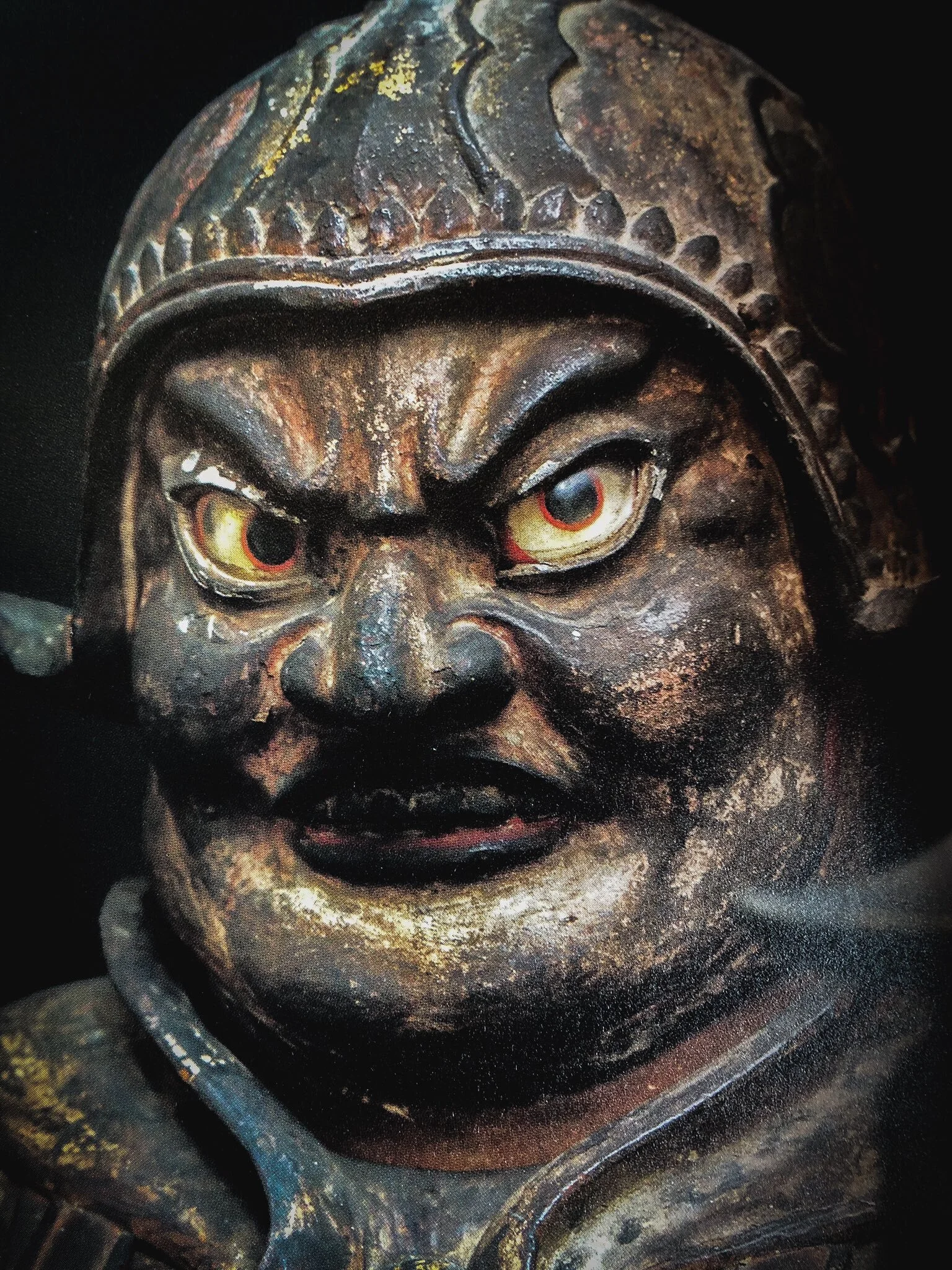
In the early periods of Japanese art history, eyes were simply carved into the wood (and then painted). This way of depicting a sculpted eye is called chougan (彫眼), and examples of this can be seen in many temples throughout Japan. However, when visiting a temple with carvings that have crystal eyes, it is impossible to ignore the intimacy of the statuary’s pensive gaze or piercing glare. This style of eye-crafting is called gyokugan (玉眼).
Left: Twenty-Eight Attendants (Basu Sennin) Sanjusangendo. Right: photo by David Bilbrey, Sculptor and Art History hound.

Left: Twenty-Eight Attendants (Basu Sennin) Sanjusangendo. Right: photo by David Bilbrey, Sculptor and Art History hound.

In 1151, an Amida Triad in the Chougakuji was the first in Japan to employ gyokugan. The technology behind this craft can simply and casually be described as an eyeball sandwich. The būshi of the Chougakuji’s Amida group carved rock crystal into a lens, painted the inside with a pupil & iris, backed it with paper, and then inserted it into an uchiguri (hollowed-out) head. The result was revolutionary. Made more famous by the Kei school about 30 years later, this technique became the sculpting standard which further set Japanese butsuzo apart from what was happening with the rest of the world.

31-12ee-horz.jpg

The 'Turin King List' - The most extensive papyrus list of Ancient Egyptian Pharaos

The Turin King List, also known as the Turin Royal Canon, is an ancient Egyptian hieratic papyrus thought to date from the reign of Pharaoh Ramesses II, now in the Museo Egizio (Egyptian Museum) in Turin. The papyrus is the most extensive list available of kings compiled by the ancient Egyptians, and is the basis for most chronology before the reign of Ramesses II.

1904 version of attempt to assemble parts of the Turin King list.

1904 version of attempt to assemble parts of the Turin King list.

Creation and use

The papyrus is believed to date from the reign of Ramesses II, during the middle of the New Kingdom, or the 19th Dynasty. The beginning and ending of the list are now lost; there is no introduction, and the list does not continue after the 19th Dynasty. The composition may thus have occurred at any subsequent time, from the reign of Ramesses II to as late as the 20th Dynasty.

The papyrus lists the names of rulers, the lengths of reigns in years, with months and days for some kings. In some cases they are grouped together by family, which corresponds approximately to the dynasties of Manetho's book. The list includes the names of ephemeral rulers or those ruling small territories that may be unmentioned in other sources.

The list also is believed to contain kings from the 15th Dynasty, the Hyksos who ruled Lower Egypt and the River Nile delta. The Hyksos rulers do not have cartouches (enclosing borders which indicate the name of a king), and a hieroglyphic sign is added to indicate that they were foreigners, although typically on King Lists foreign rulers are not listed.

The papyrus was originally a tax roll, but on its back is written a list of rulers of Egypt – including mythical kings such as gods, demi-gods, and spirits, as well as human kings. That the back of an older papyrus was used may indicate that the list was not of great formal importance to the writer, although the primary function of the list is thought to have been as an administrative aid. As such, the papyrus is less likely to be biased against certain rulers and is believed to include all the kings of Egypt known to its writers up to the 19th or 20th Dynasty.

screenshot-www.facebook.com-2021.04.07-17_11_29.jpg

Discovery and reconstruction[edit]

The papyrus was found by the Italian traveler Bernardino Drovetti in 1820 at Luxor (Thebes), Egypt and was acquired in 1824 by the Egyptian Museum in Turin, Italy and was designated Papyrus Number 1874. When the box in which it had been transported to Italy was unpacked, the list had disintegrated into small fragments. Jean-Francois Champollion, examining it, could recognize only some of the larger fragments containing royal names, and produced a drawing of what he could decipher. A reconstruction of the list was created to better understand it and to aid in research.

The Saxon researcher Gustav Seyffarth (1796–1885) re-examined the fragments, some only one square centimeter in size, and made a more complete reconstruction of the papyrus based only on the papyrus fibers, as he could not yet determine the meaning of the hieratic characters. Subsequent work on the fragments was done by the Munich Egyptologist Jens Peter Lauth, which largely confirmed the Seyffarth reconstruction.

In 1997, prominent Egyptologist Kim Ryholt published a new and better interpretation of the list in his book, "The Political Situation in Egypt during the Second Intermediate Period c. 1800–1550 B.C." After another study of the papyrus, an updated version from Ryholt is expected. Egyptologist Donald Redford has also studied the papyrus and has noted that although many of the list's names correspond to monuments and other documents, there are some discrepancies and not all of the names correspond, questioning the absolute reliability of the document for pre-Ramesses II chronology.

Despite attempts at reconstruction, approximately 50% of the papyrus remains missing. This papyrus as presently constituted is 1.7 m long and 0.41 m wide, broken into over 160 fragments. In 2009, previously unpublished fragments were discovered in the storage room of the Egyptian Museum of Turin, in good condition. A new edition of the papyrus is expected.

The name Hudjefa, found twice in the papyrus, is now known to have been used by the royal scribes of the Ramesside era during the 19th Dynasty, when the scribes compiled king lists such as the Saqqara King List and the royal canon of Turin and the name of a deceased pharaoh was unreadable, damaged, or completely erased.

Contents of the papyrus

The papyrus is divided into eleven columns, distributed as follows. The names and positions of several kings are still being disputed, since the list is so badly damaged.

  • Column 1 — Gods of Ancient Egypt

  • Column 2 — Gods of Ancient Egypt, spirits and mythical kings

  • Column 3 — Rows 11-25 (Dynasties 1-2)

  • Column 4 — Rows 1-25 (Dynasties 2-5)

  • Column 5 — Rows 1-26 (Dynasties 6-8/9/10)

  • Column 6 — Rows 12-25 (Dynasties 11-12)

  • Column 7 — Rows 1-2 (Dynasties 12-13)

  • Column 8 — Rows 1-23 (Dynasty 13)

  • Column 9 — Rows 1-27 (Dynasty 13-14)

  • Column 10 — Rows 1-30 (Dynasty 14)

  • Column 11 — Rows 1-30 (Dynasties 14-17)

screenshot-www.facebook.com-2021.04.07-17_07_45.jpg
The Turin papyrus in Museo Egizio (Egyptian Museum) in Turin, Italy.

The Turin papyrus in Museo Egizio (Egyptian Museum) in Turin, Italy.