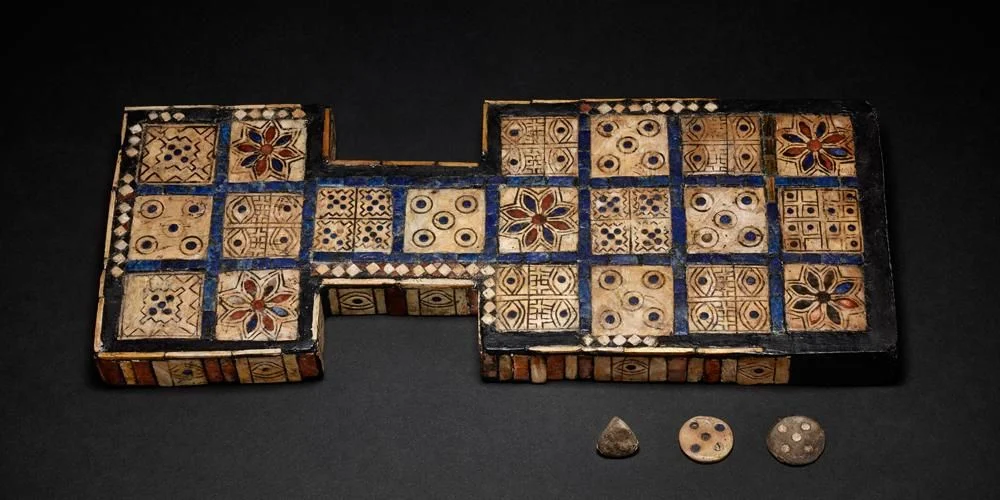
We will now explore the Homo floresiensis, an extinct species of small archaic human that inhabited the island of Flores, Indonesia. Watch the video below and find out more!
Muhammad Family Tree
In the video below we will analyze Muhammad’s family tree. Enjoy!
Palaces and Gardens of Sintra, Portugal
Sintra is a town and municipality near Lisbon in Portugal, which is famous for at least six extraordinary, very different in style palaces and castles in Sintra, most of them with adjacent gardens. The Cultural Landscape of Sintra is on the UNESCO World Heritage List. Watch the video to visually explore Sintra yourself!
Entire History of the Mayans - Ancient America History Documentary
In today’s almost 5 hours documentary we will discuss the entire history of the Mayans. Watch the video and enjoy!
Roman Houses Still Inhabited Today
Not all ancient Roman houses are ruins. In the badlands of central Turkey, on the edge of the Syrian desert, and beneath a quiet monastery not far from the Colosseum, Roman houses are still used and lived in today. Watch the video to find out more!
Archaeologists Made an Incredible Discovery and Can't Stop Marvelling!
Our earth has existed for billions of years and has certainly experienced a lot in its past. Countless cultures, religions and peoples have inhabited it and left their mark on it. Our home planet has tacitly handed down some of its past to us. More or less. Of course, coincidences have often led to the discovery of mysteries.
Mankind has been able to discover much of it so far and has been discussing and researching its meaning and purpose for centuries. Stonehenge in England, for example, or the ruined city of Machu Picchu in Peru. Humans have by no means discovered and explored everything that is mysterious, nor have they found answers to the many questions about the uniquenesses that have already been discovered. Mysterious artefacts, amazing finds and archaeological puzzles are still being uncovered.
12 Most Mysterious And Incredible Archaeological Finds That Really Exist
We've all heard the phrase "seeing is believing," but sometimes it's difficult to believe something is real even when you've seen it with your own eyes. That's how archaeologists and historians feel about the amazing things you're about to see in this video. They've looked at them and studied them, but no matter how much they study them, they're still left with the same sense of wonder. We hope that you get a sense of wonder yourself as we tell you their stories.
Scientists Scares 4500 Year Old Hidden Room Discovered in Egypt
In the annals of human history, the period that is now usually referred to as Ancient Egypt is widely regarded as among the most intriguing ages. The enigmatic tombs and crypts, in addition to the enormous pyramids created in Egypt during this time, never fail to astonish and amaze us.
Every artifact kept anywhere on this planet is like a jigsaw puzzle; it helps us fill in the gaps in our knowledge and gain a deeper comprehension of the bigger picture of human history. Researchers who study the history of humanity can occasionally come across artifacts that are so strange and unusual that it is simple to comprehend why other people might find them unsettling.
Today, we will devote part of our time to talking about the long-lost tomb that was recently discovered in Egypt and dates back 4,500 years. Are you giddy about it? If this is the case, you will need to maintain your connection to a hidden world to acquire additional information regarding the finding. Let's not waste any time and dive right into the investigation that we conducted.

Iklaina's Clay Fragment: This is the Oldest Known Decipherable Text in Europe
A clay tablet found in Greece bears the oldest decipherable text in Europe as well as the earliest record of the Greek language.
The world of archaeology was fundamentally changed when a tiny clay tablet was unearthed from the ancient site of Iklaina, Greece. A discovery that pushed back the origins of literacy in Europe by centuries, the Iklaina's clay fragment carries extraordinary significance.
According to academics, the wording on this sign, which was once thought to be "magical or mysterious," only survived because of a fire that started in a rubbish heap around 3,500 years ago.
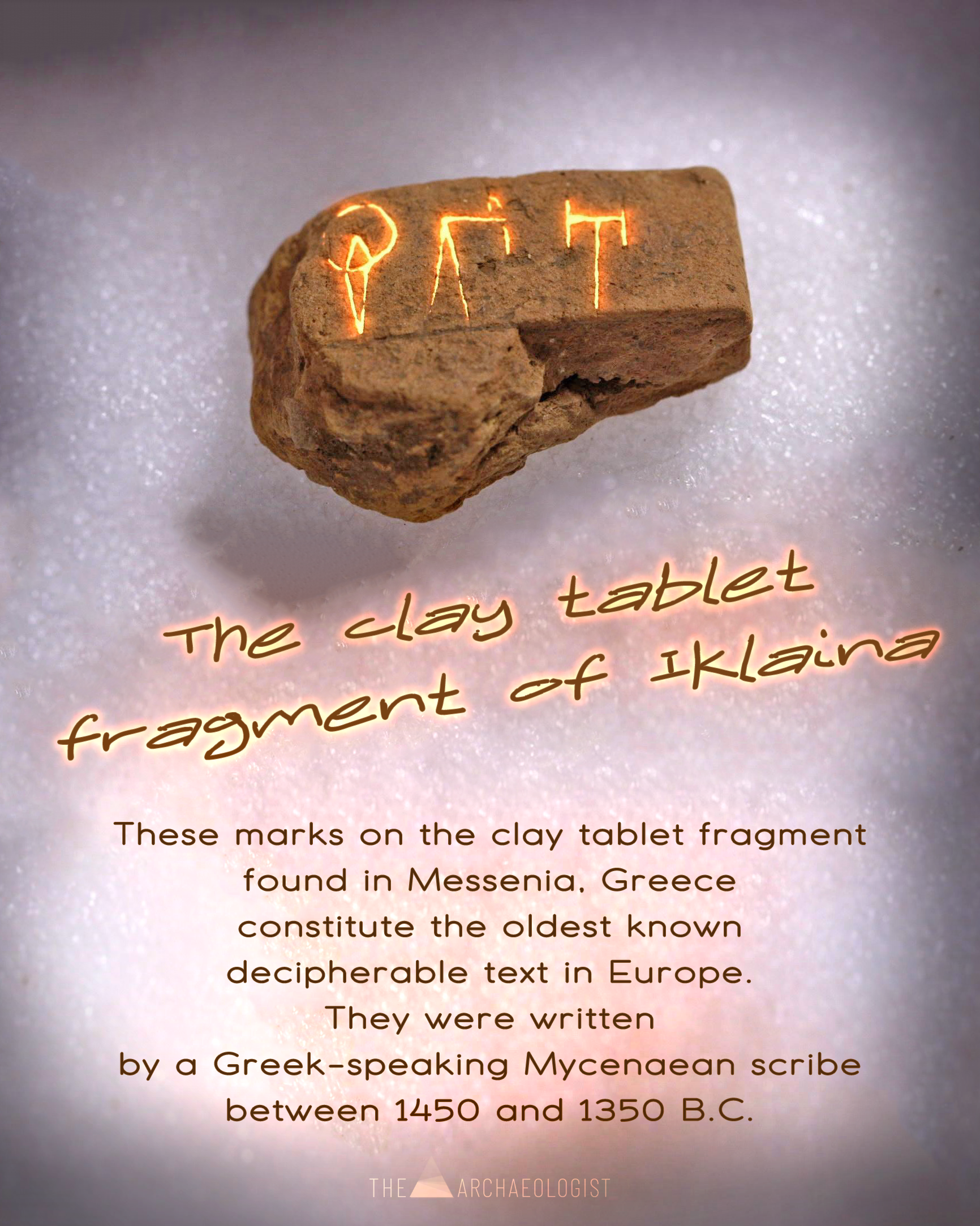
The discovery of this artifact on Iklaina, a small hill near the town of Pylos in southwest Greece, is considered one of the most important archaeological finds in the history of European literature and writing. Dated back to approximately 1450–1350 BC, written by a skilled Greek-speaking Mycenaean scribe, this clay tablet predates any known decipherable writing in Europe, making it a remarkable testament to the early ingenuity of human civilizations in the region.
Linear B script
Linear B was a syllabic script used for writing in Mycenaean Greek, the earliest attested form of Greek. The script predates the Greek alphabet by several centuries.
Linear B, deciphered by English architect and self-taught linguist Michael Ventris —based on the research of American classicist Alice Kober— is the only Bronze Age Aegean script to have been deciphered.

Iklaina’s site
The clay fragment was found during excavations conducted by the Greek Archaeological Society under the direction of Dr. Michalis Kosmopoulos, professor of archeology at St. Louis University in Missouri. The research team used advanced archaeological methods, such as ground-penetrating radar and residue analysis, to carefully uncover and analyze the site. These techniques allowed the archaeologists to avoid potential damage to the artifacts and maximize the information they could glean from the excavations.
According to excavation director Michalis Kosmopoulos, excavations at Iklaina have so far revealed an early Mycenaean palace with enormous terrace walls, frescoes, and a startlingly sophisticated drainage system.
Yet the biggest surprise of the multi-year program was the fragment discovered in 2011, and as Mr. Kosmopoulos noted, that tablet shouldn't have been there.

Iklaina’s palace
First, it was believed that the Mycenaean tablets were not made so long ago. The previous inscription that held the record, which was discovered in the ruins of a palace in what was once the city of Mycenae, was also one of the few significant palaces where inscriptions had previously been discovered.
Although an early Mycenaean palace was visible at the Iklaina archaeological site, by the time the plaque was made, the community had grown into a minor satellite of Pylos, the capital of King Nestor, a significant figure from the Iliad.
This is a rare instance where Greek mythology and archaeology come together.

Excavations at the site of Iklaina
The sign was preserved by the fire
Early examples of the writing system known as Linear B may be seen on the tablet fragment, which is about 1 inch (2.5 cm) high and 1.5 inches (4 cm) broad. Linear B, which was used for a very old form of Greek, included about 87 signs, each of which stood for a syllable.

Iklaina, which is in the process of restoration, would not have been on modern maps were it not for Michael Cosmopoulos' efforts.
Linear B appears to have been employed exclusively by the Mycenaeans to record economic issues that were important to the ruling class. According to the experts, the dots on the sign's face appear to create a verb that has to do with construction.
A list of names and numbers can be seen on the reverse, which may represent a property list.
The clay was not meant to last as these records often only stayed in storage for one fiscal year. These inscriptions were exceedingly delicate because they weren't cooked but rather sun-dried.
Basically, someone dumped the sign into the pit and lit his trash on fire. The sign was saved and made harder by the fire.
a piece of writing with a magical, mysterious quality, or just a sample of Mycenaean bureaucracy?
According to Thomas Palaima, an administrator at the University of Austin in Texas and an expert in Mycenaean tablets, the Iklaina tablet is a rare discovery.
The hand-made piece could provide information about how the ancient Greek kingdoms were governed in addition to its age, he continued.
For instance, archaeologists once believed that these tablets were only created and preserved in the major cities, or "palatial centers," like Pylos and Mycenae.
The Iklaina tablet, which was discovered in the ruins of a low-class settlement, may show that bureaucracy and education were less centralized than previously believed in the late Mycenaean period.
The discovery of Iklaina's clay fragment also impacts our understanding of Mycenaean state formation. Previously, it was believed that the Mycenaean palatial system, characterized by a complex administrative bureaucracy, developed around 1400 BC. However, the tablet, dated to an earlier period, suggests that the development of this sophisticated system happened earlier than previously thought, challenging existing theories and providing new avenues for exploration in Mycenaean studies.

The ability to read and write during the Mycenaean period, according to Palaima, was extremely rare and was generally regarded as being supernatural or mysterious.
Once the ancient Greek alphabet outgrew Linear B and eventually developed into the 26 letters, it took anywhere between 400 and 600 years for the written word to become understood in Greece.
The Iklaina clay fragment signifies more than just an ancient piece of record-keeping. It is a testament to the evolution of human communication and a witness to the birth of literacy in Europe. This humble artifact underscores the fact that even the smallest piece of our past can have profound implications for our understanding of human history.
It might just be a small clay fragment, but the Iklaina tablet has opened a significant window into a world that existed nearly 3500 years ago. As we continue to decode its secrets, we can hope to further enrich our understanding of early European civilizations and the complexities of their systems of governance and communication. Thus, the Iklaina's clay fragment stands as a beacon of our early literacy, lighting the way to a deeper comprehension of our shared past.

Top 10 Archaeological Discoveries of 2022
The Archaeologist reveals the top 10 archaeological discoveries of 2022 from its archive.
Greece: Marble head of Hercules’ statue from the Antikythera shipwreck
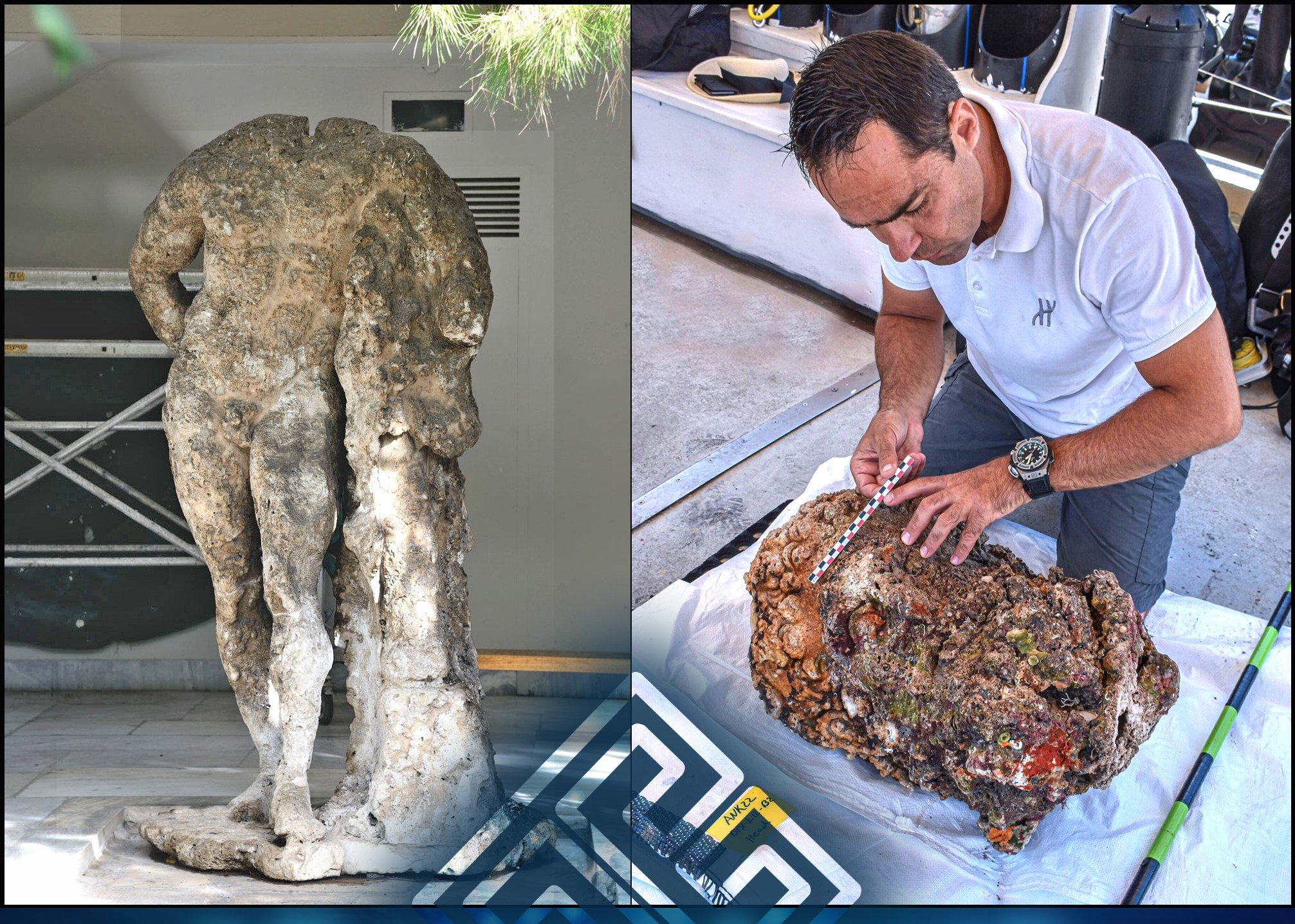
The Marble head of a male bearded figure, bigger than life size, which at first sight can be identified with Herakles (Hercules) of the so-called Farnese type. It most probably belongs to the headless statue of the so-called “Herakles of Antikythera”, inv. no. 5742 of the National Archaeological Museum, which was retrieved by sponge divers in 1900. Read more here
"Ginesthoi": The Greek word that is believed to be the only surviving handwritten signature of the legendary Queen Cleopatra of Egypt!
A single Greek word, "ginesthoi", meaning "to do as I command" in free translation, written at the bottom of a Ptolemaic papyrus, may have been written by the Egyptian queen Cleopatra VII herself, claims the Dutch papyrologist Peter van Minnen from the University of Groningen. The text was sent to Alexandria on the 26th of the sixth ancient Egyptian / Coptic month of Mesir, also known as Amsir (23 February 33 BC) and later appears to have been reused in order to be made a cartonnage mummy case, as found by a German mission at Abusir in 1904.
It is about a royal ordinance granting tax exemption and financial reliefs to a Roman officer named Publius Canidius, an ally of Marcus Antonius, who would command his land army during the Battle of Aktio (Actium) in 31 BC. Read more here

3,400-year-old city in Iraq emerges after extreme drought
A sprawling 3,400-year-old city emerged in Iraq after a reservoir's water level swiftly dropped due to extreme drought. Kurdish and German archaeologists excavated the settlement in the Mosul reservoir, along the Tigris River in the Kurdistan region of northern Iraq, in January and February. Read more here

WRECK OF SIR ERNEST SHACKLETON’S ENDURANCE
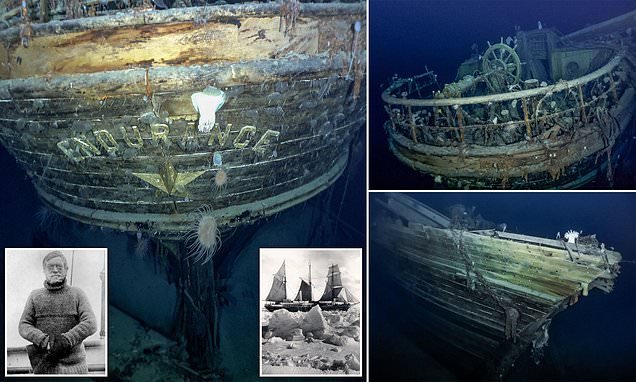
An expedition team from Endurance22 has announced the discovery of Sir Ernest Shackleton’s, Endurance, off the coast of Antarctica. The Endurance was a three-masted barquentine, despatched on the Imperial Trans-Antarctic Expedition to make the first land crossing of the Antarctic continent. The ship is sitting upright on the seabed and is largely intact. There is some damage to the fo’c’sle deck and part of her starboard side, but the paintwork and her name “ENDURANCE” are still clearly visible.
World's Oldest Straws
Ancient metal tubes unearthed in 1897 could be oldest surviving drinking straws. A set of ancient gold and silver tubes dating to about 5,500 years ago and unearthed in North Caucasus in Russia could be the world's oldest surviving drinking straws, experts have claimed. The richly furnished mound also contained hundreds of other artifacts, including ceramic vessels, metal cups, weapons, and beads made of semiprecious stones and gold. The tubes, which are hollow and measure around 3.7 feet long and just under a half inch in diameter, were originally thought to have been scepters or poles used to support a canopy.

(Photo by V. Trifonov)

4,200-YEAR-OLD HAZELNUTS, MARBLE IDOLS FOUND IN TURKEY'S KÜTAHYA
During the excavations in Tavşanlı Mound, located in the central Turkish province of Kütahya, the remains of 4,200-year-old hazelnuts and marble idols were unearthed. Read more here

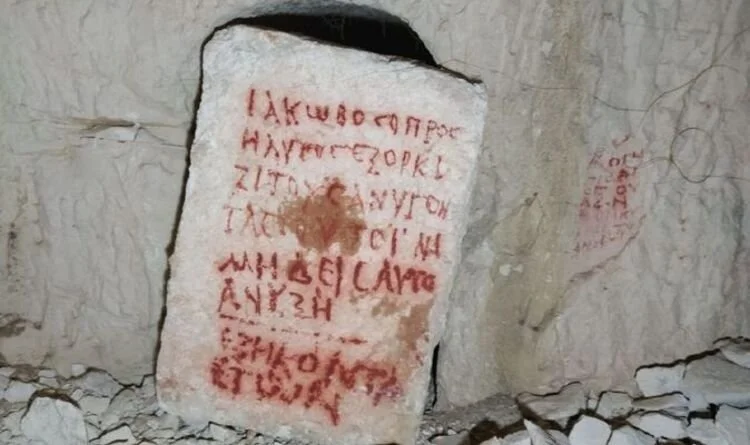
A GREEK-LANGUAGE 'BLOODY' CURSE INSCRIPTION AGAINST ROBBERS FOUND IN GALILEE, ISRAEL
Dated back to 2nd or 3rd century AD (Late Roman or Early Byzantine period) this painted bloody-looking burial curse inscription was found in a tomb in Beit She'arim Necropolis of Lower Galilee in Israel. The full text and the story of its discovery were presented at the Northern Conference, held jointly on June 1, 2022 by the University of Haifa and the northern region of the Israel Antiquities Authority (IAA). Though the Beit She’arim necropolis had been studied extensively, the catacomb in which Jacob had been buried had been unknown until last year. This curse was the first inscription archaeologists have found in Beit She’arim for 65 years! Read more here
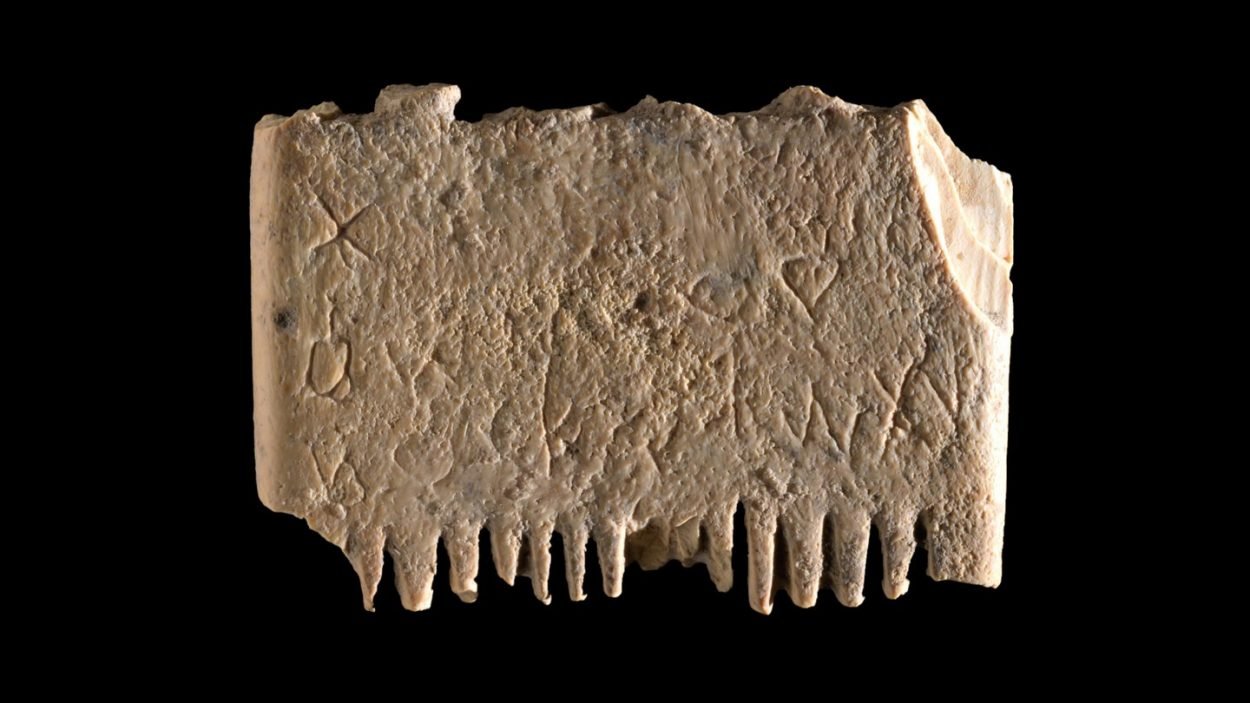
FIRST SENTENCE WRITTEN IN CANAANITE LANGUAGE DISCOVERED ON IVORY COMB
Archaeologists have identified an entire sentence in Canaanite, engraved on an ivory comb that dates from 1700 BC. On the comb are 17 Canaanite letters in an archaic form from the first stage of the invention of the alphabet script. They form seven words in Canaanite, reading: “May this tusk root out the lice of the hair and the beard.”
ORIGINS OF THE 30,000-YEAR-OLD VENUS OF WILLENDOrf SOLVED
Anthropologist Gerhard Weber from the University of Vienna used micro-computer tomography to analyse the Venus up to a resolution of up to 11.5 micrometres. Together with Alexander Lukeneder and Mathias Harzhauser from the Natural History Museum in Vienna, the team procured comparative samples from Austria and Europe for comparison to geologically determine the origin. Read more here

(Credit: frantic00/Shutterstock)
RESEARCH TEAM CLAIMS TO HAVE DECIPHERED ANCIENT IRANIAN LINEAR ELAMITE LANGUAGE
A mysterious ancient writing system called Linear Elamite, used between about 2300 B.C. and 1800 B.C. in what is now southern Iran, might have finally been deciphered, although some experts are skeptical about the findings. What's more, it's unclear whether all the artifacts used to decipher the writings were legally acquired. Read more here

Illustration by Meilan Solly / Photos via Wikimedia Commons under public domain, Getty Images, Desset et al.
The Euphrates River FINALLY Dried Up But Now Something Has Emerged
Join us as we uncover the mysteries of the Euphrates River. Get ready for a journey that's both educational and entertaining!
This is the First Find of Archaeologists Confirming Diplomacy in Antiquity
An amateur archaeologist discovered the first find of its kind during another search for artifacts in England. In addition to the gold ring with diamonds, archaeologists managed to find many other valuable items and buildings in the UK.
What did the audience eat during the battles of gladiators and animals in the Colosseum, what role did the spider monkey play in the history of Teotihuacan? You must watch the video for your questions to be answered!
The Hidden ancient Teachings of Jesus Banned from The Bible Reveal Shocking Secrets of Humanity
There are various teachings of Jesus banned or removed from the Bible, showcasing humanity's terrifying secrets. Today we will discuss the forbidden and secret teachings of Jesus, explaining powerful things that were removed from the Bible. Enjoy!
One Million Year-Old Astronaut Found In Siberia?
Has an one million year-old astronaut been found in Siberia? Watch the following video and find out!
12 Most Incredible Archaeological Discoveries That Really Exist
Now is as good a time as any to make a discovery! From the sheer number of amazing finds made by archaeologists, scientists, researchers, and even the general public in recent times, it’s clear that we’re going through a boom period in terms of collecting knowledge and information. There have been hundreds of astonishing discoveries made recently, and we’ve put together some of the most fascinating examples for you in this video!
You Won’t BELIEVE This Egyptian Discovery - sacred tomb opened People Are SPEECHLESS!
You won't believe what they found in Egypt, people can't say anything. Even though ancient Egypt has been forgotten for a long time, its treasures are still on Earth. Archaeologists have already found hundreds of ancient Egyptian Royal tombs. What if we told you that this time it's not about the Royals but the common people of ancient Egypt? Yes, you did hear right. Archaeologists have found over 800 graves in Egypt, some of which are over 4,000 years old. These graves were found during excavating a burial ground that archaeologists have known about for over a century.
How did these tombs come to light? What priceless artifacts did they find in these tombs that left people speechless? Let’s get all the answer through the following video. Enjoy!
List of inventions and discoveries of the Indus Valley Civilisation
BY THE ARCHAEOLOGIST EDITOR GROUP
This list of inventions and discoveries of the Indus Valley Civilisation lists the technological and civilisational achievements of the Indus Valley Civilisation, an ancient civilisation which flourished in the Bronze Age around the general region of the Indus River and Ghaggar-Hakra River in what is today Pakistan, and parts of India.

The extent of the Indus Valley Civilisation
Inventions
Button, ornamental: Buttons—made from seashell—were used in the Indus Valley Civilisation for ornamental purposes by 2000 BC. Some buttons were carved into geometric shapes and had holes pierced into them so that they could be attached to clothing by using a thread. Ian McNeil (1990) holds that: "The button, in fact, was originally used more as an ornament than as a fastening, the earliest known being found at Mohenjo-daro in the Indus Valley. It is made of a curved shell and about 5000 years old."
Shipyard: The world's oldest shipyard has been found in Lothal. It is situated 80 km south of Ahmedabad in Gujarat.
Cockfighting: Cockfighting was a pastime in the Indus Valley Civilisation in what today is Pakistan by 2000 BC and one of the uses of the fighting cock. The Encyclopædia Britannica (2008)—on the origins of cockfighting—holds: "The game fowl is probably the nearest to the Indian red jungle fowl (Gallus gallus), from which all domestic chickens are believed to be descended...The sport was popular in ancient times in the Indian subcontinent, China, the Persian Empire, and other Eastern countries and was introduced into Greece in the time of Themistocles (c. 524–460 BC). The sport spread throughout Asia Minor and Sicily. For a long time the Romans affected to despise this "Greek diversion," but they ended up adopting it so enthusiastically that the agricultural writer Columella (1st century CE) complained that its devotees often spent their whole patrimony in betting at the side of the pit."

An ancient well, and the city drainage canals, in Lothal, Gujarat, India
Stepwell: Earliest clear evidence of the origins of the stepwell is found in the Indus Valley Civilisation's archaeological site at Mohenjo Daro in Pakistan and Dholavira, India. The three features of stepwells in the subcontinent are evident from one particular site, abandoned by 2500 BC, which combines a bathing pool, steps leading down to water, and figures of some religious importance into one structure. The early centuries immediately before the common era saw the Buddhists and the Jains of India adapt the stepwells into their architecture. Both the wells and the form of ritual bathing reached other parts of the world with Buddhism. Rock-cut step wells in the subcontinent date from 200-400 CE. Subsequently, the wells at Dhank (550-625 CE) and stepped ponds at Bhinmal (850-950 CE) were constructed.
Bow Drill: Bow drills were used in Mehrgarh between the 4th and 5th millennium BC. This bow drill—used to drill holes into lapis lazuli and carnelian—was made of green jasper. Similar drills were found in other parts of the Indus Valley Civilisation and Iran one millennium later.
Public Baths: The earliest public baths are found in the ruins in of the Indus Valley Civilisation. According to John Keay, the "Great Bath" of Mohenjo Daro in present-day Pakistan was the size of 'a modest municipal swimming pool', complete with stairs leading down to the water at each one of its ends.
Grid Plan: Rehman Dheri contains the earliest evidence of a grid-planned city in south Asia dated c. 3300 BC. By 2600 BC, Mohenjo-daro and Harappa, and other major cities of the Indus Valley Civilisation, were built with blocks divided by a grid of straight streets, running north–south and east–west. Each block was subdivided by small lanes.
Flush Toilet: Mohenjo-Daro circa 2800 BC is cited as having some of the most advanced, with toilets built into outer walls of homes. These toilets were Western-style, albeit a primitive form, with vertical chutes, via which waste was disposed of into cesspits or street drains.
Drainage System: The Indus Valley Civilisation had advanced sewerage and drainage systems. All houses in the major cities of Harappa and Mohenjo-daro had access to water and drainage facilities. Waste water was directed to covered gravity sewers, which lined the major streets.
Distillation: A terracota distillation apparatus in the Indus Valley in West Pakistan dates from around 3000 BC.

Computer-aided reconstruction of Harappan coastal settlement in Pakistan on the westernmost outreaches of the civilisation
Cotton industry: The Indus cotton industry was well-developed and some methods used in cotton spinning and fabrication continued to be used until the industrialization of India.
Public Litter bins: Archaeologists have found several brick containers that were strategically located along the street junctions of Mohenjo-Daro specifically for garbage disposal.
Dentistry: The evidence of dentistry being practised as far back as 7000 BC. An IVC site in Mehrgarh indicates that this form of dentistry involved curing tooth related disorders with bow drills operated, perhaps, by skilled bead crafters. The reconstruction of this ancient form of dentistry showed that the methods used were reliable and effective.
Touchstone: Found in excavations from Banawali, Haryana.
Signboard: One of the most significant discoveries at Dholavira was made in one of the side rooms of the northern gateway of the city, and is generally known as the Dholavira Signboard. The Harappans had arranged and set pieces of the mineral gypsum to form ten large symbols or letters on a big wooden board. At some point, the board fell flat on its face. The wood decayed, but the arrangement of the letters survived. The letters of the signboard are comparable to large bricks that were used in nearby walls. Each sign is about 37 cm (15 in) high and the board on which the letters were inscribed was about 3 m (9.8 ft) long. The inscription is one of the longest in the Indus script, with one symbol appearing four times, and this and its large size and public nature make it a key piece of evidence cited by scholars arguing that the Indus script represents full literacy. A four-sign inscription with large letters on a sand stone is also found at this site, considered the first of such inscriptions on sand stone at any of the Harappan sites.

One of the water reservoirs, with steps, at Dholavira
Hydraulic Engineering: "The kind of efficient system of Harappans of Dholavira, developed for conservation, harvesting and storage of water speaks eloquently about their advanced hydraulic engineering, given the state of technology in the third millennium BC" says R.S.Bist, Joint Director General (Rtd.), Archaeological Survey of India. One of the unique features of Dholavira is the sophisticated water conservation system of channels and reservoirs, the earliest found anywhere in the world, built completely of stone. The city had massive reservoirs, three of which are exposed. They were used for storing fresh water brought by rains or to store water diverted from two nearby rivulets. This clearly came in response to the desert climate and conditions of Kutch, where several years may pass without rainfall. A seasonal stream which runs in a north–south direction near the site was dammed at several points to collect water.
Dams: In Neolithic Mehrgarh pre-Harappan phase (7000-3200 BC) people had developed a water storage system called Bund to trap rain and torrential waters in the semi-arid region of Kach in-between the Indus river and Balochistan mountains where the seasonal Bolan river flows. Stone walls were built along the slope of torrential river beds to serve as reservoir dams, restrict flow of water and for diverting water into canals for irrigation.
Stadium: the world's earliest stadium with terraced stands was constructed at Dholavira and Juni Kuran. Two stadiums have been identified at the ancient site, one is considered a ceremonial ground, another, a small stadium. At Juni Kuran, two separate stadiums for commoners and the elite have been discovered.
Bronze sculpture: Dancing Girl from Mohenjodaro belonging to the Harappan civilisation dating back to 2500 BC is said to be the first bronze statue.
Lost wax casting: a detailed, full-field photoluminescence study of a 6,000 year old copper "wheel" amulet from Mehrgarh in Balochistan has opened the door to many new facts about this period of history. This study by Ipanema, the European center for the study of ancient materials, believes that this is the oldest known example of the "lost wax" casting technique, one of the most important innovations in the history of metallurgy.
Shampoo: Pre-Harappan level of Banawali (2750-2500 BC), Haryana have revealed traces of a mixture of shikakai with soap nuts and Amla (Indian Gooseberry) of what would constitute herbal shampoo, exhibiting ancient roots of South Asian hygiene.
Mordant (Dye Fixing): Mordants for fixing dyes were used since the Indus Valley Civilisation, it exhibited Indian mastery over clothes dyeing which was unrivalled until the invention of western chemical dyes.
Stoneware: Earliest stonewares, predecessors of porcelain have been recorded at the Indus Valley Civilisation sites of Harappa and Mohenjo Daro, they were used for making stoneware bangles.
Seven Stones: An Indian subcontinent game also called Pitthu is played in rural areas and has its origins in the Indus Valley Civilisation.
English Bond: This bond has alternating stretching and heading courses, with the headers centred over the midpoint of the stretchers, and perpends in each alternate course aligned. Harappan architecture in South Asia was the first use, anywhere in the world, of so-called English bond in building with bricks.
Saw, modern: True saws with modern teeth were a Harappan invention.
Needle's eye: The eye of the needle was another Harappan contribution.
Etched Carnelian beads: are a type of ancient decorative beads made from carnelian with an etched design in white. They were made according to a technique of alkaline-etching developed by the Harappans during the 3rd millennium BC and were widely disperced from China in the east to Greece in the west.
Finished Ivory Goods: Finished Ivory products like kohl sticks, pins, awls, hooks, toggles, combs, gamesmen, dice, inlay and other personal ornaments are considered to have its origin form Harappan sites.
Discoveries
Gemstones and Lapis Lazuli: Lapis lazuli artifacts, dated to 7570 BC, have been found at Bhirrana, which is the oldest site of the Indus Valley Civilisation.
Sesame oil: Sesame seeds were one of the first crops processed for oil as well as one of the earliest condiments. Sesame was cultivated during the Indus Valley Civilisation and was the main oil crop. It was probably exported to Mesopotamia around 2500 BC.
Pashmina: Samples of wool fibres discovered from corroded copper artifacts from Harappa dating back to the Indus Valley Civilisation are extremely fine and resemble Pashmina and Shatoosh.
Archaeologists are Shocked to Discover the Real Reason Behind Mummification
For over a century archaeologists and teachers have taught students that ancient Egyptians mummified their deceased to “preserve” their bodies.
So, imagine the surprise of archaeologists when they discovered that the painstaking elaborate process of mummification was never intended to preserve the bodies of the deceased at all! In today’s video we are crunching the real reason behind the ancient Egyptians' mummification.
12 Most Amazing Archaeological Finds Scientists Still Can't Explain
There’s always something new to look at and study when it comes to archaeology. Archaeologists never stop digging, and so there will always be new discoveries and new information to sink our teeth into! While new archaeological discoveries are made almost every day, only the best of them make it to our channel. This is a video collection of all the most remarkable finds made in recent times!
10 MYSTERIOUS Cases Of Forbidden History!
In today’s video we will investigate 10 mysterious cases of forbidden history. Watch the video below and enjoy!