Today we take a look at the history of fairies, what exactly they are and where they came from. This includes multiple regions around the world and features creatures such as Changelings, leprechauns, Pixies, Banshees, Boggarts and even angels and demons.
Greek Mythology Stories: The Essential - The Origins, The War and Rise of the Gods of Olympus
In the following video we will be talking about the origins, the war and rise of the Gods of Olympus. Enjoy!
The Sad Stories of Zeus Lovers
In the video below we will go through the sad stories of Zeus lovers. Watch the video to find out more!
How Did Cain Die in the Bible? Who Was Cain Afraid of in Genesis 4?
Cain killed Abel, but who killed Cain in the Bible? What does tradition say about the death of Cain?
Watch this documentary to track the real killer of Cain as recorded in ancient text sources. Find out who Cain was afraid of in Genesis 4, what the mark of Cain is, the descendants of Cain and how they are involved in his death, and much more.
First Muslim Incursion into India - Early Muslim Expansion DOCUMENTARY
In this video we will focus on the first Muslim incursion into India, as we discuss the Sindh campaign that allowed the Arabs to gain a foothold in the subcontinent. Enjoy!
Cult of Mithras Explained
The Cult of Mithras was a thriving religion in the Roman Empire. But by the 5th century....it was gone. What do we know about the Cult of Mithras? And what was its relationship with Christianity?
The Plantagenets: The Full Story Behind England's Bloodiest Dynasty
The Plantagenets have gone down in history as England's greatest royal dynasty. But how did this family hold on to power for so long in medieval Europe's often brutal and dangerous world? Follow Dan Jones as he gives a full and comprehensive overview of one of history's most fascinating families.
Rise of the Vandals: How the Vandals Took Over Roman Africa
In this video we will be talking about the rise of the Vandals and how an initially minor Germanic tribe managed to take over the Roman province of Africa after travelling from the Danube to Hispania and then across Gibraltar. Enjoy!
What Are Dwarves? - A Quest For the Origins and Nature of Dwarves
A close examination of dwarves in Germanic mythology and folklore reveals some surprising results. Sleep, dreams, spirits and elves loom large. Are you prepared to descend into the mists of their realm to discover the truth?
Century of Crisis - Why the 1300s Were the Worst
In the following video we will discuss why the 1300s were a century of crisis and what made them one of the worst eras to live in. Enjoy!
Lost Treasures of the Silk Road - Full Documentary
China - the “Middle Empire” has long been thought to have developed completely independently of the West. New archaeological findings seem to support the theory that there had been contact between the East and West much earlier than originally assumed.

From Battle to Beauty: The Tale of the Helepolis Siege Engine and Its Role in Building the Colossus of Rhodes
Turning Swords into Plowshares: The incredible journey from Helepolis to the Colossus of Rhodes. The siege engine that transformed into one of the seven wonders of the world.
In the annals of ancient warfare, few inventions capture the imagination quite like the Helepolis, an imposing, mammoth siege tower that brought new dimensions to the art of siegecraft. Weighing an enormous 160 tons and requiring the combined strength of 3,400 men to move, this tapered tower played an instrumental role in the evolution of warfare. Yet, its most lasting legacy was born not from its formidable military prowess but from its ironic contribution to the creation of one of the Seven Wonders of the Ancient World, the Colossus of Rhodes.
Design and Mechanism: The Making of a War Behemoth
The mobile siege tower's Greek name, Helepolis, translates to "Taker of Cities." The most well-known was that created by Polyidus of Thessaly during the Siege of Rhodes, and refined by Demetrius I of Macedon and Epimachus of Athens (305 BC). Diodorus Siculus, Vitruvius, Plutarch, and Athenaeus Mechanicus all provided descriptions of it.
Polyidus of Thessaly, who was often associated with the conception of the Helepolis, remains an enigmatic figure in the annals of military engineering. As a notable engineer and tactician in the service of Alexander the Great and Demetrius I of Macedon, Polyidus was credited with the invention of several prominent siege engines, including the Helepolis. His ingenious contributions to siege warfare laid the groundwork for later innovations and shaped the landscape of Hellenistic military strategy. Despite the ingenuity of his designs, it was through his unintended contribution to art and architecture through the repurposing of the abandoned Helepolis that Polyidus of Thessaly left a lasting, if ironic, legacy.

3D model and cross-section of Helepolis approximately as described in the wiki article Created in the TrueSpace 3 demo edition and GIMP.
Evan Mason own work
The Helepolis was not merely a large tower. It was an architectural marvel—an imposing iron-clad fortress on wheels, meticulously designed for both attack and defense. The outer surface of the tower was covered in iron plates, rendering three sides fireproof, a critical adaptation for surviving the flaming projectiles of the enemy. The interior was divided into multiple stories, housing soldiers equipped with light dart throwers designed to clear walls and heavy armaments providing the raw, destructive power necessary to break enemy defenses.
The Helepolis was essentially a massive, manually propelled tower that measured 65 feet (20 meters) in width and 130 feet (40 meters) in height on each side. It was supported by eight 15 feet (5 m) high, caster-equipped wheels that allowed for both lateral and straight movement. The interior was separated into floors that were joined by two wide flights of steps, one for climb and one for descent, and the three exposed sides were made fireproof with iron plates. The machine weighed 160 tons, and it took 3,400 men working in relays to move it. As 200 men turned a huge capstan that drove the wheels with a belt, the remaining 1,200 men pushed the machine forward. The casters allowed for lateral movement, allowing the entire apparatus to be maneuvered towards the intended attack location while maintaining the siege engines inside pointed towards the city walls and the machine's protective body in direct contact with the men advancing behind it.

Model of a Helepolis siege tower, Thessaloniki Science Center and Technology Museum
Gts-tg: Own work
Helepolis siege engine, 4th century BC, Greece (modeled after Demetrius Poliorcetes Helepolis siege tower). Thessaloniki Technology Museum. Design and construction by K. Kotsanas
The Helepolis was equipped with a terrifying array of heavy weapons, including two 180-lb (82 kg) catapults, one 60-lb (27 kg) catapult, three 60-lb catapults on the second floor, and two 30-lb (14 kg) catapults on each of the following five stories. The forward wall of the tower was perforated with openings for the missile launchers that were protected by automatically adjustable shutters and lined with skins that were filled with wool and seaweed to make them fireproof. Soldiers could easily clear the walls of defenders on each of the top two floors with the help of two lightweight dart throwers.
The Siege of Rhodes: The Helepolis Meets Its Match
Despite its formidable design, the Helepolis met its match during the Siege of Rhodes. According to Vitruvius, the people of Rhodes, under the ingenious guidance of Diognetus, managed to immobilize the colossal siege tower. Instead of countering iron with iron, they relied on the simple elements of water, mud, and sewage, channeling these onto the area of attack. The Helepolis, for all its ironclad majesty, became irretrievably stuck and was ultimately abandoned, marking a turning point in the siege.
The Rhodians were able to knock parts of the metal plates off the Helepolis as it was being moved toward the city, and Demetrius decided to remove it from the fight to prevent it from being set on fire.

The Birth of the Colossus: From War Machine to Iconic Monument
This event not only marked the lifting of the siege but also paved the way for the creation of one of the most iconic monuments in the ancient world.
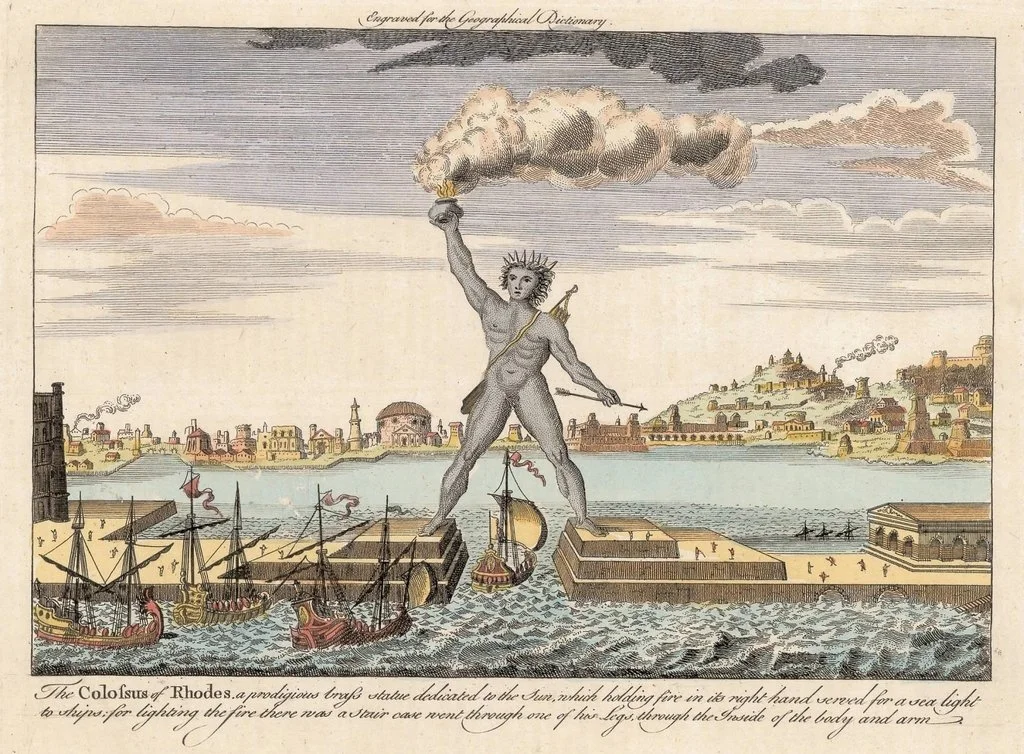
The Helepolis and the other siege engines were abandoned after the siege failed, and the people of Rhodes used the materials and money to construct the Colossus of Rhodes, a statue of their patron god Helios that is now known as one of the ancient Seven Wonders of the World. They also melted down their metal plating and sold abandoned weapons. Thus, from the failed engine of war, a symbol of peace and triumph was born.
In a different story provided by Vitruvius, the Rhodians pleaded with Diognetus, who had previously served as the town architect of Rhodes, to devise a strategy for capturing the Helepolis. He ordered the Rhodians to breach the city wall under cover of night in order to direct copious volumes of water, mud, and sewage into the region where the Helepolis was anticipated to launch an assault the following day. The tower was moved forward to the planned attack point by Diognetus and became trapped in the muck forever. When the siege was over, the Rhodians utilized the proceeds from the sale of Demetrius's abandoned siege engines to build the massive Colossus of Rhodes.
The Legacy of the Helepolis: Influence and Adaptation in Subsequent Ages
The Helepolis's story did not end with the Siege of Rhodes, however. The concept of the moving tower endured, and its name was adopted for similar siege engines in subsequent eras. Notably, Demetrius utilized a comparable machine in the successful siege of Thebes the following year. The term was also later used by the Byzantines to describe a different form of siege engine, further attesting to the enduring influence of the Helepolis on siege warfare.
Later siege engineers continued to refer to movable towers that were equipped with battering rams as well as spear and heavy stone hurling equipment as helepolis.
Even later, the traction trebuchet, a quite different type of siege engine, was referred to as a helepolis by the Byzantines. Theophylact Simocatta used this language for the first time in his description of the siege of Tiflis during the Byzantine-Sassanid War in 602–628.
A Symbol of Human Ingenuity
In the tale of the Helepolis, we find a unique intersection of war, innovation, and beauty. The iron giant that was built to conquer cities instead ended up contributing to the construction of a monument that has mesmerized humanity for centuries. It is a fitting testament to the transformative power of human ingenuity, reminding us that even instruments of destruction can play a role in the creation of wonders.

Artificial Intelligence is Used to Reconstruct the Lighthouse in the Ancient City of Patara
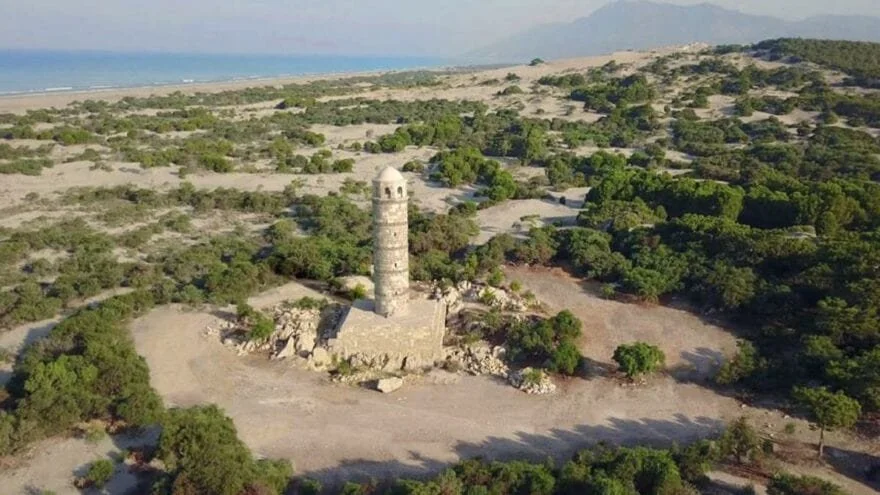
The lighthouse in the ancient city of Patara, which was constructed by the Roman Emperor Nero and is thought to have collapsed in the tsunami of 1481, was rebuilt using artificial intelligence technology.
The Turkish Ministry of Culture and Tourism approved the designation of 2020 as the Patara Year, and the 2020 Patara Year will take place at the ancient city of Patara, which is now known as Ovagelemiş Village, in the southern Turkish province of Fethiye. Patara is also of particular significance due to its archaeological and historical significance, as well as the fact that it is one of the few beaches where the Caretta-Caretta Mediterranean turtles lay their eggs and have bred for millions of years.
Beginning in 1988, excavations took place in Patara Ancient City, the seat of Lycia. The couple, Prof. Dr. Fahri Işık and Prof. Dr. Havva İşkan Işık In the excavations that started, hundreds of historical items, particularly from the Lycian culture, have been found.
The lighthouse Nero, the Roman Emperor, constructed in 64 AD is one of the most significant pieces of art discovered during the Patara excavations. It was discovered that the lighthouse discovered by Prof. Dr. Havva had 2,500 original stones, precisely 12 years after the excavations got underway.

500 stones are being merged to make 2,050
On the completed 6-meter podium, the lighthouse is being constructed by replacing the stones that can't be utilized statically due to dropping from a height.
The Antalya Governorship Investment Monitoring and Coordination Directorate (YIKOB) Cultural Heritage Directorate submitted the application, according to reports from the DHA agency.
A technical report was created in the 15th century in an effort to stop the lighthouse from collapsing in the event of another earthquake or tsunami in the years following its reconstruction. At the time, it was believed that the Rhodes earthquake and the ensuing tsunami had destroyed the lighthouse. According to the report written by Dr. Cenk Üstünda, the reconstruction would make use of components including steel spirals, steel pipes, steel rods, pure epoxy resin glue, carbon-fiber mesh reinforcement, and high-strength natural hydraulic lime-binder mortar.
2500 stones had their X-rays taken
2,500 stones were removed one by one throughout the course of the protracted excavations, and after being subjected to physical and chemical tests in the lab, their original locations were discovered using artificial intelligence technology and computer software.
Havva şkan worked on the construction site alongside the architectural team, and Ahabettin Ztürk, head of the department of architecture at Van Yüzüncü Yl University and the reconstruction project's scientific consultant, explained that about 2,050 stone excavations were laser studied in three dimensions, and all dimensions were scanned.
It spent over a thousand years underground
Doctor Ztürk noted that the stones were still present beneath the sand after the lantern collapsed, and their preservation for use in the current rebuilding is a significant benefit. Dr. Ztürk points out that each stone is examined in the lab for its physical and chemical characteristics. Although it is not direct proof, certain information about the general position of the lighthouse was utilized on several coins from the Nero era.
Only when they are set in their actual locations can stones with concave and convex surfaces built of polygonal and rectangular stones align with their positions. The lengthy duration of the study is due to the fact that each stone in the stone hospital was individually x-rayed and examined to determine whether there was tissue loss inside. He advised using the sturdy ones one by one rather than the bad ones.

technology using artificial intelligence
Dr. Ztürk stated, "All data were processed in the program. It is the building system software that is used to determine the original placement of the stones. A total of 2,500 stones were tested using a variety of trial-and-error techniques, and 80–90% of them were determined to be compliant.
According to my assessment of the early data we have gathered, it is estimated that 80% of the original stone and 20% of the new stone will be used. In this manner, the lighthouse will be repaired; however, this procedure is more like reconstruction than restoration, as the building is being rebuilt, he stated.
No example exists in the world
In terms of a lighthouse indicating that the first application in Turkey was 2 thousand, or about 80% of the annual refurbished using the original stones, Dr. Ztürk noted that there are no examples in the world where 80% original materials are employed. Doctor ztürk, It is a significant structure that serves as the initial application in this sense. It has an upward spiraling architectural texture and a cylindrical body that is around 26.5 meters high and 6 meters in diameter.
The Prestige Project of Nero
An inscription in gold lettering on the lighthouse provides information about who built it and when, and it is claimed to be the prestige project of the Roman Emperor Nero. The Patara Council and Sextus Marcius, the ruler of the Patara people at the time, are thanked in a statement found in stone inscriptions that was unearthed during the excavations: "We thank you for governing the people of Lycia rightfully, without taking bribes, and for adorning our city with beautiful monuments for eight years."
a valuable landmark for all people
Prof. Havva, who worked on the lighthouse excavation, said:
"Our nation will have another monument of worldwide importance when our works, which were started by the Antalya Governorship and Investment Monitoring and Coordination Directorate in Patara in 2020 and accepted with the request of our Ministry of Culture and Tourism and the permission of our President, are completed.
As a scientist, I want to show my gratitude to each of them. We continue to work on our lighthouse, which has the potential to become one of Antalya's emblems, using a multidisciplinary approach and cutting-edge technology. Nero claims that he built this lighthouse, one of the most important structures in the Roman Empire, "for the salvation of the mariners." We are striving toward the time when we may proudly display this lighthouse to our nation and to the valiant sailors of this nation.

Illustration by Dimosthenis Vasiloudis
Interweaving Mythology and Metallurgical Developments: The Case of the Succession of the Five Ages of Man in Hesiod's 'Works and Days'
The succession of the Five Human Generations in Hesiod's "Works and Days": Correspondence of the mythological narrative with the metallurgical developments in Greece and the wider area?
The history of metallurgy is directly linked to the evolution of man. The technological and cultural developments in Greek mainland and the wider area of southeastern Europe and the eastern Mediterranean associated with metallurgy may have left their echo in the traditions and myths that survived until historical times, according to several modern scholars of ancient Greek literature. The transformation of precious metals into impressive objects of prestige, power, and religious symbolism made a special impression on prehistoric people, and it is quite logical that these innovations left their traces in timeless traditions. A mythological narrative that shows a remarkable temporal parallel with these developments is the succession of human genera in Hesiod's work, "Works and Days" (the Golden Age, the Silver Age, the Bronze Age, the Age of Heroes, and the Iron Age).
The ancient Greek poet Hesiod, in his work "Works and Days," presents us with a remarkable chronology of humanity's development. His account, rooted deeply in mythological narratives, describes the succession of five human generations. As intriguing as the narrative itself is the speculated correspondence of this progression with the metallurgical developments, This article will delve into the layers of Hesiod's anthropogonic myth, tracing the intricate connection with the era's technological advancements in metallurgy.
The Age of Gold
Hesiod's first age of man, the Golden Age, was an era of abundance, peace, and prosperity. Humans lived in harmony with the gods; their lives were filled with joy and devoid of toil. This age aligns with the Greek Neolithic era, a period marked by the crafting of gold artifacts. The use of gold in this epoch was mainly symbolic, signifying wealth, power, and divine favor, reflecting the harmony between gods and men in Hesiod's golden age.
The heyday of Balkan gold metallurgy occurred during the 5th millennium BC. According to the archaeological data, it is probably reflected in the time-compressed "golden age" of the "Golden Generation", the starting point of the human species according to Hesiod's myth (which, as we now know from natural anthropology, took place several million years ago).

Representation of the burials in the Varna necropolis in Bulgaria. Those Eneolithic burials have also offered a lot more than the precious artifacts found within them and discoveries relating to social hierarchies; the features of the graves have also provided key insights into the religious beliefs and complex funerary practices of this ancient civilization.
The Age of Silver
In the Silver Age, Hesiod's narrative darkens. Humans in this era lived as children for a hundred years, under the dominion of their mothers. When they grew up, their short-lived maturity was marked by strife and ignorance. The silver generation refused to worship the gods, resulting in Zeus destroying them.
Historically, the progression to the use of silver in the Aegean area marks a shift in technological and cultural development. The shift might parallel Hesiod's mythological narrative's movement towards strife and ignorance. The silver artifacts found from this era are often associated with burial practices, symbolizing a shift towards mortality's acknowledgment, reminiscent of the harsh punishment faced by Hesiod's silver generation.
Silversmithing, another metallurgical manifestation that extends chronologically to the beginning of the 3rd millennium BC, knew its heyday in the innovative Aegean with the highly symbolic ring-shaped periaptas, possibly capturing their meaning as a memory in the collective ideology of the people of that time of the era. This development seems to have been erased in the era of the "Silver Generation," which was destroyed for its impiety with the so-called Ogygus Flood, an old mythological story etched deep in the memory of humanity that is also compressed in time.
The Age of Bronze
The next era, that of the "Bronze Age", is undoubtedly associated with a new important innovation, that of the copper-tin alloy (bronze), which is concentrated in time from the 3rd millennium BC. and gave the conventional name to the research of the so-called "Bronze Age". According to the myth, Zeus created the people of this Generation from ashes. Their armor was forged from copper, as were their houses and tools.
The Bronze Age in Hesiod's sequence represents a time of warriors. These men, made from ash trees, were strong and formidable. They lived by the sword and ultimately fell by it. Their end was violent, and their passage to Hades was without honor.
Historically, the Bronze Age marked a significant technological breakthrough in metallurgy. The advent of bronze tools and weapons revolutionized societies, leading to the growth of trade networks and facilitating the rise of complex civilizations. Yet it was also an age marked by territorial conflicts and warfare, echoing the violent nature of Hesiod's Bronze Age men.
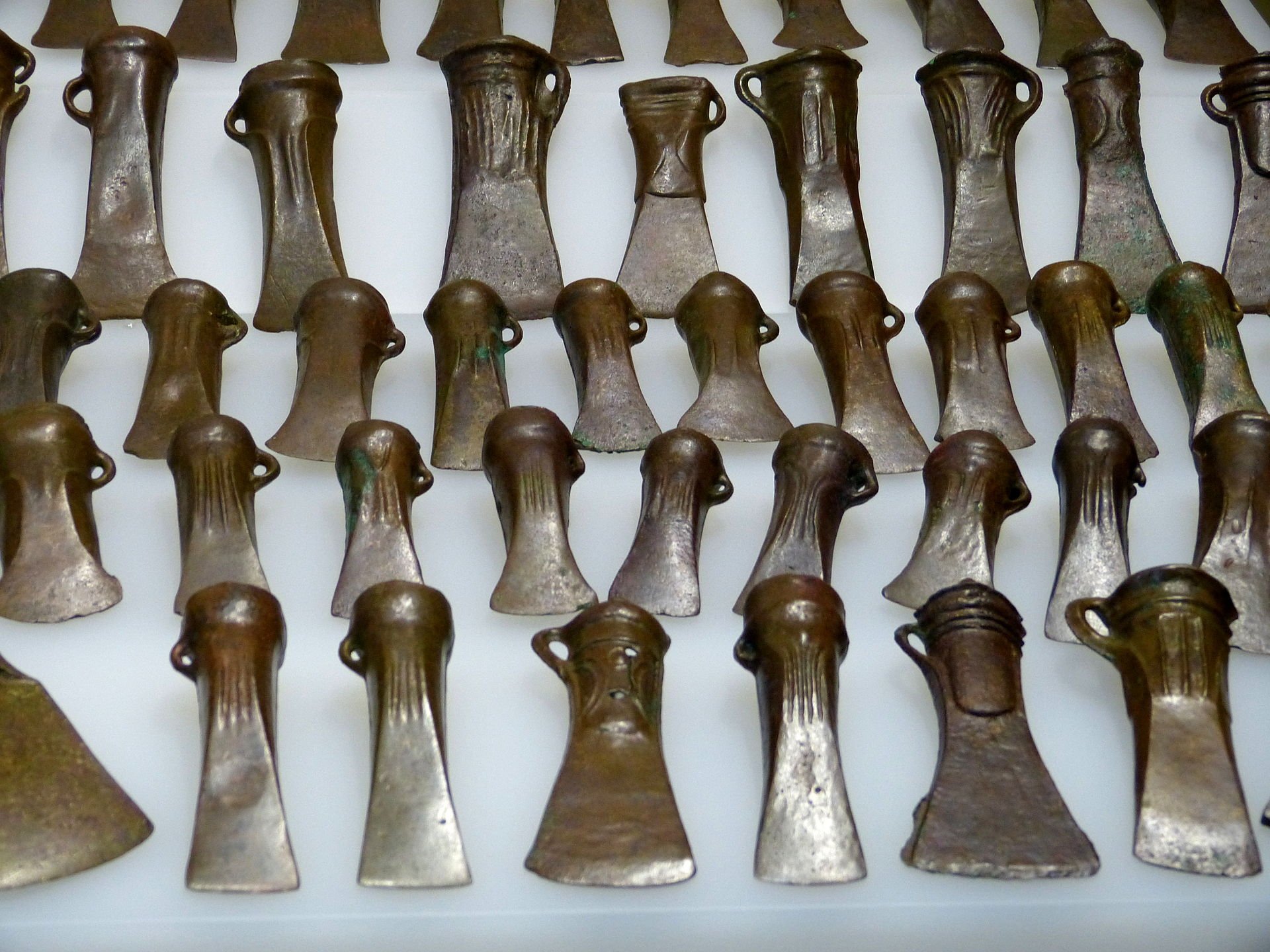
A hoard of bronze socketed axes from the Bronze Age was found in modern Germany. This was the top tool of the period and also seems to have been used as a store of value.
Wolfgang Sauber's own work
The Age of Heroes
This age, unique to Hesiod's narrative, is an intermediary period, the age of heroes and demigods. These individuals were nobler and more righteous, living in the time of legendary heroic exploits. This era doesn't have a direct metallurgical association but might symbolize a period of cultural and social transition, marked by the Homeric tales' heroic deeds.
The "Age of Heroes" is the only generation that does not correspond to any metal. It is also the only one more brilliant than the generation it succeeds. To this generation belonged the so-called Heroes of mythology, such as the Heroes of the Homeric Epics, the Argonauts, Theseus, and others. Its identification with the Bronze Age is also logical. According to experts, this generation of people summarizes a long memory horizon of past human achievements that do not necessarily have a chronological sequence between them.
The Age of Iron
The Iron Age, according to Hesiod, is the current and last generation of men. It is a time of toil, strife, and decay, where virtue is rare and injustice prevails. This pessimistic portrayal reflects the turmoil and upheavals during the Greek Dark Ages, when iron started being widely used. Iron, being common and prone to rust, can symbolize the deterioration of moral values and the hardship of life during this time.
Hesiod, like all his contemporaries, belongs to the "Iron Generation". People of this generation are also hardy but live a sad existence full of toil, drudgery, and misery without any moral principle. During this generation, Pygmy Law applies. Babies will be born with gray hair, and the gods will have completely abandoned humanity. In archaeology, the Iron Age refers to that period of history when people used iron to make tools and weapons. The adoption of this material coincided with other changes in past societies in terms of cultural methods, religious beliefs, and artistic style, which affected the economic, social, and possibly spiritual development of the era.

An exhibit of metal tools and weapons (likely votive deposits) found in the gravel pits around the River Sile is on display in the Venice National Archaeological Museum, a museum in San Marco, Venice.
Own work by the original uploader, Author Ethan Doyle White
The mythical succession of the five generations in Hesiod's "Works and Days" presents a remarkable parallel to the metallurgical advancements on the Greek mainland and in the wider region. The narrative can be seen as an allegorical representation of the socio-cultural transformations during these periods. However, one must remember that while the similarities are compelling, the allegory is not an exact historical account. It instead shows how ancient Greeks may have conceptualized and rationalized their past, drawing from the material culture they knew and the mythological narratives they believed in.
Information derived from the book of Theodoros G. Giannopoulos, ‘The Greeks: Whence and When? Crete University Press, 2012


A polished and carved phallus discovered in a German cave: One of the earliest depictions of male sexuality ever discovered
According to academics, one of the earliest depictions of male sexuality ever discovered is a polished and carved phallus discovered in a German cave.
The 20 cm long by 3 cm wide stone artifact, which is thought to be roughly 28,000 years old, was discovered buried in the renowned Hohle Fels Cave in the Swabian Jura region, close to Ulm.
14 pieces of siltstone were used to put the ancient "tool" back together.
Because of its lifelike size, scientists speculate that its Ice Age creators may have used it as a sex aid.
It was occasionally employed for knapping flints as well as being a symbolic representation of male genitalia, according to Professor Nicholas Conard of the Early Prehistory and Quaternary Ecology department at Tübingen University.
He emphasizes, "There are some locations where it has some pretty characteristic scars from that."

There can be little debate about the object's symbolic origins, according to researchers, because of its unusual design and the engraved rings that surround one end.
It is extremely polished and easily recognizable, according to Professor Conard.
The phallus' 13 broken pieces were previously stored by the Tübingen team working at Hohle Fels, but it wasn't until the discovery of a 14th component last year that the team was finally able to put the "jigsaw" back together.
The various stone pieces were all found in a well-dated ash layer in the cave complex linked to current human activity (not their pre-historic "cousins", the Neanderthals).
One of the most amazing excavation sites in central Europe is this one. Thousands of Upper Palaeolithic artifacts have been found at Hohle Fels, which is located in the Ach River Valley and is more than 500 meters above sea level.
Some of them have been genuinely stunning in their intricacy and detail, like a 30,000-year-old mammoth-ivory bird figurine. It is said to be among the oldest examples of a bird in the historical record.

Some slightly older stone artifacts that are plainly phallic emblems are known to science; of special note are those from France and Morocco. Yet, it is quite difficult to find any depictions of male genitalia from this historical period.
Male representations are quite uncommon, according to Professor Conard. "Female images with highly accentuated sexual features are fairly well documented at several sites," he said.
According to the most recent research, the Swabian Jura in southwest Germany was one of the key areas for cultural innovation after modern humans first arrived in Europe approximately 40,000 years ago.
The Europeans who look East Asian
The Sami are the indigenous people of Northern Norway, Sweden, Finland and Russia’s Kola Peninsula. Watch the video below to find out more about them!
Weird Things That The Neanderthals Did!
300,000 years ago, long before humans were walking around, were the neanderthals. They were a species of human that lived across much of the modern Eurasian continent. Much of what first comes to mind when we think of them is wrong.
11 Incredible Secrets Of Ancient Egypt
Have you ever wondered what secrets the ancient Egyptian era holds? From the Great Pyramids to the Valley of the Kings, the ancient Egyptians left behind a wealth of knowledge, culture, and secrets that still intrigue and captivate us today. So, stay tuned to explore the 11 incredible secrets of Ancient Egypt as it is one of the most fascinating and mysterious civilizations in human history.
Archaeologists discovered a Bronze Age burial site during excavation in Dorset
Archaeology students from Bournemouth University have discovered a Bronze Age burial site during an excavation of a prehistoric settlement in Dorset.
It is the first time Bronze Age bones have been discovered on the site in Winterborne Kingston, where the university’s Department of Archaeology and Anthropology has been excavating settlements from the Iron Age for nearly fifteen years.
The settlements, which were inhabited by the Durotriges tribe, date back to around 100 BC whereas the Bronze Age began around 2000 years before.
How is THAT possible? NEW 10 Archaeological Finds That Will Rewrite History
In this video, we will show you 10 new archaeological discoveries that can change our history. The video thumbnail shows a conventional flush toilet that almost every person on our planet has. The only problem is that it was previously believed that the first toilet appeared 500 years ago. And this discovery could change a lot. We will show you an ancient sword that turned out to be much older than previously thought. And we'll tell you about the mummy of a mermaid, the secret of which was recently revealed by scientists. About these finds and not only look in this video.