The Origins Of The First Ancient Egyptians


THE ARCHAEOLOGIST EDITOR GROUP


Tracing the Roots of Egyptian Civilization

The story of ancient Egypt is one of grandeur, mystery, and architectural marvels. From the Great Pyramids of Giza to the intricate hieroglyphics that adorn temple walls, the remnants of this great civilization continue to captivate and inspire. But where did the first ancient Egyptians come from? Delving deep into the annals of prehistory and utilizing modern genetic and archaeological research, we seek to uncover the origins of the people who would one day build one of history's most iconic empires.

Prehistoric Settlements: Before the Pharaohs

Long before the pharaohs ruled and the first pyramid was constructed, prehistoric communities thrived along the Nile's banks. The Nile, with its annual floods, provided a fertile environment, making it an attractive location for early agricultural communities.

1. Nabta Playa: Located in what is now southern Egypt, Nabta Playa stands as one of North Africa's earliest known agricultural sites, dating back to around 7000 BC. Early settlers in this region domesticated cattle and began simple farming practices.

2. Migrations from the Levant: Archaeological evidence suggests that during the Neolithic period, groups from the Levant migrated to Egypt, bringing with them new technologies and practices. This movement enriched the cultural melting pot that was brewing in the region.

Genetic Origins: A Melting Pot

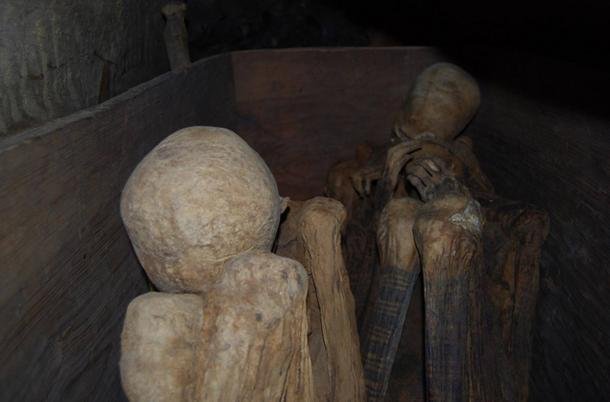
Recent genetic studies of mummies and modern Egyptians have shed light on the ancient Egyptians' complex ancestry. These studies suggest a mix of North African, Near Eastern, and Sub-Saharan African lineages. This genetic diversity reflects both the ancient migrations into the region and the various empires and traders that interacted with Egypt throughout its long history.

The Birth of Civilization: The Role of the Nile

The Nile River was undoubtedly the lifeblood of ancient Egypt. As early agricultural communities settled along its banks, they took advantage of the fertile lands provided by the river's annual inundation. Over time, these scattered communities began to form larger settlements, eventually leading to the rise of powerful city-states.

The unification of these city-states around 3100 BC under the leadership of Narmer marked the beginning of the Pharaonic era. The development of writing, state institutions, and monumental architecture soon followed.

Cultural Syncretism: Embracing Diversity

The ancient Egyptians had a knack for assimilating various cultural elements from neighboring regions. Interactions with Nubians to the south, Libyans to the west, and the cultures of the Near East greatly influenced Egyptian art, religion, and daily life. This syncretism became a hallmark of Egyptian civilization and contributed to its enduring legacy.

The origins of the first ancient Egyptians are as multifaceted as the civilization they birthed. While the Nile provided the environmental backbone for the rise of this civilization, it was the confluence of various cultures, migrations, and innovations that truly molded ancient Egypt. Through a combination of archaeological and genetic insights, we continue to unravel the intricate tapestry of events and influences that gave rise to a civilization that would stand the test of time.

The Ages of Man in Greek Mythology


BY THE ARCHAEOLOGIST EDITOR GROUP


The Ages of Man in Greek Mythology: Hesiod's Perspective

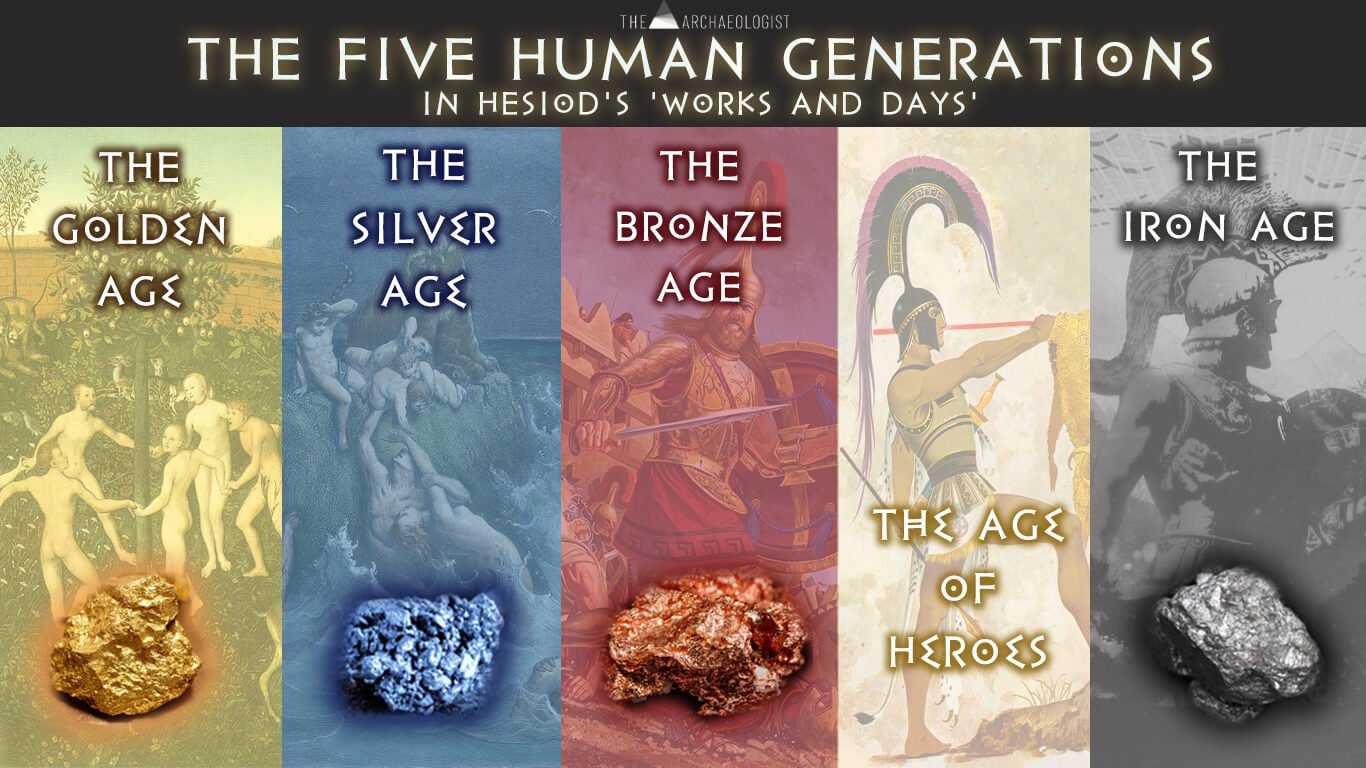
Greek mythology, with its intricate web of tales and legends, often provides profound insights into human nature and society's evolution. One of the most intriguing of these narratives is Hesiod's account of the "Ages of Man" as detailed in his work "Works and Days". This tale chronicles the successive eras of humankind, each defined by its own unique characteristics, virtues, and flaws.

Golden Age: Paradise Lost

The Golden Age signifies the pinnacle of human existence, where peace and prosperity reigned supreme. Mankind lived in harmony, untouched by labor or sorrow, and the earth spontaneously yielded its fruits. The inhabitants of this age were said to be molded by the gods themselves and lived like them — free from worries, old age, or conflict. When their time came, they gently passed away, becoming benevolent spirits that roamed the earth.

Silver Age: The Decline Begins

Though still a prosperous era, the Silver Age marks a decline from the previous age's perfection. The men of this age were created by the gods to be inferior to their golden predecessors. They lived as children for a hundred years, looked after by their mothers. Upon reaching adulthood, they lived briefly, often succumbing to their own folly and ignorance. These men did not honor the gods, leading Zeus to bury them, but they too had an afterlife as spirits, albeit less exalted than those of the Golden Age.

Bronze Age: Age of War and Valor

Born from ash trees, the men of the Bronze Age were formidable, aggressive, and robust. Their hearts were as hard as the metal they were named after, and they took pride in their strength and combat prowess. Though they enjoyed the fruits of the earth, their lives were dominated by warfare and conflict. Their own violent tendencies led to their ultimate destruction, and they found no afterlife, being consigned to the "dank house of Hades."

Heroic Age: A Brief Respite

Unlike the other ages, the Heroic Age wasn't a product of natural succession but rather an interlude in the narrative. It was an era of demigods and heroes, who took part in great adventures and fought in significant wars like the Trojan War and Thebes' adventures. Many of these heroes found eternal life on the Isles of the Blessed, enjoying an existence similar to the Golden Age.

Iron Age: The Descent into Strife

Hesiod himself believed he lived in the Iron Age, an era marked by toil, sorrow, and decline in divine influence. Men labored hard, facing the wrath of the seasons, and were burdened by injustice and wickedness. The bonds of hospitality and love weakened, replaced by betrayal and mistrust. Hesiod foretold that this age would continue to deteriorate until humanity's inherent goodness disappeared, prompting Zeus to destroy this race as he had others.

Hesiod's "Ages of Man" paints a cyclical view of human history, oscillating between periods of prosperity and decay. While it offers a moralistic interpretation of human development, it also encapsulates the ancient Greeks' understanding of their world — a combination of divine intervention and human nature. Through the prism of these ages, we gain insights into not just ancient beliefs but also the perennial issues that have fascinated and challenged humanity throughout time.

Tags

Socrates' Trial: The Account They Didn't Tell You About


BY THE ARCHAEOLOGIST EDITOR GROUP


In the heart of ancient Athens, around 399 BCE, a drama unfolded that would forever shape the course of philosophical thought and discussion. At its center stood Socrates, the enigmatic philosopher, facing charges of impiety and corrupting the youth. Yet beneath the well-trodden account of this historic trial lies a tapestry of politics, tension, and tales not often recounted. This is the untold story of Socrates' trial.

Athens: A City in Turmoil

To understand the backdrop of the trial, it's vital to grasp Athens' political climate. The city-state had just emerged from the devastating Peloponnesian War against Sparta, leaving its democracy weakened. The brief but harsh rule of the Thirty Tyrants further strained the city’s democratic ideals. The return to democracy was fraught with tension, and many were suspicious of potential subversives who might again threaten their political system.

Socrates: The Unconventional Thinker

Throughout his life, Socrates had always been a figure of controversy. Eschewing the norms of the day, he often questioned everything, from the nature of wisdom and virtue to the very foundations of Athenian society. His method of relentless questioning, now known as the Socratic method, was unsettling for many, especially those in power.

Moreover, Socrates had associations with some of the city's most controversial figures. Critias, one of the Thirty Tyrants, was his former pupil, and Alcibiades, who was seen as a traitor to Athens, was his close associate.

The Charges: More than Meets the Eye

On the surface, Socrates was charged with "not recognizing the gods the city recognizes" and "corrupting the youth." However, diving deeper, it's clear that the charges were likely a façade for deeper political and social grievances. Socrates’ critiques of democracy and his association with figures who had harmed Athens made him a target for those who wanted to restore faith in the democratic system.

The Trial: Democracy in Action?

The trial was more a reflection of Athens’ democratic process than a fair examination of Socrates' actions or beliefs. With a jury of 501 citizens, the trial was swayed more by rhetoric than evidence. Socrates, true to his nature, refused to pander to the crowd. Instead of apologizing or defending himself in a traditional sense, he posed challenging questions, further alienating the jury.

The Aftermath: The Death of a Philosopher

Found guilty, Socrates was sentenced to die by consuming poison hemlock. His death, however, immortalized him. Plato, his most famous student, would go on to memorialize Socrates’ thoughts and methods, ensuring that his legacy would endure for millennia.

Socrates' trial wasn't merely a legal proceeding; it was a reflection of a city at a crossroads, struggling with its identity and values. More than just an account of a philosopher's persecution, it’s a cautionary tale about the complexities of democracy, the dangers of unchecked mob rule, and the sacrifices made in the name of truth and integrity. Through the lens of Socrates' trial, we are compelled to examine society's values and the lengths one might go to defend them.


Experience history like never before as we take you on a journey through ancient Athens, reimagining the story of Socrates in a modern light. In this video, we present Xenophon's 'Apology'.

Xenophon, unlike Plato, was not present at the trial, but his account provides a more personal, intimate perspective on Socrates' final days, revealing the philosopher's indomitable spirit and unshakeable conviction in his principles.

By transforming this historical text into today's vernacular, we hope to foster a deeper understanding of this pivotal moment in history and the enduring relevance of Socrates' teachings. So, whether you're a lover of philosophy, history, or simply enjoy thought-provoking content, this video is a must-watch!

Historical Statues Brought To Life Using Colorization & AI Technology

Prior to 19th century there was no photography and the only way to reimagine our favourite historical characters of those times is by looking at the sculptures and paintings left to us by our skilful ancestors. In particular the ancient Greek and Roman cultures have left us a myriad of realistic statues and sculptures that we can use today, to reimagine what early historical figures might have looked like in real life.

In light of this, we have selected few statues for this video, to see if we can breathe some life into them by applying today's modern technology involving AI stuff and facial reconstruction. Enjoy!

The Day That Zeus Was Defeated - Typhon: The Nightmare of the Greek Gods


BY THE ARCHAEOLOGIST EDITOR GROUP


Greek mythology, with its pantheon of gods and monsters, is a treasure trove of epic tales and timeless narratives. Among these tales, there exists a lesser-known story, a narrative of a day when even the mighty Zeus met his match. This is the saga of Typhon, a monstrous and fearsome creature whose very existence sent shivers down the spines of the gods on Mount Olympus.

Typhon: Birth and Description

Typhon was the offspring of Gaia, the Earth, and Tartarus, the deep abyss used as a dungeon of torment. Described in various ancient sources, Typhon often appears as an enormous serpentine giant with hundreds of fire-spewing dragon heads, massive wings, and eyes that shoot flames.

Hesiod, in his "Theogony," paints a vivid picture of Typhon, calling him the "mightiest of all monsters" whose "head brushes the stars."

The Clash of Titans: Zeus vs. Typhon

It is said that Gaia, angered by the defeat of the Titans—hher earlier children—bby the Olympian gods, birthed Typhon to exact revenge. And Typhon was a force to be reckoned with.

When Typhon began his ascent to Mount Olympus, his mere presence caused panic among the gods. Many of them, including Hera, Demeter, and even Apollo, disguised themselves as animals and fled in terror. But Zeus, the king of the gods, stood firm, determined to defend his realm.

What ensued was a cataclysmic battle. Typhon hurled mountains at Zeus while the skies echoed with roars and thunderbolts. The two titans clashed with such force that the very fabric of the cosmos trembled.

However, despite Zeus's immense power, Typhon managed to briefly best him, tearing out Zeus's sinews and rendering him helpless. He hid Zeus in a cave, planning to use him as a perpetual feast.

The Turn of the Tide: Zeus's Recovery

All hope was not lost. Hermes, the cunning messenger god, and Aegipan, a Pan-like deity, managed to stealthily enter the cave where Zeus was held. They retrieved his sinews and restored him to full strength.

Re-energized and furious, Zeus mounted a swift counterattack. He pursued Typhon, unleashing his mighty thunderbolts. The final confrontation occurred at Mount Casius, where Zeus, with a barrage of relentless thunderbolts, managed to subdue and trap Typhon beneath Mount Etna.

Typhon's Legacy

While Zeus's victory solidified his status as the supreme deity, the legacy of Typhon lived on. It is said that the volcanic eruptions of Mount Etna are a result of Typhon's fiery breath, a constant reminder of the day the gods' dominion was challenged.

Furthermore, Typhon's offspring, like the Sphinx and the Nemean lion, would go on to challenge heroes and feature prominently in Greek myths.

The tale of Typhon serves as a reminder that even in a realm of gods and deities, vulnerabilities exist. It underscores the Greek belief in the ever-present balance of power and the cyclical nature of dominance. Typhon's challenge to Zeus wasn't just a battle of strength; it was a confrontation of old versus new, of primordial Earth versus the heavens, and a testament to the Greek imagination's richness and depth.

The Roman Mosaic that was Found in Ancient Slave Monster’s Villa

Researchers have discovered an antique Roman mosaic that formerly adorned the residence of the dreadful tyrant Publius Vedius Pollio at a luxurious coastal mansion in Posillipo, close to Naples. Legend has it that Pollio, who is remembered for his heinous treatment of slaves, even fed his workers parasitic worms.

Pauslypon, which translates to "respite from concern," is a posh residential area in the Naples hills. Ancient Greek and Roman texts claim that wealthy Roman families during the Roman era were drawn to the coastline of Campania, much as today's residents of Los Angeles are drawn to beachside houses along the coast of Malibu.

The 770-meter (2526-foot)-long "Grotta Seiano" tunnel, which was initially dug during the Roman era, is the only way to get to Posillipo. A collection of historic Roman buildings facing the sea make up the Pausilypon Archaeological-Environmental Park, which is based on Vedius Pollio's main mansion, one of history's most dreadful dictators. Researchers discovered a unique mosaic floor from the villa's initial building at this old villa.

This location, also referred to as the Imperial Villa, is located on a rocky promontory at the far end of the Bay of Naples. An Odeon offered smaller performances and also a 2000-seat mega-theatre for major nights. Moreover, a bath complex and a Nymphaeum shrine dedicated to water nymphs made sure that the city's privileged citizens and visitors enjoyed the pinnacle of luxury.

In a recent news release, archaeologists from the University of Naples L'Orientale stated that the mosaic was found in a living room with a view of the sea in Naples. "Tiny white pieces of tesserae with a double black framing" were used to create the floor covering. The term "tesserae" refers to any tiny piece of stone, glass, or ceramic in ancient Roman mosaic art.

The mosaic's excavation was overseen by Professor Marco Giglio of the L'Orientale University of Naples, who noted that while stratigraphic dating was impossible, the mosaic's design suggested that it may have originated during "the late Republican age or Augustan at the latest." The relic may not be outstanding, but its setting is arguably of the utmost significance.

The mosaic is thought to have been buried beneath remodeling projects that Emperor Augustus ordered following Vedius's passing. We must first study a little about the dreadful deeds of Publius Vedius Pollio in order to comprehend why a Roman emperor spent money at a soldier's opulent resort.

According to an article in Heritage Daily, Pollio became well-known in the first century BC not only for his opulent tastes but also for his "cruelty to slaves." The fact that this affluent Roman cavalier was born into a family of freed slaves makes Pollio's horrendous treatment of his fellow humans, in this case slaves, all the more repulsive.

Hearing about the details of his particularly heinous treatment of slaves makes Pollio seem to have been a traitor of the highest and most vile sort. Yet Pollio wasn't only interested in "regular" torture; according to history, he also had a fetish for intense agony and horror.

The incident that occurred when Augustus himself visited the opulent mansion in the Bay of Naples is arguably the most illustrative of Pollio's diabolical methods. A slave carrying a cup stumbled while serving dinner and broke a crystal glass. Pollio ordered the man to be thrown into a well with parasitic lamprey worms as punishment for his small infraction. But this time, the slave begged Augustus for pity.

The emperor gave the order to destroy all of Publius Vedius Pollio's most valuable glasses because he was so dissatisfied with how Pollio had assessed and treated the slave. Furthermore, he gave the order to fill the eel pool.

Vedius Pollio was so ashamed of himself that he left Augustus his entire fortune in 15 BC when he passed away. All Roman emperors up until Hadrian in 138 AD had control over it as an imperial possession. So, the mosaic provides yet another window into the extravagant wealth of a very repulsive man who fed parasitic human beings.

The Enchanted Crystal Caves of Mexico: Uncovering the Mysteries Beneath the Earth


BY THE ARCHAEOLOGIST EDITOR GROUP


There is a hidden world of glittering beauty in the very center of Mexico, a world where light dances off walls of sparkling crystals and the air is filled with the soft hum of the earth's energy. Mexico's crystal caves are a natural wonder, a place where the seemingly impossible becomes possible and where the earth's mysteries appear to be revealed in the caves' glimmering light.

Nothing else on Earth compares to these caves. Every inch of wall space is adorned with glistening crystals, each one a work of art formed by nature over eons of time. Unusual geological formations, such as soaring crystal columns and glistening pools of water, can be found throughout the caves.

Discovery and Initial Exploration

In 2000, miners excavating new tunnels for the Naica mine broke into the cave, revealing a world unlike any seen before. The conditions were extreme, with temperatures soaring up to 136°F (58°C) and humidity levels nearing 100%. Such conditions made initial explorations incredibly challenging, with humans able to withstand the environment for only short periods, even with protective gear.
A Window into the Earth's Past

The crystals' sheer size suggests they grew at an exceptionally slow rate. Scientists believe these giants took nearly a million years to reach their current size. The conditions in which these crystals formed are unique:

  1. Anhydrite Saturation: The underground chambers were filled with mineral-rich water, where anhydrite (a dehydrated form of gypsum) was abundant. As the temperature dropped, the anhydrite began to dissolve, leading to the formation of gypsum in crystalline form.

  2. Consistent Conditions: The stable temperature and mineral-rich environment, maintained by the magma below, allowed for the uninterrupted growth of the crystals over hundreds of thousands of years.

Legends told from one generation to the next are where the real intrigue of the crystal caves lies. The indigenous people of Mexico have revered these caves for centuries, believing that their mystical energy and the spirits who guard them are the key to unlocking the secrets of the universe. There have been stories told about people who ventured into the caves and were never seen again, and some believe that supernatural events have taken place there.

For decades, the mystery of the crystal caves has captivated researchers and explorers. Some people think the caves are connected to a system of tunnels below the ground that the ancient Mexicans used as a safe haven. Others argue that the caves are linked to the region's ancient civilizations and contain the secrets to harnessing the earth's energy.

The crystal caves have long been the subject of speculation and legend, but one thing is certain: they will never cease to amaze and perplex visitors. The crystals are a destination for those in search of the planet's hidden secrets, thanks to both their aesthetic appeal and the strange events that have been reported there. The crystal caves of Mexico are a once-in-a-lifetime experience for any curious mind, whether you're a scientist, an explorer, or just someone who finds the unknown fascinating.

Not everyone has what it takes to make the trek to the crystal caves. The caves are buried deep within the Mexican jungle, making the journey there difficult and dangerous. Anyone who makes the effort will be rewarded with a glimpse of a mysterious and magical world. You will never forget the caves; the energy that permeates the air and the way the light dances off the walls are unlike anything you have ever experienced.

In conclusion, Mexico's crystal caves are a magical place where the fantastic becomes possible and the earth's deepest mysteries appear to be revealed in the glimmering light. Regardless of whether or not you believe the supernatural tales told about the caves, there is no denying that they are a place of unparalleled beauty and mystery.

How Did Ancient Sparta Really Fall?


BY THE ARCHAEOLOGIST EDITOR GROUP


The Fall of Ancient Sparta: A Glimpse into Decline and Defeat

Ancient Sparta, renowned for its fearsome warriors and austere way of life, stood as a dominant power on the Peloponnesian Peninsula for several centuries. Known for its rigidly militaristic society, Sparta's influence peaked during the Peloponnesian War (431–404 BC), when it successfully challenged the might of Athens. However, as with many great civilizations, a combination of internal challenges and external threats eventually led to its decline. But how did this once-mighty city-state truly meet its end?

Initial Successes and Challenges

Sparta's dominance in the Peloponnesian War, culminating in the defeat of Athens in 404 BC, was both a high point and the beginning of its challenges:

1. Internal Strife: The victory over Athens, while significant, didn't lead to lasting peace. Sparta's hegemony was challenged by its former allies, leading to the Corinthian War (395–387 BC). Though the war concluded with the King's Peace, which acknowledged Sparta's dominance, it also demonstrated Sparta's vulnerability.

2. Economic Issues: Sparta's economy heavily relied on the helot system, a class of serfs tied to the land who provided the Spartans with the resources to train as full-time soldiers. As Sparta expanded its territories, managing and controlling the Helot population became more challenging.

Major Defeats

1. Battle of Leuctra (371 BC): Perhaps the most significant blow to Sparta's military reputation was its defeat by the Theban-led Boeotian League at the Battle of Leuctra. The brilliant Theban general Epaminondas employed innovative tactics that not only defeated the Spartans but also shattered their image of invincibility.

2. Loss of Helot Territory: Following the Battle of Leuctra, Epaminondas invaded the Peloponnese and liberated the Messenian helots, a crucial economic pillar for Sparta. The loss of Messenia was a massive economic and strategic blow from which Sparta couldn't recover.

Internal Decay and External Threats

1. Decline in Spartiate Population: Over time, the number of full-citizen Spartiates, those who underwent the rigorous agoge training, dwindled due to various reasons, including warfare, economic challenges, and restrictive citizenship criteria.

2. Influx of Wealth and Corruption: With the conquests during the Peloponnesian War, a considerable amount of wealth flowed into Sparta, undermining the traditional austerity that had defined Spartan society. This led to increased corruption and a weakening of the communal ethos.

3. External Powers: As Sparta's influence waned, other powers like Macedonia under Philip II and his son Alexander the Great rose to prominence. The hegemony of Macedon further diminished Sparta's influence in Greek affairs.

The ancient theatre of Sparta and the modern city in the foothills of Taygetus mountain.

The Final Blow

Despite its reduced status, Sparta tried to maintain its independence and even challenged the rise of Macedon. However, at the Battle of Sellasia in 222 BC, the Spartans were defeated by the Achaean League and the Macedonians. While Sparta continued to exist, it did so as a shadow of its former self, and by the time of the Roman conquests, it was more of a tourist attraction than a significant polity.

The fall of Sparta wasn't the result of a single event but a culmination of internal decay and external pressures. Its decline serves as a reminder that even the mightiest of civilizations can be eroded by time, internal challenges, and the rise of new powers.

Roman Castra - How Legionaries Built and Lived in their Fortresses


THE ARCHAEOLOGIST EDITOR GROUP


Fortress Construction and Life in the Imperial Period

The Roman legions, renowned for their discipline and martial prowess, were not only formidable warriors but also adept builders. During the Imperial Period (27 BC – 476 AD), the expanding boundaries of the Roman Empire necessitated the establishment of fortified bases across diverse terrains. These fortresses served as vital hubs for military, administrative, and logistical operations. Understanding how legionaries built and lived in these fortresses offers a glimpse into the Roman military's daily life and the Empire's broader strategic objectives.

Construction of the Fortress

1. Site Selection: Ideally, the Romans selected sites that offered natural defenses, like hills or river bends, while also ensuring proximity to vital transportation routes.

2. Standardized Layout: Roman military forts, known as "castra", typically followed a standardized rectangular plan. The size could vary based on the intended number of troops, but the general design remained consistent.

3. Fortifications: Walls, usually constructed initially from turf or wood and later replaced with stone, encircled the fortress. These walls were further reinforced by towers and a V-shaped ditch known as a fossa.

4. Interior Structures: Inside the fortress, roads were laid in a grid pattern, with the main road, the via praetoria, leading to the main entrance. Essential buildings included the principia (headquarters), horrea (granaries), valetudinarium (hospital), and barracks for the legionaries. There were also workshops, bathhouses, and temples.

5. Speed and Efficiency: Owing to their training and experience, legionaries could construct a basic fort in a matter of days, making it possible to establish a secure base even during active campaigns.

Life Within the Fortress Walls

1. Daily Routine: The life of a Roman soldier was highly regimented. Days began with the sounding of a bugle, followed by morning drills, weapon training, and other duties. Soldiers also engaged in construction projects, road building, and maintenance tasks.

2. Diet: Legionaries consumed a diet primarily consisting of wheat or barley, which they often made into porridge or bread. They also ate lentils, beans, vegetables, and occasionally meat. The horrea, or granaries, played a crucial role, ensuring that legions had a steady supply of grains.

3. Recreation: While their lives were rigorous, soldiers did have moments of leisure. They visited bathhouses, engaged in gambling or board games, and sometimes attended performances in makeshift theaters within the fort.

4. Religious Life: The Romans were deeply religious, and this extended to their military life. Temples within the fortress were dedicated to various deities, including the god of war, Mars, and the Imperial cult. Rituals and sacrifices were an integral part of the legionaries' lives.

5. Cohesion and Morale: The fortresses were not just military bases; they were tight-knit communities. The sense of brotherhood among the soldiers, combined with a rigorous daily routine and shared responsibilities, fostered unit cohesion and high morale.

Conclusion

The Roman legions' fortresses were marvels of strategic design, engineering prowess, and organizational skill. They were not just impenetrable strongholds but also thriving microcosms of Roman society. By delving into the intricacies of their construction and daily life, one gains a deeper appreciation for the legionaries' adaptability and the Roman Empire's expansive infrastructure.

How DNA reveals Vikings never left Scotland


BY THE ARCHAEOLOGIST EDITOR GROUP


In the 8th and 9th centuries, Vikings conquered many of Scotland's islands as well as the mainland. They came, they conquered, and they left, or so the story seemed to go. Now historians are reassessing the legacy the Vikings left on islands like Islay, a small island of about 3,000 inhabitants off the west coast of Scotland. Linguistic and DNA evidence now suggests that the Vikings never really left at all, as BBC Reel's Melissa Hogenboom reports.

DNA Revelations: The Lingering Viking Legacy in Scotland

The Viking invasions, spanning from the late 8th to early 11th centuries, left an indelible mark on the regions they touched. Scotland, with its close proximity to Scandinavia, bore witness to numerous Viking raids, settlements, and cultural exchanges. Over the centuries, historical records and archaeological findings have provided insights into the Viking presence in Scotland. However, recent advances in genetic studies have offered a more intimate understanding, suggesting that the Vikings didn't merely touch the Scottish shores and leave—tthey became an integral part of its genetic fabric.

Decoding the Genetic Evidence

The advent of sophisticated DNA testing technologies has enabled researchers to delve deeper into the genetic heritage of populations. By examining the Y-chromosomes (passed from father to son) of men in the UK, scientists have identified markers, or specific sequences of DNA, that are associated with Norse Viking ancestry.

1. Geographic Patterns: In regions of Scotland known historically for having strong Norse Viking settlements, such as the Shetland and Orkney islands, a significant proportion of the male population carries these Norse genetic markers. In Orkney, for instance, studies suggest that as many as 60% of the male lineage could be of Norse origin.

2. Continuity of Lineage: The sheer prevalence of Norse DNA markers in these regions indicates not just a fleeting presence but a sustained settlement and integration of the Vikings into local communities.

Reconciling with History

Historical records, sagas, and archaeological findings have long confirmed the Norse Viking influence in Scotland. From place names to artifacts, the Viking legacy has been evident. DNA studies further corroborate these historical accounts.

1. Settlement Over Raiding: While the Vikings initially arrived as raiders, they soon transitioned to settlers, particularly in the Northern Isles and along the west coast of Scotland. Over time, these Norse settlers intermarried with the local populace, leading to a genetic blending that is evident today.

2. Cultural Integration: The Norse didn't just leave their genetic footprint; they also influenced language, culture, and trade. The Norn language, a North Germanic language spoken in the Northern Isles until the 18th century, is a testament to this integration.

What This Means for Scotland

The DNA evidence underscores a vital facet of Scottish identity. While Scotland has its own unique cultural and historical narrative, it has always been a mosaic of influences, from the Romans and Picts to the Celts and Vikings.

The genetic legacy of the Vikings in Scotland reiterates the idea that histories are not just about conquests and kings; they are about everyday people, communities, and the intricate relationships they forge. The Vikings, once seen as foreign invaders, are now recognized as ancestors by many in Scotland, underscoring the fluidity of identity and the lasting ties that bind cultures together.

In unveiling the secrets embedded in our genes, DNA research has painted a nuanced picture of the Viking Age in Scotland. More than just raiders or traders, the Vikings were settlers, neighbors, and eventually family. Their legacy, intricately woven into Scotland's genetic tapestry, stands as a testament to the enduring connections forged in the crucible of history.