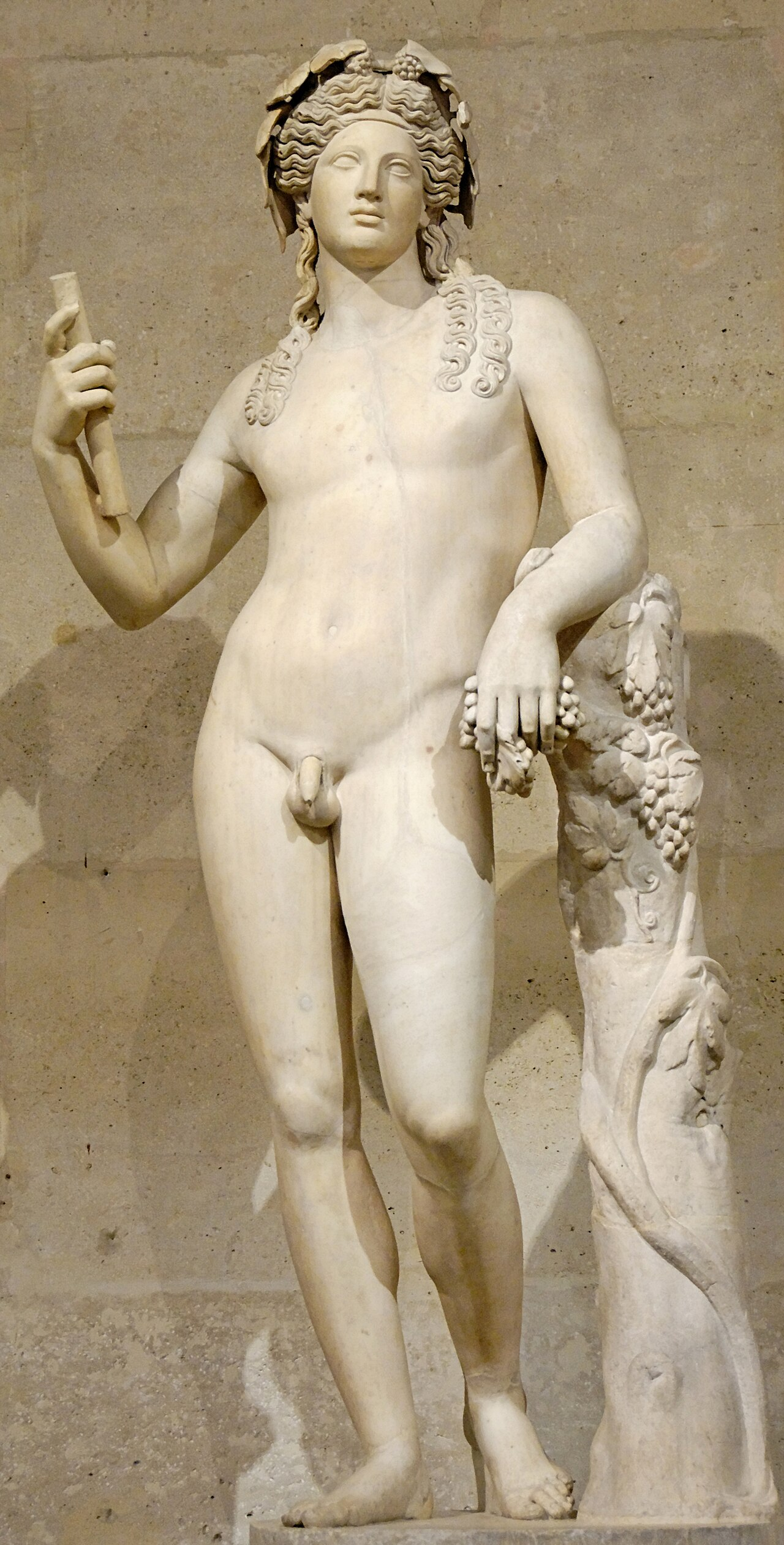
In the following video we will recreate Cleopatra’s face as well as the faces of some other Ptolemy kings mixed with some historical facts about that Hellenistic kingdom.
The Bizarre Lifestyle of Qianlong, China's Emperor
A man who keeps his word is a man of honor, which is well illustrated by none other than the longest-reigning Emperor, Qianlong. He made a vow not to rule for more than his grandfather's reign, which was 61 years, and in his 60th year, he abdicated the throne to his son Jiaqing.
A Secret Tunnel Found in Mexico May Finally Solve the Mysteries of Teotihuacán
In the fall of 2003, a heavy rainstorm swept through the ruins of Teotihuacán, the pyramid-studded, pre-Aztec metropolis 30 miles northeast of present-day Mexico City. Dig sites sloshed over with water; a torrent of mud and debris coursed past rows of souvenir stands at the main entrance. The grounds of the city’s central courtyard buckled and broke. One morning, Sergio Gómez, an archaeologist with Mexico’s National Institute of Anthropology and History, arrived at work to find a nearly three-foot-wide sinkhole had opened at the foot of a large pyramid known as the Temple of the Plumed Serpent, in Teotihuacán’s southeast quadrant.

“My first thought was, ‘What exactly am I looking at?’” Gómez told me recently. “The second was, ‘How exactly are we going to fix this?’”
Gómez is wiry and small, with pronounced cheekbones, nicotine-stained fingers and a helmet of dense black hair that adds a couple of inches to his height. He has spent the past three decades—almost all of his professional career—working in and around Teotihuacán, which once, long ago, served as a cosmopolitan center of the Mesoamerican world. He is fond of saying that there are few living humans who know the place as intimately as he does.
And as far as he was concerned, there wasn’t anything beneath the Temple of the Plumed Serpent beyond dirt, fossils and rock. Gómez fetched a flashlight from his truck and aimed it into the sinkhole. Nothing: only darkness. So he tied a line of heavy rope around his waist and, with several colleagues holding onto the other end, he descended into the murk.
Gómez came to rest in the middle of what appeared to be a man-made tunnel. “I could make out some of the ceiling,” he told me, “but the tunnel itself was blocked in both directions by these immense stones.”

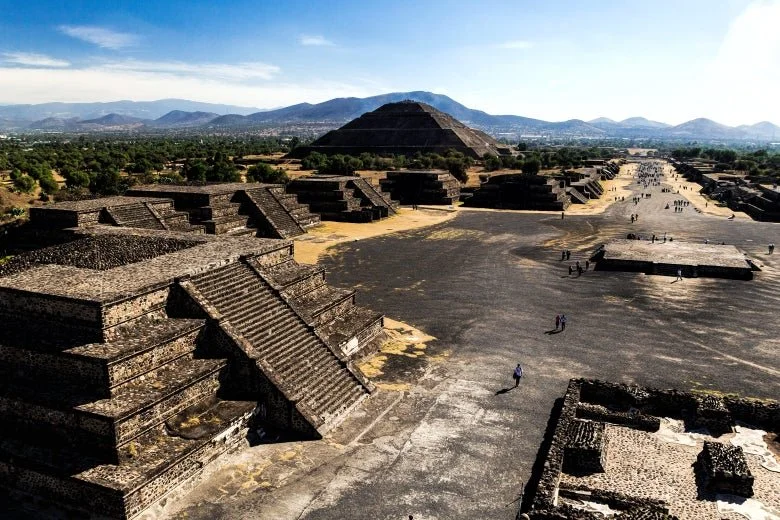
In designing Teotihuacán (pronounced tay-oh-tee-wah-KAHN), the city’s architects had arranged the major monuments on a north-south axis, with the so-called “Avenue of the Dead” linking the largest structure, the Temple of the Sun, with the Ciudadela, the southeasterly courtyard that housed the Temple of the Plumed Serpent. Gómez knew that archaeologists had previously discovered a narrow tunnel underneath the Temple of the Sun. He theorized that he was now looking at a kind of mirror tunnel, leading to a subterranean chamber beneath the Temple of the Plumed Serpent. If he was correct, it would be a find of stunning proportions—the type of achievement that can make a career.
“The problem was,” he told me, “you can’t just dive in and start tearing up earth. You have to have a clear hypothesis, and you have to get approval.”
Gómez set about making his plans. He erected a tent over the sinkhole, to keep it away from the prying eyes of the hundreds of thousands of tourists who visit Teotihuacán each year, and with the help of the National Institute of Anthropology and History arranged for the delivery of a lawnmower-size, high-resolution, ground-penetrating radar device. Beginning in the early months of 2004, he and a handpicked team of some 20 archaeologists and workers scanned the earth under the Ciudadela, returning every afternoon to upload the results to Gómez’s computers. By 2005, the digital map was complete.
As Gómez had suspected, the tunnel ran approximately 330 feet from the Ciudadela to the center of the Temple of the Plumed Serpent. The hole that had appeared during the 2003 storms was not the actual entrance; that lay a few yards back, and it had apparently been intentionally sealed with large boulders nearly 2,000 years ago. Whatever was inside that tunnel, Gómez thought to himself, was meant to stay hidden forever.

Teotihuacán has long stood as the greatest of Mesoamerican mysteries: the site of a colossal and influential culture about which frustratingly little is understood, from the conditions of its rise to the circumstances of its collapse to its actual name. Teotihuacán translates as “the place where men become gods” in Nahuatl, the language of the Aztecs, who likely found the ruins of the deserted city sometime in the 1300s, centuries after its abandonment, and concluded that a powerful ur-culture—an ancestor of theirs—must have once resided in its vast temples.
The city lies in a basin at the southernmost edge of the Mexican Plateau, an undulating landmass that forms the spine of modern-day Mexico. Inside the basin the climate is mild, the land riven by streams and rivers—ideal conditions for farming and raising livestock.
Teotihuacán itself was likely settled as early as 400 B.C., but it was only around A.D. 100, an era of robust population growth and increased urbanization in Mesoamerica, that the metropolis as we know it, with its wide boulevards and monumental pyramids, was built. Some historians have theorized that its founders were refugees driven north by the eruption of a volcano. Others have speculated that they were Totonacs, a tribe from the east.
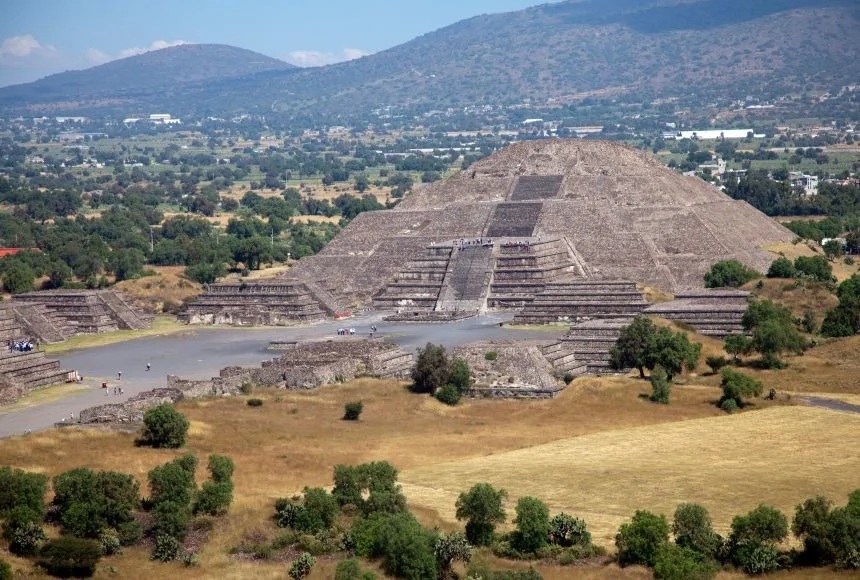
Whatever the case, the Teotihuacanos, as they are now known, proved themselves to be skilled urban planners. They built stone-sided canals to reroute the San Juan River directly under the Avenue of the Dead, and set about constructing the pyramids that would form the city’s core: the Temple of the Plumed Serpent, the even larger 147-foot-tall Temple of the Moon and the bulky, sky-obscuring 213-foot-tall Temple of the Sun.

Clemency Coggins, a professor emerita of archaeology and art history at Boston University, has suggested that the city was designed as a physical manifestation of its founders’ creation myth. “Not only was Teotihuacán laid out in a measured rectangular grid, but the pattern was oriented to the movement of the sun, which was born there,” Coggins has written. She is far from the only historian to see the city as large-scale metaphor. Michael Coe, an archaeologist at Yale, argued in the 1980s that individual structures might be representations of the emergence of humankind out of a vast and tumultuous sea. (As is in Genesis, Mesoamericans of the time are thought to have envisioned the world as being born from complete darkness, in this case aqueous.) Consider the Temple of the Plumed Serpent, Coe suggested—the same temple that hid Sergio Gómez’s tunnel. The structure’s facade was splashed with what Coggins called “marine motifs”: shells and what appear to be waves. Coe wrote that the temple represents the “initial creation of the universe from a watery void.”
Recent evidence suggests that the religion practiced in these pyramids bore a resemblance to the religion practiced in the contemporaneous Mayan cities of Tikal and El Mirador, hundreds of miles to the southeast: the worshiping of the sun and moon and stars; the veneration of a Quetzalcoatl-like plumed serpent; the frequent occurrence, in painting and sculpture, of a jaguar that doubles as deity and protector of men.
Yet peaceful ritual was apparently not always enough to sustain the Teotihuacanos’ connection to their gods. In 2004, Saburo Sugiyama, an anthropologist from the University of Japan and Arizona State University, who has spent decades studying Teotihuacán, and Rubén Cabrera, of Mexico’s National Institute of Anthropology and History, located a vault under the Temple of the Moon that held the remains of an array of wild animals, including jungle cats and eagles, along with 12 human corpses, ten missing their heads. “It is hard to believe that the ritual consisted of clean symbolic performances,” Sugiyama said at the time. “It is most likely that the ceremony created a horrible scene of bloodshed with sacrificed people and animals.”

Between A.D. 150 and 300, Teotihuacán grew rapidly. Locals harvested beans, avocados, peppers and squash on fields raised in the middle of shallow lakes and swampland—a technique known as chinampa—and kept chickens and turkeys. Several heavily trafficked trade routes were established, linking Teotihuacán to obsidian quarries in Pachuca and cacao groves near the Gulf of Mexico. Cotton came in from the Pacific Coast, ceramics from Veracruz.
By A.D. 400, Teotihuacán had become the most powerful and influential city in the region. Residential neighborhoods sprang up in concentric circles around the city center, eventually comprising thousands of individual family dwellings, not dissimilar to single-story apartments, that together may have housed 200,000 people.
Recent fieldwork by scholars like David Carballo, of Boston University, has revealed the sheer diversity of the citizenry of Teotihuacán: Judging by artifacts and paintings found inside surviving structures, residents came to Teotihuacán from as far afield as Chiapas and the Yucatán. There were likely Mayan neighborhoods, and Zapotec ones. As the scholar Miguel Angel Torres, an official at Mexico’s National Institute for Anthropology and History, told me recently, Teotihuacán was probably one of the first major melting pots in the Western Hemisphere. “I believe that the city grew a little like modern Manhattan,” Torres says. “You walk around through these different neighborhoods: Spanish Harlem, Chinatown, Koreatown. But together, the city functions as one, in harmony.”

The harmony did not last. There is a hint, in the demolition of some of the sculptures that adorn the temples and monuments, of periodic regime change in the ruling class of Teotihuacán; and, in the depiction of shield- and spear-toting warriors, of clashes with other local city-states. Perhaps, as several archaeologists suggested to me, civil war swept through Teotihuacán, culminating in a fire that seems to have damaged vast sections of the interior of the city around A.D. 550. Perhaps the fire was caused by a visiting army. Perhaps a large-scale migration occurred.
In A.D. 750, nearly 700 years after it was established, the city of Teotihuacán was abandoned, its monuments still filled with treasures and artifacts and bones, its buildings left to be eaten by the surrounding brush. The former residents of Teotihuacán, if they were not killed, were presumably absorbed into the populations of neighboring cultures, or returned along the established trade routes to the lands where their ancestral kin still lived throughout the Mesoamerican world.
They took their secrets with them. Today, even after more than a century of excavation at the site, there is an extraordinary amount we do not know about the Teotihuacanos. They did have some kind of quasi-hieroglyphic written language, but we haven’t cracked it; we don’t know what tongue was spoken inside the city, or even what the natives called the place. We have a conception of the religion they practiced, but we don’t know much about the priestly class, or the relative piety of the city’s citizenry, or the makeup of the courts or the military. We don’t know exactly what led to the city’s founding, or who ruled over it during its half-millennium of dominance, or what exactly caused its fall. As Matthew Robb, the curator of Mesoamerican art at San Francisco’s de Young Museum, told me, “This city wasn’t designed to answer our questions.”
In archaeology and anthropology circles—to say nothing of the popular press—Sergio Gómez’s discovery was greeted as a major turning point in Teotihuacán studies. The tunnel under the Temple of the Sun had been largely emptied by looters before archaeologists could get to it in the 1990s. But Gómez’s tunnel had been sealed off for some 1,800 years: Its treasures would be pristine.
In 2009, the government granted Gómez permission to dig, and he broke ground at the entrance of the tunnel, where he installed a staircase and ladders that would allow easy access to the subterranean site. He moved at a painstaking pace: inches at a time, a few feet every month. Excavating was done manually, with spades. Nearly 1,000 tons of earth were removed from the tunnel; after each new segment was cleared, Gómez brought in a 3-D scanner to document his progress.

The haul was tremendous. There were seashells, cat bones, pottery. There were fragments of human skin. There were elaborate necklaces. There were rings and wood and figurines. Everything was deposited deliberately and pointedly, as if in offering. The picture was coming into focus for Gómez: This was not a place where ordinary residents could tread.
A university in Mexico City donated a pair of robots, Tlaloque and Tláloc II, playfully named for Aztec rain deities whose images appear in early iterations throughout Teotihuacán, to inspect deeper inside the tunnel, including the final stretch, which descended, on a ramp, an extra ten feet into the earth. Like mechanical moles, the robots chewed through the soil, their camera lights aglow, and returned with hard drives full of spectacular footage: The tunnel seemed to end in a spacious cross-shaped chamber, piled high with more jewelry and several statues.
It was here, Gómez hoped, that he’d make his biggest find yet.
I met Gómez late last year, on a smoldering afternoon. He was smoking a cigarette and drinking coffee out of a foam cup. Tides of tourists swept to and fro over the grass of the Ciudadela—I heard scraps of Italian, Russian, French. An Asian couple stopped to peer in at Gómez and his team as if they were tigers at a zoo. Gómez looked back stonily, the cigarette hanging off his bottom lip.

Gómez told me about the work his team was doing to study the 75,000 or so artifacts they had already found, each of which needed to be carefully cataloged, analyzed and, when possible, restored. “I would estimate that we’re only about 10 percent through the process,” he said.
The restoration operation is set up in a cluster of buildings not far from the Ciudadela. In one room, a young man was sketching artifacts and noting where in the tunnel the objects had been found. Next door, a handful of conservators sat at a banquet-style table, bent over an array of pottery. The air smelled sharply of acetone and alcohol, a mixture used to remove contaminants from the artifacts.
“It might take you months just to finish a single large piece,” Vania García, a technician from Mexico City, told me. She was using a syringe primed with acetone to clean a particularly tiny crack. “But some of the other objects are remarkably well preserved: They were buried carefully.” She recalled that not long ago, she found a powdery yellow substance at the bottom of a jar. It was corn, it turned out—1,800-year-old corn.

Passing through a lab where wood recovered from the tunnel was being carefully treated in chemical baths, we stepped into the storeroom. “This is where we keep the fully restored artifacts,” Gómez said. There was a statue of a coiled jaguar, poised to pounce, and a collection of flawless obsidian knives. The material for the weapons had probably been brought in from the Pachuca region of Mexico and carved in Teotihuacán by master craftspeople. Gómez held out a knife for me to hold; it was marvelously light. “What a society, no?” he exclaimed. “That could create something as beautiful and powerful as that.”
In the canvas tent erected over the entrance to the tunnel, Gómez’s team had installed a ladder that led down into the earth—a wobbly thing fastened to the top platform with frayed twine. I descended carefully, foot over foot, the brim of my hard hat slipping over my eyes. In the tunnel it was damp and cold, like a grave. To get anywhere, you had to walk on your haunches, turning to the side when the passage narrowed. As protection against cave-ins, Gómez’s workmen had installed several dozen feet of scaffolding—the earth here is unstable, and earthquakes are common. So far, there had been two partial collapses; no one had been hurt. Still, it was hard not to feel a shiver of taphophobia.
Through the middle of Teotihuacán studies runs a division like a fault line, separating those who believe that the city was ruled by an all-powerful and violent king and those who argue that it was governed by a council of elite families or otherwise bound groups, vying over time for relative influence, arising from the cosmopolitan nature of the city itself. The first camp, which includes experts like Saburo Sugiyama, has precedent on its side—the Maya, for instance, are famous for their warlike kings—but unlike Mayan cities, where rulers had their visages festooned on buildings and where they were buried in opulent tombs, Teotihuacán has offered up no such decorations, nor tombs.
Initially, much of the buzz surrounding the tunnel beneath the Temple of the Plumed Serpent centered on the possibility that Gómez and his colleagues might finally locate one such tomb, and thereby solve one of the city’s most fundamental enduring mysteries. Gómez himself has entertained the idea. But as we clambered through the tunnel, he laid out a hypothesis that seemed to stem more directly from the mythological readings of the city laid out by scholars like Clemency Coggins and Michael Coe.
Fifty feet in, we stopped at a small inlet carved into the wall. Not long before, Gómez and his colleagues had discovered traces of mercury in the tunnel, which Gómez believed served as symbolic representations of water, as well as the mineral pyrite, which was embedded in the rock by hand. In semi-darkness, Gómez explained, the shards of pyrite emit a throbbing, metallic glow. To demonstrate, he unscrewed the nearest light bulb. The pyrite came to life, like a distant galaxy. It was possible, in that moment, to imagine what the tunnel’s designers might have felt more than a thousand years ago: 40 feet underground, they’d replicated the experience of standing amid the stars.
If, Gómez suggested, it was true that the layout of the city proper was meant to stand in for the universe and its creation, might the tunnel, beneath the temple devoted to an all-encompassing aqueous past, represent a world outside of time, an underworld or a world before, not the world of the living but of the dead? Up above, there was the Temple of the Sun and the eternal day. Down below, the stars—not of this earth—and the deepest night.
I followed Gómez down a short ramp and into the cross-shaped chamber directly under the heart of the Temple of the Plumed Serpent. Four archaeologists were kneeling in the dirt, brushes and thin-bladed trowels in hand. A nearby boombox blared Lady Gaga.
Gómez told me he had not been prepared for the sheer diversity of the objects he encountered in the farthermost reaches of the tunnel: necklaces, with the string intact. Boxes of beetle wings. Jaguar bones. Balls of amber. And perhaps most intriguingly, a pair of finely carved black stone statues, each facing the wall opposite to the entryway of the chamber.
Writing in the late 1990s, Coggins speculated that religious tradition at Teotihuacán would have been “perpetuated in the linked repetition of ritual,” likely on the part of a priesthood. That ritual, Coggins went on, “would have concerned the Creation, Teotihuacán’s role in it, and probably also the birth/emergence of the Teotihuacán people from a cave”—a deep and dark hole in the earth.
Gómez gestured at the area where the twin figures once stood. “You can imagine a scenario where priests come down here to pay tribute to them,” he explained—to the Creators of the universe, and of the city, one and the same.
Gómez has one more crucial task to undertake: the excavation of three distinct, buried sub-chambers located below the resting place of the figurines, the final sections of the tunnel complex as yet unexplored. Some scholars speculate that the elaborate ritual offerings on display here, and the presence of pyrite and mercury, which held known associations with the supernatural among ancient Mesoamericans, provide further evidence that the buried sub-chambers represent the entryway to a particular type of underworld: the place where the city’s ruler departed the world of the living. Others argue that even the discovery of long-sought human remains buried in spectacular fashion would hardly close the book on the mystery of Teotihuacán’s rulers: Whoever is buried here could be just one ruler among many, perhaps even some other kind of holy person.
For Gómez, the sub-chambers, whether they are filled with more ritual relics, or remains, or something entirely unexpected, might be best understood as a symbolic “tomb”: a final resting place for the city’s founders, of gods and men.
A few months after leaving Mexico, I checked in with Gómez. He was only marginally closer to uncovering the chambers beneath the end of the tunnel. His archaeologists were literally often working with toothbrushes, so as not to damage whatever lay beneath.
Regardless of what he found at the end of the tunnel, once his excavation was complete, he promised me, he’d be satisfied. “The number of artifacts we’ve uncovered,” he said, pausing. “You could spend a whole career evaluating the contents.”
Fossil prep: suspected 19-million-year-old fossil in a very soft matrix
In the video below we are prepping a fossil that was hiding in concretion. It was such a soft matrix that we could use a combination of a small screwdriver and a wooden toothpick to remove the siltstone to expose the crab.
The Top 5 Greatest Roman Generals of all Time
In the following video we will analyze the top 5 greatest Roman generals of all time. Watch the video to find out more!

Who Were The Pelasgians? (Pre-Historic People of Greece)
Unraveling the Enigma of Pre-Historic Greece
The ancient world, with its myriad cultures and mysterious pasts, has long captivated the imagination of historians and archaeologists alike. Among the many enigmatic groups that pepper the landscape of antiquity, few are as intriguing and elusive as the Pelasgians. Their story is woven into the very fabric of Greek history, emerging as a shadowy precursor to the luminous dawn of classical Greek civilization.
They are perceptible throughout a vast amount of time and space in the ancient Aegean world, but due to the passing of time and the subsequent dominance of Hellenic culture, they are still largely a mystery. Described variously by classical authors as the original inhabitants of Greece, their story is a tapestry of myth, legend, and fragmented historical accounts.
In exploring the Pelasgian enigma, one encounters a labyrinth of questions regarding their origins, language, and culture. Were they the first settlers of the Greek mainland, or a diverse group of indigenous people unified under a Greek nomenclature? Did they speak a language that was an antecedent to Greek or something entirely distinct? Theories abound, but answers are fleeting, like chasing shadows in the dim light of early dawn.
Origins and Identity
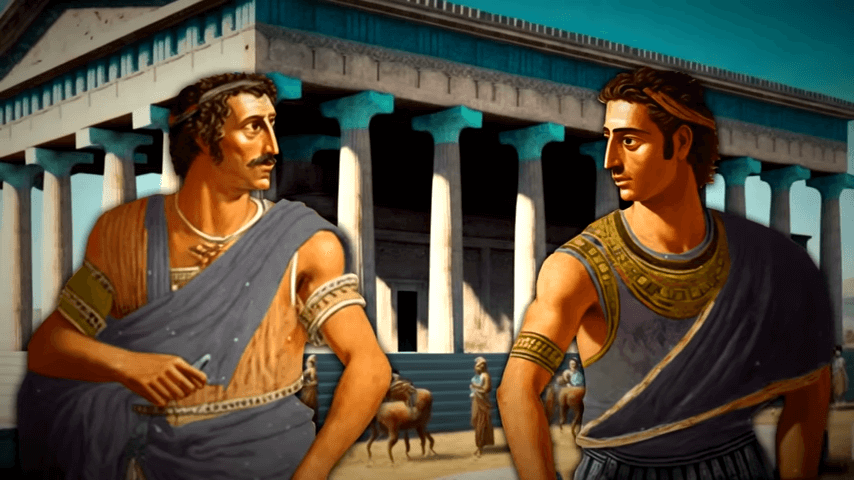
The term "Pelasgians" (Ancient Greek: Πελασγοί) primarily referred to the indigenous populations of Greece before the Hellenic era. According to historian Peter Green, this broad designation suggests a diverse and ancient group that predated and possibly influenced early Greek culture.
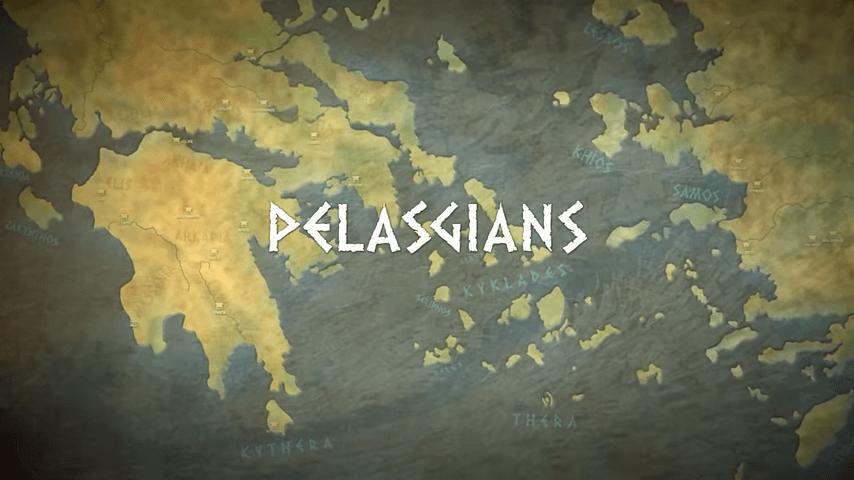
A lack of conclusive archaeological evidence and unambiguous historical records in antiquity obscures the origins and identity of the Pelasgians. They are often described as the autochthonous people of Greece, predating the arrival of Hellenic tribes. Ancient Greek writers variably portrayed them as ancestors or contemporaries of the early Greeks, possibly inhabiting regions across Greece, the Aegean islands, and parts of Anatolia.
The statements regarding the Pelasgians having lived in the Aegean region before the arrival of the Greeks are intriguing but not entirely supported by current scholarly consensus or scientific evidence. Addressing these assertions requires a careful examination of historical, archaeological, and linguistic evidence.
The consensus is that the Pelasgians were indeed a pre-Hellenic people inhabiting parts of Greece, the Aegean, and possibly other regions. However, the extent to which they were genetically related to the ancient Greeks, Thracians, and Illyrians is not definitively established. Genetic studies have advanced our understanding of ancient populations, but they do not yet provide conclusive evidence about the specific relationships between these groups.
Etymology and Mythology
The etymology of "Pelasgian" is shrouded in uncertainty. The Ancient Greeks linked the term to 'pelargos' (stork), suggesting a migratory origin. Another theory relates 'pelas' to 'near' or 'neighboring land'. Mythologically, the Pelasgians are often connected to the foundational myths of Greek culture. Pelasgus, a figure in Greek mythology, is sometimes considered their eponymous ancestor, often depicted as a primitive, earth-born king, reinforcing their image as the original inhabitants of the Greek lands.
A.J. Van Windekens, a prominent linguist and philologist, contributed significantly to the study of Indo-European languages and their etymology. In his exploration of the ethnonym "Pelasgos," Van Windekens proposed an intriguing etymology that diverges from more traditional interpretations.
According to Van Windekens, the name "Pelasgos" could be derived from an Indo-European root, which he posited as *bhelosgho-s. This root, in his interpretation, translates to "blooming branch" or something akin to it. This suggestion is perhaps quite poetic and symbolic, implying a connection to growth, fertility, or perhaps a flourishing civilization. On the other hand, this etymology may connect the Pelasgians with the Neolithic inhabitants of Greece. This is a fascinating topic that intertwines linguistic analysis with archaeological and historical evidence. Some scholars contend that the Pelasgians represent this pivotal period in Greek prehistory, which was characterized by significant agricultural advancements and the shift from nomadic to settled lifestyles. This hypothesis positions the Pelasgians as pivotal in the dawn of agriculture and settled civilization in ancient Greece, yet the lack of definitive evidence keeps their story enigmatic and largely interpretive.
Linguistic and Cultural Aspects
Linguistically, the Pelasgians are a conundrum. Greek sources described their language as 'barbarian', implying it was non-Greek, yet its specifics remain unknown. This has led to speculation that the Pelasgians spoke a pre-Indo-European language, or possibly a variety of languages reflecting their widespread geographical distribution. Culturally, they are thought to have influenced the developing Greek culture, with some Greek practices and deities possibly having Pelasgian origins. Their language remains a topic of extensive speculation, with various theories suggesting connections to Indo-European, Anatolian, or even non-Indo-European roots.
Regarding the influence of Anatolian languages on Greek, there is evidence of cultural and linguistic exchanges across the Aegean in the ancient world. However, the exact nature and extent of these influences, particularly regarding the development of Greek language and culture, are still subjects of ongoing research and debate.
Archaeological Evidence
Archaeological evidence regarding the Pelasgians is sparse and often indirect. Excavations in regions traditionally associated with them, like Lemnos, Thessaly, and Attica, have unearthed settlements and artifacts suggesting a Neolithic presence. However, unequivocally linking these findings to the Pelasgians is challenging, primarily due to the absence of inscriptions or distinct cultural markers that can be conclusively attributed to them.
Literary References
Literary references to the Pelasgians are found in the works of Homer, Herodotus, Thucydides, and other ancient authors. These accounts are often ambiguous and contradictory, sometimes describing the Pelasgians as barbaric, other times as Greeks. They are mentioned in various contexts, including their participation in the Trojan War and their widespread settlements across the Aegean region.
The paradox of the Pelasgians lies in their simultaneous omnipresence and obscurity in ancient Greek records. They are everywhere and nowhere, a people whose absence is just as important as their presence, according to Homer, Herodotus, and scholars throughout history. Their role in the formation of Greek identity, their linguistic contributions, and their cultural practices are subjects of ongoing academic debate and fascination.
DNA Evidence and the Pelasgian-Anatolian Connection in the Aegean Neolithic Tapestry
Finding Neolithic DNA in the Greek mainland, Crete, and Anatolia shows a link between the Pelasgians and people from Anatolia. This is an interesting mix of archaeogenetics, linguistics, and cultural history that sheds light on the complex web of ancient civilizations in the Aegean and Near Eastern areas.
The discovery of similar Neolithic DNA across regions inhabited by these ancient groups suggests a significant level of genetic continuity that spans across geographical boundaries. This genetic similarity indicates that the populations on the Helladic mainland, Crete, and Anatolia shared common ancestors during the Neolithic period, highlighting a deeper prehistoric connection that predates the emergence of distinct cultural and linguistic identities known from later historical periods.
Turning to Colin Renfrew's Anatolian hypothesis, it postulates that Anatolia was the place where Indo-European languages first spread during the Neolithic era. This theory aligns with the genetic evidence of shared ancestries, suggesting that as Neolithic farmers from Anatolia migrated into Europe, they brought with them the proto-Indo-European language, which would later diversify into various language families, including Greek. If the Pelasgians were indeed part of this widespread Neolithic population, as suggested by the genetic evidence, it could imply that they were either speakers of a proto-Indo-European language or were influenced by the linguistic changes brought about by these migrations.
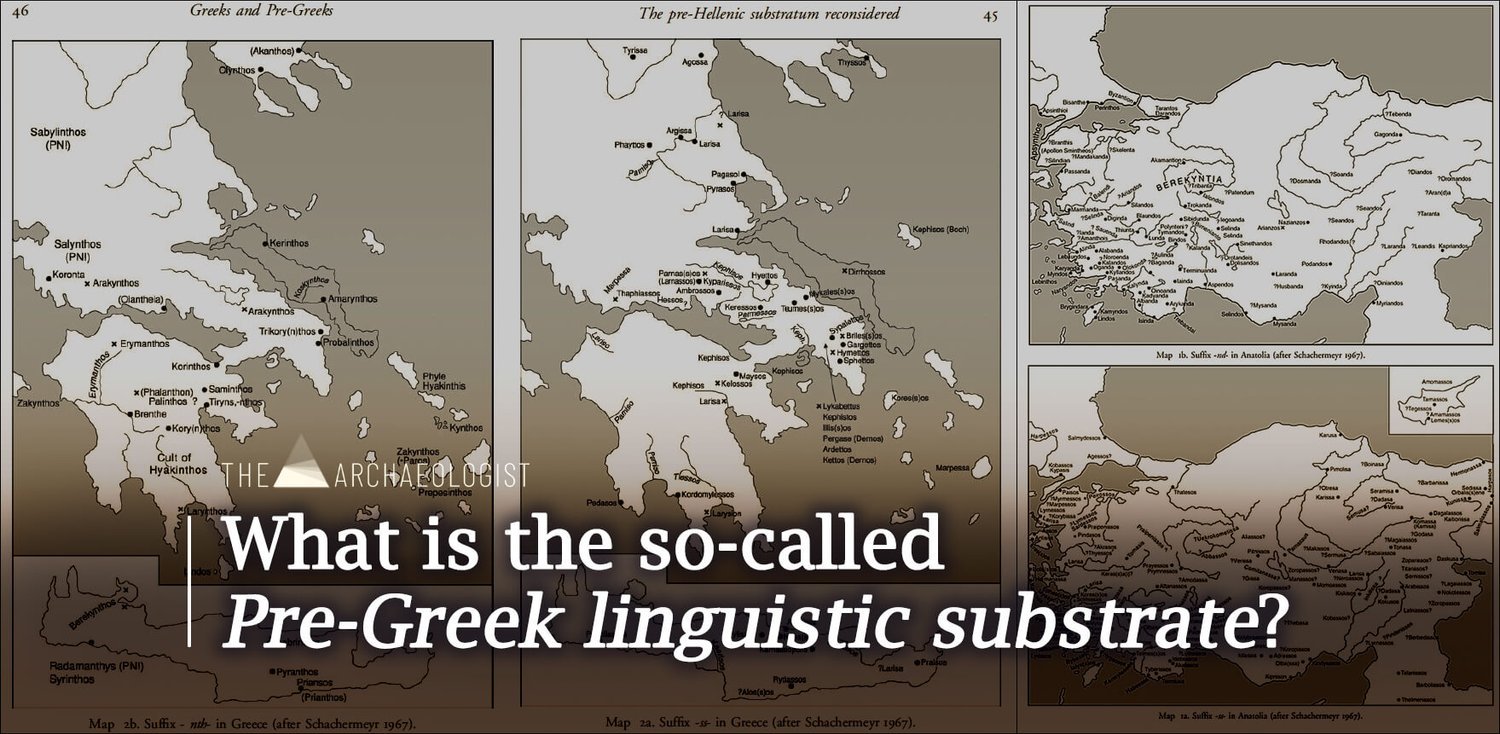
Furthermore, the concept of a pre-Greek linguistic substrate refers to the influence of non-Greek, possibly indigenous, languages on the Greek language as it developed. The presence of non-Indo-European or proto-Indo-European elements in Greek, some of which might be traced back to the Pelasgian language (if it indeed was distinct from Greek), could be a remnant of these early linguistic interactions. This substrate could potentially be linked to the languages spoken in Anatolia, reflecting a complex web of cultural and linguistic exchanges over millennia.
Neolithic DNA evidence shows that the Pelasgians and Anatolian people had genetic, cultural, and linguistic links. These links suggest that these ancient groups were connected and interacted with each other. The Anatolian hypothesis and the idea of a pre-Greek linguistic substrate make for a strong framework for understanding these connections. They suggest that the roots of ancient Greek civilization and Indo-European languages may be much more connected to their Neolithic ancestors in Anatolia than was previously thought. These findings not only challenge our understanding of ancient ethnic and linguistic identities but also highlight the fluid and interconnected nature of human societies in the ancient world.
Theories and Speculations
The lack of concrete information has led to various theories and speculations about the Pelasgians. These range from considering them the bearers of a pre-Greek, possibly Anatolian or Thracian culture, to theories proposing them as a branch of the wider Indo-European family. Some modern scholars view them as a cultural and linguistic conglomerate, representing the diverse ethnic and linguistic landscape of the pre-Hellenic Aegean and Balkan regions.
In conclusion, the Pelasgians, as elusive as they are intriguing, represent a pivotal piece in the puzzle of ancient Mediterranean civilizations. Their study offers a fascinating glimpse into the complexities of cultural identity, linguistic evolution, and historical interpretation in one of the most historically significant regions of the ancient world.
Galatia - The Celts of Anatolia
The celts are a group of people that are usually linked with western Europe. However, how and why did the Celts end up in Anatolia? Watch the video for more!
Beautiful ancient artwork found under 2,000-year-old volcanic ash
In 2018, archaeologists made an astonishing discovery in the ancient city of Pompeii. A remarkable work of art was unearthed, shedding new light on the rich history and culture of this fascinating archaeological site.

A worker carefully brushed away 2000-year-old volcanic ash to reveal a fresco, or watercolor wall painting. It depicts the myth of Leda and the Swan.
In the story, the God Jupiter takes the form of a swan and impregnates a mortal woman, named Leda.
The scene has been depicted in various ways throughout the centuries.

According to the lead archaeologist at Pompeii, scenes of Leda and the Swan were fairly common in the city's houses.
This particular depiction stands out because, "Leda watches the spectator with a sensuality that's absolutely pronounced."

After being hidden for nearly two millennia, it's a scene that can appreciated again.
The city of Pompeii was destroyed in A.D. 79 when Mt. Vesuvius had a catastrophic volcanic eruption.
Archaeological work at Pompeii has been going on for centuries — but a recent renewed push has revealed several fascinating finds, including skeletons and pottery.


The Story of Hannibal: The Nightmare of the Roman Empire
For nearly two decades, Hannibal fought the Romans. He invaded Italy and forced Rome to battle for its very survival. Every army sent against him perished, with Hannibal employing a set of stratagems and tactics to outmaneuver and defeat his superior foe.
In the video below we will explore the story of Hannibal, who is considered to be the nightmare of the Roman Empire. Enjoy!
The History of Thailand Explained in 5 minutes
Throughout their history, Thais have been known for their ability to absorb foreign impacts and translate them into something uniquely Thai. The culture, customs, and cuisine of modern Thailand represent a happy synthesis of many influences remaining at the same time faithful the core Thai values.
In the following less than 5 minutes long video we will be explaining the history of Thailand. Enjoy!
The rise and fall of Italy’s warriors-for-hire
Dig into the history of the elite mercenaries known as condottieri, who were soldiers for hire for Italy's rich and powerful.
During the 14th and 15th centuries, mercenaries known as condottieri dominated Italian warfare, profiting from— and encouraging— the region’s intense political rivalries. As rulers competed for power and prestige, their disputes often played out in military conflicts, fought almost entirely by the condottieri. So who were these elite and conniving warriors? Stephanie Honchell Smith investigates.
The Khan Who Drank From The Skull of a Byzantine Emperor
The incredible true story of the Bulgar Khan Krum the fearsome, who defeated his enemy the Byzantine emperor Nikephoros I at Pliska in 811 AD, and made a wine chalice from his fallen foes skull. Watch the video for more!
In Granada, Spain, a new Muslim Andalusian cemetery was found
In Granada, a significant city in the Andalusia area of southern Spain, excavations carried out as part of a building's repair uncovered a centuries-old Muslim graveyard.

An archeologist works on human remains, presumably belonging to Muslims Cemetery from the Andalusian Islamic era (711-1492) found during an excavation in Granada, Spain on September 16, 2023.
The almost 700-year Andalusian Islamic dominion, which was eradicated during the reign of the Catholic Monarchs that followed, left behind traces that are currently being sought in and around Granada, the former capital of an emirate that ruled between the 13th and the 15th centuries and was the last known Muslim state in the Iberian Peninsula.
One of the eight Muslim cemeteries in the city was discovered during excavations on the property of a building in the ancient city center of Granada, in the region known as "Bab al-Fukhareen," or Potters' Quarter, according to archaeologist Amjad Suliman, who is researching the Andalusian Islamic civilization.
Suliman stated that two further cemeteries had also been discovered and that a total of roughly 150 Muslims were believed to be interred in the constrained space, adding that they had so far discovered the bones of more than 40 Muslims in the Potters' cemetery.
"Granada was the last place of refuge for Muslims in Andalusia, and the density of burials in the ancient graves unearthed here shows us how high the number of Muslims living at that time was," Suliman explained.
Suliman claimed they discovered three underground layers of graves and numerous pieces of pottery with Arabic inscriptions similar to those found in the Alhambra Palace, which was constructed in the middle of the 13th century in Granada. He also said they were able to determine the human remains belonged to Muslims by examining the manner in which they were buried and the objects around them.
Suliman said that Andalusia has required consulting archaeologists for construction and restoration projects since 1995.
"In the past, human remains found during construction works were either buried again in the ground and built on top of them, or thrown away. Especially in the last 20 years, these works have become much more organized ... done in a controlled manner."
"In the excavations carried out so far, when we count only the documented ones, the remains of more than 10,000 Muslims have been unearthed," he added.
Once their anthropological research is finished, the bones that have been excavated from floors of buildings or from pieces of land are interred in the region's present Muslim cemeteries.
Focus is brought on 8000 years of history revealed by the Tarradale Through Time Black Isle archaeology project
The most recent Cromarty History Society discussion was focused on the work of a trailblazing Black Isle archaeology project that involved the larger community and produced some exciting discoveries.

Tarradale Through Time excavating a Bronze Age landscape.
The Cromarty History Society's new season was inaugurated by Eric Grant's talk. He has been researching the potential for archaeology at the western end of the Black Isle, around Tarradale and Muir of Ord, since he moved to Ross-hire about 20 years ago.
His presentation painted a brief picture of how the region's archaeological legacy was discovered through six community digs, which revolutionized knowledge of the archaeology of the Black Isle and beyond.
Many members of the community participated in the Tarradale Through Time project and got to see how archaeology is conducted, from walking through fields that have been ploughed to find artifacts from ancient times to digging test pits and excavations that turn up unexpected findings and then interpreting the results.

Part of an antler harpoon found in an excavated shell midden.
Eric gave an example of how the project purposefully encompassed 8000 years of history and archaeology, beginning in the Neolithic with the entrance of the first farmers and continuing through the Bronze, Iron, Pictish, Medieval, and Post-Medieval abandoned communities. Good soil and relatively level terrain have historically made Tarradale an agricultural region, with rougher and less farmed country rising to the north.
This has affected how it was settled, how it was used, and what kinds of archaeological evidence were discovered. Axes, flints, arrowheads, pottery, stones, and shell middens are the principal "hard" objects that archaeology discovers that have survived. Since the soil at Tarradale is acidic, all traces of bones will be lost.

Tarradale landscape.
Eric's presentation was illustrated by aerial photos of crop markings, archaeology-related features, plans for rebuilding, and images of artifacts. There was a wealth of knowledge to absorb, and I also realized how mysterious some locations may be, leaving interpretation always up for debate. The area's continued habitation and land use are both obvious. Locals have been acknowledged with becoming more enthusiastic and interested thanks to the community effort.
Eric still has additional plans to carry out even though it is over. "We feel sure that we will be inviting him back again for further updates," a CHS spokeswoman said.
The next gathering will take place on Tuesday, October 17. Professor David Worthington will be the speaker. He will present a fresh interpretation of the Highlands before to Culloden based on the writings of Rev. James Fraser (1634-1709). The presentation will take place at the Victoria Hall in Cromarty and will begin at 7.30 p.m. Everyone is welcome.
Ancient emperor's tomb discovered in China's Shaanxi
According to the Shaanxi Academy of Archaeology on Tuesday 19th of September, archaeologists in northwest China's Shaanxi Province have unearthed the tomb of the Northern Zhou Dynasty's founder monarch (557–581) in the city of Xianyang.

This undated file photo shows a relic unearthed at the tomb of Yuwen Jue, the founding emperor of the Northern Zhou Dynasty (557-581), in Beihe Village, Weicheng District of Xianyang, northwest China's Shaanxi Province. Archaeologists in northwest China's Shaanxi Province have discovered the tomb of the founding emperor of the Northern Zhou Dynasty (557-581) in the city of Xianyang, according to the Shaanxi Academy of Archaeology on Tuesday.(Shaanxi Academy of Archaeology/Handout via Xinhua)
Yuwen Jue was the name of the emperor. In Weicheng District, Xianyang's Beihe Village is home to his grave. High-quality tombs from the Northern Dynasties (439–581) to the Sui and Tang dynasties (581–907) are found in this area.
The single-chamber earth cave tomb has four patios in the sloped tomb corridor and is facing south. The tomb's length from north to south is 56.84 meters, and its bottom is 10 meters below the present ground level. The tomb is a medium-sized example of Northern Zhou architecture.
Archaeologists have discovered 146 burial objects—mostly porcelain figurines—from the once-plunder of the tomb.
Archaeologists have established that the owner of the tomb was the emperor Yuwen Jue (542–557) based on the epitaph on the eastern side of the tomb's entrance.
According to Zhao Zhanrui, an assistant researcher at the school, the tomb's finding is extremely significant for historical studies on Northern Dynasty emperors.
Mexican physicians assert that the mummified "alien corpses" are made up of individual skeletons and were not put together
According to Mexican physicians, the two reported "non-human" alien corpses each belonged to a single skeleton and were not assembled.

'Alien corpses' shown to politicians
After academics, scientists, and archaeologists said the remains were a fraud, the doctors conducted a number of scientific tests on them.
Professor Brian Cox, a physicist and television host, was one of several who criticized them, saying they were "way too humanoid" to be real.
In a hearing that sparked excitement among UFO enthusiasts, the mummified specimens were on display in glass cases as part of an official reveal last week in Mexico's Congress.

Politicians were informed that the remains were thought to be 1,000 years old and had been discovered in Cusco, Peru.
Jaime Maussan, a journalist and UFO researcher, organized the event in Mexico City. According to Mexican media, he testified under oath that the specimens' about one-third of their DNA is "unknown" and that they are not products of "our terrestrial evolution."
"These specimens are not part of our evolutionary history on Earth," he said in his presentation to Mexican government officials and representatives from the US.
"They are not beings recovered from a UFO crash. Instead, they were found in diatom (algae) mines and subsequently became fossilised."

Mexican doctors have carried out tests on the remains
Prof. Cox has advocated sending a sample to the biotechnology firm 23andme for impartial confirmation that the samples aren't extraterrestrial.
"It's very unlikely that an intelligent species that evolved on another planet would look like us," he said last week.
Mr. Maussan has made claims of having discovered extraterrestrial life before.
He asserted in 2015 that a mummified body discovered in Peru's Nazca region belonged to an alien, but it was ultimately determined to be the remains of a human infant.
The mummified remains that UFO enthusiasts allege are aliens are typically modified human bodies, according to academics, archaeologists, and scientists.

They claim that the remainder, especially the smaller ones like those displayed in Mexico last week, are bodies put together from the bones of both animals and people.
The examinations performed on Monday by Mexican medical professionals, however, imply that they were not built but rather were taken from a single skeleton.

Speaking to the delegation from Mexico City about his supposed discovery from last week, Mr. Maussan said that the specimens had previously undergone examination at the Autonomous National University of Mexico.
He claimed that one had "eggs" within, as revealed by X-rays, and that experts had used radiocarbon dating to acquire DNA proof.
Politicians in Mexico said last week that they will "continue talking about this" because the material had given them "thoughts" and "concerns."
A Romanian woman attempted to take marbles from the site of the Acropolis
On Tuesday morning (19/9), a 36-year-old Romanian lady who was visiting the Acropolis archeological site attempted to steal some marbles. According Greek sources, the traveler chose to bring home two marbles as a "memory" after being inspired by the Acropolis.

However, a 42-year-old lady who was also present during the incident spotted her and called the police. After a short while, patrol division officers noticed the 36-year-old lady, who was then detained for aggravated theft.
A possible Viking-era horse bridle is discovered by melting ice near Norway's highest mountain
Archaeologists have discovered evidence of horse movement close to a mountain pass, not far from Galdhpiggen, the highest mountain in Norway.

The fact that both the bit and the leather straps that have been fastened to the horse's head are preserved makes it possible to determine how old the bridle is. (Photo: Espen Finstad / Secrets of The Ice / Innlandet County Municipality)
From beneath the ice, a metal bit and some of the leather straps that secure around the horse's head have been seen.
“The bridle has a shape that suggests it could be from the Viking Age,” Espen Finstad says to sciencenorway.no.
He works for the Innlandet County Municipality as a glacial archaeologist.
During the Viking Age, traffic through a mountain pass on Lomseggen was at its busiest.
Numerous ancient artifacts have already been discovered in the area as a result of snow and ice melting. The usage of this mountain route by Norwegians for more than 1,200 years has been made known (link in Norwegian).
However, the bridle discovered by archaeologists this year implies that other animals also walked here.
The journey, which took place over 2,000 meters above sea level, also involved horses.

The recent expedition took place on a smaller snow patch south of Lendbreen. (Photo: Espen Finstad / Secrets of The Ice / Innlandet County Municipality)
“We have never made such a discovery before. It essentially completes the picture that this is an ancient travel route,” Finstad says.
According to the archaeologists who work on the Secrets of the Ice conservation program's social media posts about the discovery,
We just made an incredibly discovery on the south side of the Lendbreen pass: An iron horse bit, with parts of the leather bridle preserved!❤️ It could well be from the Viking Age, when traffic through the pass was at its peak. But let's see what the radiocarbon date says. pic.twitter.com/cIRNXsZD9Y
— Secrets Of The Ice (@brearkeologi) September 7, 2023
A few months before they learn the solution
The archaeologists are particularly intrigued by the strap, or halter, that is fastened to the bit.
The horse bridle can actually be dated thanks to this.
The archaeologists will use carbon-14 dating to determine whether the find indeed dates to the Viking Age.
The definitive answer will likely take a few months, but Finstad is confident that it dates to the Iron Age or the early Middle Ages.

The archaeologists also found part of an old horseshoe that has been lying under the ice. (Photo: Espen Finstad / Secrets of The Ice / Innlandet County Municipality)
Horseshoes and horse manure
One of the many finds made by archaeologists on this year's expedition is a horse bridle.
In addition, they discovered horse excrement, linens, horseshoes, leaf food, a piece of a horse snowshoe, a knife, and other little wooden artifacts. approximately 150 things in all.
Finnes notes that although the mountain pass is like a gold mine for archaeologists, the discoveries are relatively uncommon in the overall scheme of things.
The preservation of organic stuff including wood, leather, fabrics, and feces is what makes this find so unique.
For centuries, the ice has used as a freezer. But it's melting now.
“The fact that the ice is now melting due to man-made climate change is tragic. The paradox is that new and exciting knowledge about our common past is emerging,” Finnes says.
Underwater explorers discovered temples for ancient gods on Egypt's Mediterranean coast
A group of archaeologists led by Franck Goddio discovered temples for the Greek goddess Aphrodite and the Egyptian god Amun off the shore of Egypt, according to CNN on September 19.
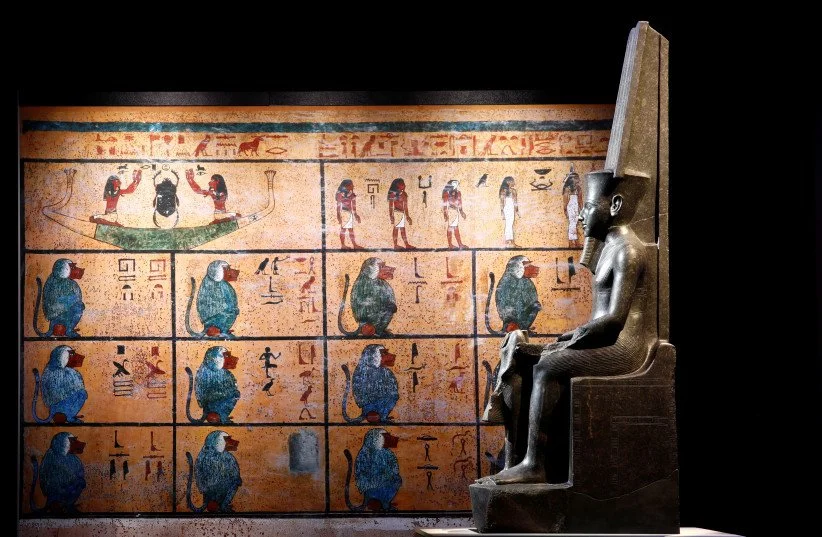
The god Amun protecting Tutankhamun is pictured during a press visit of the Tutankhamun, Treasures of the Golden Pharaoh exhibition, displaying more than 150 original artefacts, at the Grande Halle de la Villette in Paris, France, March 21, 2019.
The study team investigated the ancient port city of Thonis-Heracleion in the Bay of Aboukir and found the temple ruins in the southern canal of the city.
Although the buried metropolis was discovered in 2000, many of the hidden treasures are still being discovered.
The temple in Egypt
The temple, which was devoted to Amun, the Egyptian god of air, is thought to have fallen "during a cataclysmic event dated to the mid-second century BC," according to the European Institute for Underwater Archaeology (IEASM) institute. The city of Thonis-Heracleion completely vanished under the sea in a 110 square kilometer area of the Nile delta as a result of rising sea levels, earthquakes followed by tidal waves, and land liquefaction events.
"The ancient temple was once the site where pharaohs went to receive the titles of their power as universal kings from the supreme god of the ancient Egyptian pantheon,” IEASM explained.
“Precious objects belonging to the temple treasury have been unearthed, such as silver ritual instruments, gold jewelry and fragile alabaster containers for perfumes or unguents,” IEASM said. “They bear witness to the wealth of this sanctuary and the piety of the former inhabitants of the port city.”

Sep 8, 2023; Paris, FRA; The Venus de Milo or Aphrodite of Melos is an ancient Greek sculpture unearthed on the island of Milos that was created during the Hellenistic period. (credit: MICHAEL MADRID/USA TODAY SPORTS VIA REUTERS)
“It is extremely moving to discover such delicate objects, which survived intact despite the violence and magnitude of the cataclysm,” mentioned Goddio, president of IEASM and director of excavations.
The Greek temple of antiquity
Numerous metal and ceramic idols discovered helped to pinpoint the temple that was dedicated to the Greek goddess of love Aphrodite.
Because it "illustrates that Greeks who were allowed to trade and settle in the city during the time of the Pharaohs of the Saïte dynasty (664 - 525 BC) had their sanctuaries to their own gods," IEASM added, this discovery is regarded to have been especially significant.
A number of weapons belonging to Greek mercenaries were also found. “They were defending the access to the Kingdom at the mouth of the Canopic Branch of the Nile. This branch was the largest and the best navigable one in antiquity,” IEASM explained.
Over 50,000-year-old Neanderthal remains have been found in Spain
In Simanya Cave in Sant Llorenc Savall Natural Park, close to Barcelona, researchers discovered the remains of Neanderthals, early humans who lived between 250,000 and 40,000 years ago.

The 50,000-year-old remains, which are made up of 54 parts, were shown at a press conference held on Tuesday the 19th of September at the Archaeological Museum of Catalonia. The remains are those of an adult, most likely female, as well as those of a kid between the ages of 7-8 and an 11–12-year–old teen.
According to the press conference, the remains are some of the most significant Neanderthal remains discovered in the Iberian Peninsula and offer information about the dispersion of Neanderthal populations throughout Europe.
Current excavations in the cave are being carried out in collaboration with other colleges in Italy and Spain.