A forgotten Roman fort at the empire's northern frontier gave up its most beautiful secret yet.
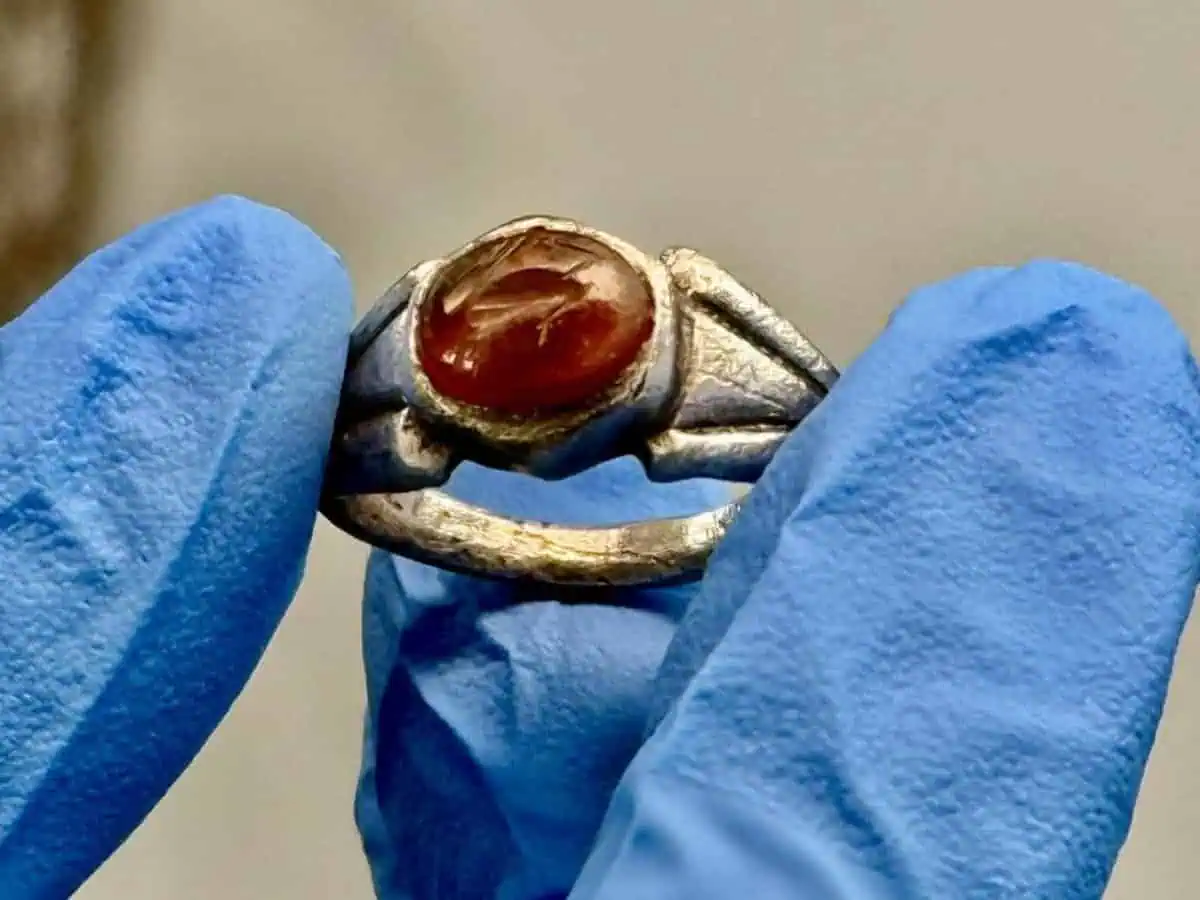
The silver ring was found during digs over this summer.
A volunteer working near the cold stones of Hadrian’s Wall made a remarkable discovery: an ancient silver ring featuring a finely carved intaglio. This find provides a rare glimpse into the lives of people who lived along the rugged frontier of Roman Britain.
The ring was uncovered at the Magna Roman Fort in Northumberland, located near the western end of Hadrian’s Wall. Magna, along with its nearby counterpart Vindolanda, is a hotspot for archaeological research, consistently yielding artifacts that shed light on life at the edge of the Roman Empire, where a strong military presence was maintained for centuries.
A Perfectly Preserved Roman Silver Ring
The discovery occurred in early August of this year. Volunteer Shaun noticed something unusual while working in the trench and immediately called over his supervisor.
Rachel Frame, the senior archaeologist at Magna, recounted the moment: “Heading over to where he was digging, I was amazed when he showed me a complete silver finger ring with an intaglio set into it,” she wrote in the team’s diary.
The ring was immediately recognized as an extraordinary artifact, offering a tangible connection to the personal lives of Romans stationed on Britain’s northern frontier.

From the moment it was unearthed, the ring drew attention for its exceptional preservation. “Even before any cleaning or conservation, it was obvious that this was a beautiful piece of jewellery, and in really good condition despite being buried for over 1,500 years!” noted Rachel Frame.
The band of the ring is simple in design, drawing focus to its centerpiece: the intaglio. The gemstone, likely carnelian, bears a finely carved image of a hare. In Roman symbolism, hares represented fertility, agility, and rebirth, and they frequently appeared in art as motifs of luck and the natural world.
The Vindolanda Charitable Trust highlighted the find in its ‘dig diary’ update on November 19, describing it as “beautiful” and “complete.”
A Mystery on the Frontier
Despite its beauty, the ring raises many unanswered questions about its original owner. The context of the find offers no immediate clues, leaving archaeologists to admire its craftsmanship while pondering its history.
Frame admitted her fascination with the artifact’s unknown past. “Was it worn by a man or a woman? Who were they and why were they at Magna? Did they lose the ring, and how did they react when they realised?”
For now, the ring stands as a remarkable artifact among many personal items uncovered at Magna and Vindolanda, where archaeologists have previously found ancient leather shoes and other belongings.
The ring has also made its television debut, appearing in episode three of Sandi Toksvig’s Hidden Wonders, which aired on Channel 4 on November 18. Sandi Toksvig and Raksha Dave joined the excavation team in August to film the series.
“Although excavating the rest of the deposit this ring was found in provided no clues about its story,” Frame reflected, “we can at least appreciate the beauty and craftsmanship of this artefact now it has been brought to light once again.”