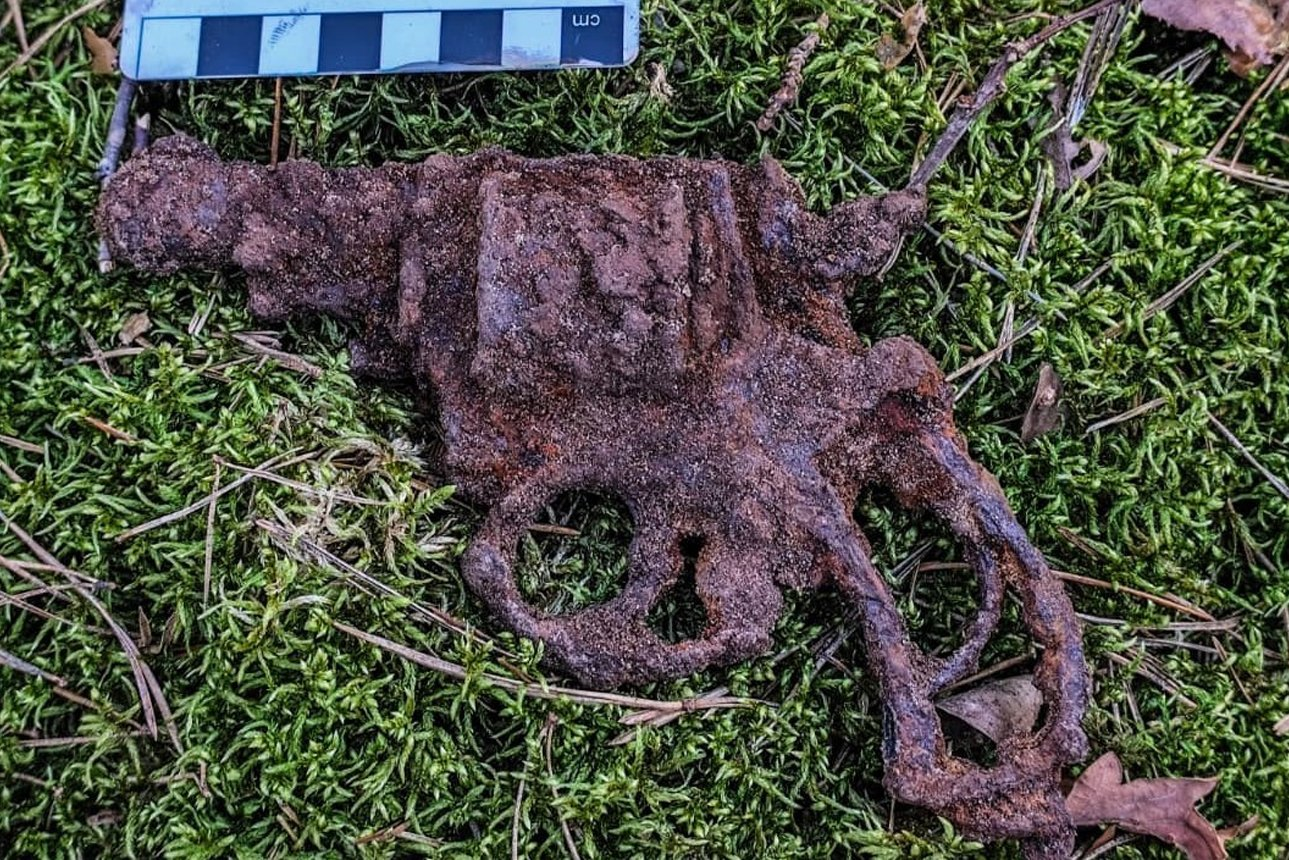
A heavily corroded 19th-century pocket revolver believed to be a British Bulldog revolver has been discovered during a metal-detecting survey in a forest near Kalisz in western Poland.
The firearm was found by a member of the Kalisz Exploration Group, a local organisation dedicated to historical exploration. After the discovery, the group reported the find to authorities in accordance with Polish regulations regarding the recovery of weapons and historical artefacts.
A Famous Pocket Revolver of the 19th Century
The weapon has been identified as a British Bulldog-type handgun, a small revolver that became widely popular in the late 19th century. The design originated around 1868 and was later produced commercially by the British gunmaker Henry Webley.
Designed as a compact firearm for personal protection, the Bulldog revolver was valued for its small size, which allowed it to be easily concealed in a pocket. This portability made it particularly appealing to civilians seeking a practical self-defense weapon.
Despite its compact frame, the revolver was considered powerful for its size. Early models were typically chambered in .442 Webley or .450 Adams calibre and featured a five-shot cylinder. Later versions were produced in smaller calibres such as .320 and .380.
The design soon gained international popularity, and manufacturers across Europe and the United States produced their own versions. As a result, the Bulldog became one of the most recognizable pocket revolvers of its time. Production of original models continued until the outbreak of World War I.
Connection to a Historic Assassination
The revolver design is also associated with a well-known historical event. In 1881, James A. Garfield, the President of the United States, was assassinated with a Belgian-made copy of a Bulldog revolver.
Examination of the Discovery
According to the Kalisz Exploration Group, openings are visible in the chambers of the revolver’s cylinder. However, heavy corrosion makes it impossible to determine whether the chambers still contain ammunition, spent cartridges, or are empty.
Police authorities will now examine the firearm to assess its condition and determine whether further investigation or conservation work will be required.