
40,000-Year-Old Artefacts Reveal Early Human Attempts at Communication
A recent discovery of artefacts dating back 40,000 years may offer clues about one of humanity’s most important developments: the origin of written communication. While we may never know exactly what these early markings meant, they provide a rare glimpse into how our ancestors expressed and recorded ideas.
Early Signs of Symbolic Communication
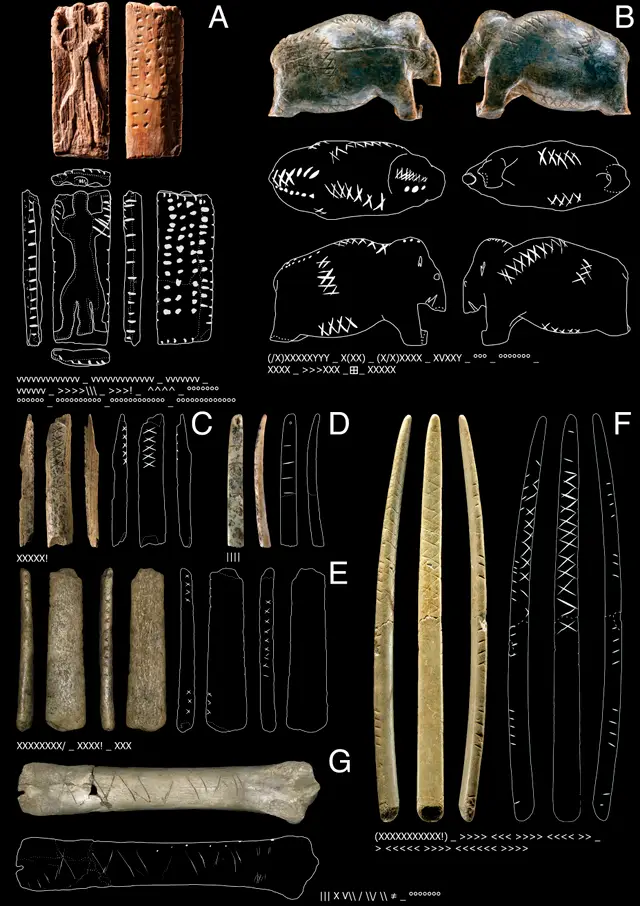
The study, led by linguist Christian Bentz of Saarland University and archaeologist Ewa Dutkiewicz of the Berlin State Museums, examined carvings etched into bones and crafted ornaments.
The researchers found that these markings, while not directly tied to spoken language, were likely deliberate and meaningful. The patterns suggest that early humans were using a form of visual communication long before the invention of writing as we know it.
Patterns, Not Random Marks
The team analyzed the carvings and found that they were systematic and non-random, showing observable patterns. These early hunter-gatherers, known as the Aurignacians, lived in Europe between roughly 43,000 and 26,000 years ago.
Although the symbols do not correspond to modern words, the deliberate use of repeated sign sequences suggests these markings conveyed information to others, even if we cannot decode it today.
Comparison with Early Writing Systems
Researchers compared the 40,000-year-old carvings to protocuneiform, a proto-writing system from Mesopotamia dating to the fourth millennium BC. They concluded:
The Aurignacian markings cannot be considered writing in the same sense as protocuneiform.
Unlike protocuneiform, which evolved into Sumerian writing, the carvings remained stable in form and information content for over 10,000 years and eventually disappeared.
This shows that early humans were capable of complex symbolic thought tens of thousands of years before the advent of true written language.
Limitations and Legacy
Despite their significance, researchers emphasize that it is likely impossible to know the exact meaning of these carvings. They may have served ritual, mnemonic, or informational purposes—but without a direct link to spoken language, their intent remains a mystery.
Nevertheless, the artefacts are a remarkable testament to human creativity and cognitive ability. They demonstrate that our ancestors were already thinking in abstract, symbolic ways long before writing became a formalized system.
Conclusion
These 40,000-year-old carvings highlight a missing chapter in human history, showing that the drive to record, symbolize, and communicate was present far earlier than previously documented. While we may never translate their meaning, the markings reveal the roots of one of humanity’s defining skills: the ability to convey information visually, paving the way for the written word thousands of years later.