For most of human history, music leaves almost no archaeological trace. Songs disappear when their performers die, wooden instruments decay, and the rhythms of ancient communities cannot be recovered from stone tools alone. Yet deep within the caves of the Swabian Jura in southwestern Germany, archaeologists discovered something extraordinary: carefully manufactured musical instruments dating to the Upper Paleolithic. At Geißenklösterle Cave, fragments of flutes made from mammoth ivory and bird bone have provided some of the strongest evidence that early modern humans in Europe possessed a sophisticated musical culture tens of thousands of years ago.
The significance of Geißenklösterle extends far beyond the discovery of ancient instruments. The cave preserves evidence of the Aurignacian, an archaeological culture associated with some of the earliest populations of Homo sapiens in Europe. Alongside musical instruments, archaeologists have found stone tools, worked bone and ivory, ornaments, animal remains, and evidence of repeated human activity. Together, these discoveries challenge the outdated image of Ice Age people as individuals concerned only with survival. The inhabitants of the Swabian Jura were hunters and gatherers living in a demanding environment, but they were also artists, craftspeople, symbol-makers, and musicians.
A Cave in the Swabian Jura
Geißenklösterle—often translated as something close to “Goat Monastery”—is located in the Ach Valley of the Swabian Jura, a limestone region of southern Germany famous for its concentration of Paleolithic caves. During the Upper Paleolithic, this landscape offered rock shelters and caves that could be repeatedly used by human groups moving through the region.
The caves of the Swabian Jura have become internationally important because they preserve an exceptional concentration of early figurative art and musical instruments. Geißenklösterle is part of this wider archaeological landscape, which also includes sites such as Hohle Fels and Vogelherd Cave.
Its deposits contain layers associated with different periods of prehistoric occupation. The most famous belong to the Aurignacian, generally associated with the early expansion of anatomically modern humans across Europe during the Upper Paleolithic.
The Aurignacian and the Arrival of Modern Humans
The Aurignacian is one of the earliest Upper Paleolithic archaeological traditions in Europe. It is associated with the period when Homo sapiens populations were expanding across the continent and, in many regions, eventually replacing or absorbing populations of Neanderthals.
Aurignacian communities produced increasingly specialized technologies. Archaeologists identify the period through characteristic stone and bone tools, ornaments, artistic objects, and other cultural remains.
The discoveries at Geißenklösterle are particularly important because they demonstrate that symbolic and artistic behavior was already highly developed during this early phase of modern human occupation in Europe.
The creation of a flute, for example, requires much more than finding a hollow piece of bone. A maker must select suitable material, shape or prepare it, create finger holes in appropriate positions, and produce an instrument capable of generating controlled sound. Such work suggests accumulated technical knowledge and cultural transmission.
The Discovery of the Ancient Flutes
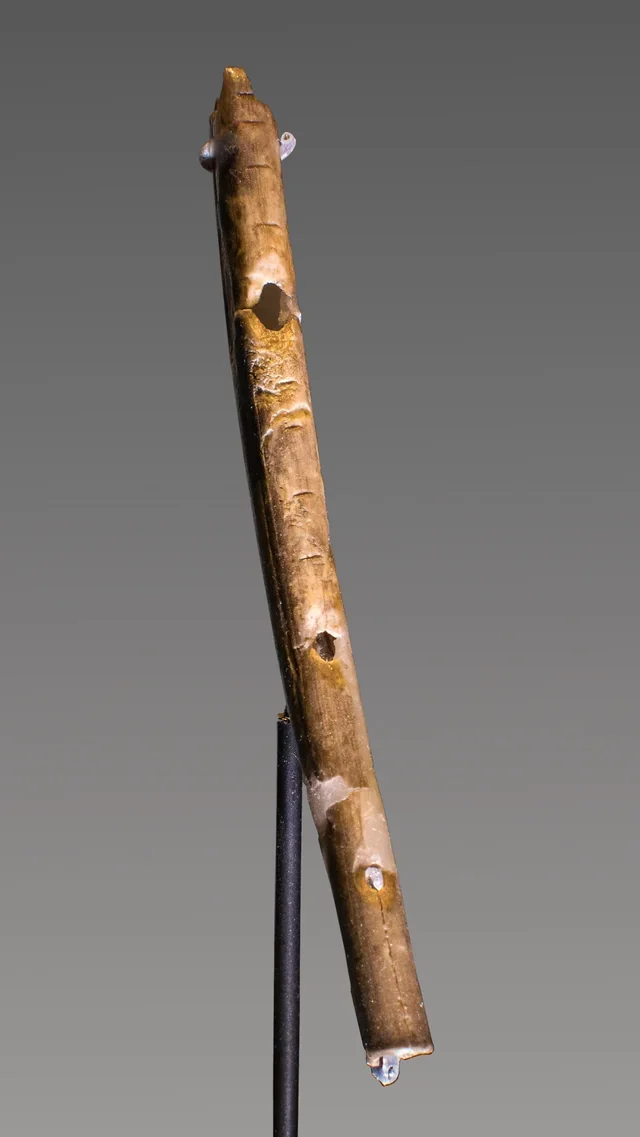
Among the most remarkable finds from Geißenklösterle are fragments of musical instruments made from bird bone and mammoth ivory.
Bird bones were particularly suitable for flute production because some are naturally hollow. A long bone from a large bird could be modified by creating finger holes and shaping the instrument.
Mammoth ivory presented a much greater technical challenge.
Unlike a bird bone, a mammoth tusk is solid. To create a hollow instrument, Ice Age craftspeople had to split, shape, hollow, and join pieces of ivory. This required planning and technical expertise. The resulting object was not accidental—it represented a deliberately engineered instrument.
The existence of multiple instruments or instrument fragments strongly suggests that music was not an isolated experiment performed by a single individual. It was more likely part of a broader cultural tradition.
How Old Are the Instruments?
Dating Paleolithic sites is complicated. Archaeologists rely on methods such as radiocarbon dating and careful analysis of stratigraphic layers—the sequence of deposits in which artifacts are found.
The Geißenklösterle instruments have been the subject of significant scholarly discussion because of their great age and the difficulties involved in dating materials near the limits of radiocarbon analysis.
The instruments are generally associated with the early Upper Paleolithic and are often dated to approximately 40,000 years ago or more, depending on the dating method and chronological framework being used.
The precise ranking of the world’s “oldest flute” can change as new discoveries are analyzed, but Geißenklösterle remains among the most important sites for the study of humanity’s earliest known musical instruments.
What Did the Music Sound Like?
This is where archaeology encounters an unavoidable limitation.
The original melodies played inside Geißenklösterle are lost.
No written musical notation survives from the Upper Paleolithic, and even if a flute can be reconstructed, modern researchers cannot know exactly what scales, rhythms, or musical traditions ancient people used.
However, experimental archaeology can help answer some questions.
Researchers can reconstruct instruments based on archaeological dimensions and test the sounds they are capable of producing. Such experiments demonstrate that the flutes were functional musical instruments rather than symbolic objects resembling instruments.
This does not mean that a reconstructed performance reproduces Ice Age music exactly. Instead, it shows the acoustic possibilities available to the original makers.
Why Would Ice Age People Make Music?
Music may have served many purposes.
It could have accompanied:
Rituals and ceremonies
Storytelling
Group gatherings
Dance
Social bonding
Courtship
Mourning
Seasonal celebrations
Teaching and cultural transmission
Music can also create emotional coordination among groups. Modern humans use rhythm and shared performance to reinforce identity and cooperation, and it is possible that prehistoric communities benefited from similar social effects.
The archaeological evidence cannot tell us exactly why a particular flute was played. But the effort invested in creating these instruments demonstrates that sound and performance mattered enough to justify valuable time and materials.
Music, Art, and the Ice Age Mind
The Swabian Jura is famous not only for music but also for some of the earliest known figurative artworks.
This combination is significant.
A society capable of carving animals and human-like figures from ivory, manufacturing ornaments, and creating musical instruments possessed a complex symbolic culture. These activities required imagination, memory, manual skill, and the ability to transmit knowledge.
The Ice Age inhabitants of the region were therefore not simply adapting biologically to a harsh environment. They were creating shared worlds of images, sounds, symbols, and traditions.
The Cave’s Wider Importance
Geißenklösterle demonstrates why caves are such important archaeological archives.
Over thousands of years, human activity can accumulate in layers. A cave floor may preserve discarded tools, food remains, fragments of ornaments, hearth-related material, and broken objects that would otherwise disappear.
By excavating these layers carefully, archaeologists can reconstruct changing patterns of occupation.
The cave also provides evidence relevant to one of prehistory’s largest questions: what happened when modern humans entered Europe?
Sites such as Geißenklösterle show that some of the earliest Upper Paleolithic Homo sapiens communities brought with them—or rapidly developed—complex technological and symbolic traditions.
Why Geißenklösterle Changed the History of Music
For centuries, prehistoric people were often portrayed as intellectually primitive. Artistic and musical achievements were assumed to belong to much later civilizations.
The discoveries from Geißenklösterle helped destroy that assumption.
By approximately forty millennia ago, humans in southern Germany were producing objects requiring advanced craftsmanship and engaging in activities that cannot be explained simply as immediate survival.
A flute does not kill an animal, build a shelter, or directly protect its owner from winter.
Yet someone made one.
Someone understood how it worked.
Someone probably taught others.
And someone, standing in or near an Ice Age cave, once transformed breath into organized sound.
That is why Geißenklösterle remains one of the most extraordinary archaeological sites in Europe. It preserves evidence not only of ancient people but of one of humanity’s oldest surviving conversations with music.