Introduction
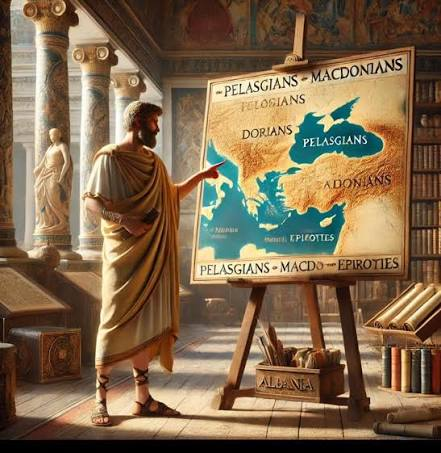
The origin of the Albanian language and its biological connection to ancient Balkan populations has long been one of the most fiercely contested debates in European historical linguistics and anthropology. Positioned as an entirely distinct, independent branch of the Indo-European language family, Albanian lacks close living relatives, leading nineteenth- and twentieth-century scholars to construct highly polarized theories about its roots. Local folklore and classical national romanticism frequently invoked a dual ancestry, linking the modern population alternatively to the historical Illyrians—the iron-working tribes who occupied the western Balkans during classical antiquity—or the even more semi-mythical Pelasgians, described by Homer and Herodotus as the shadowy, pre-Greek indigenous inhabitants of the Aegean world.
Because centuries of shifting imperial borders, Slavic migrations, and Ottoman-era population movements heavily complicated the linguistic trail, traditional historical methods reached an impasse. To separate national mythology from biological reality, international archaeogenetic teams turned to wide-scale genomic sequencing, extracting ancient DNA from Bronze and Iron Age burials across Albania and the wider Balkan peninsula.
The Genomic Continuity of the Western Balkans
The paleogenomic profiling of ancient Balkan skeletons shattered several long-standing historical assumptions while confirming an extraordinary biological continuity. When geneticists mapped the DNA of Bronze Age and Iron Age individuals excavated from tumulus burials in Albania, they revealed a highly localized genomic profile. These ancient individuals carried a dominant genetic signature that descended from a mix of Early European Agriculturalists and Yamnaya-derived steppe pastoralists who had settled the western Balkans around 3000 BCE. Crucially, when these ancient genomes were compared directly to modern Albanian populations, the data demonstrated a profound, unbroken maternal and paternal genetic lineage spanning over three millennia.
The data provided no scientific support for the abstract "Pelasgian" concept as a distinct, separate migration wave; instead, it showed that the people classical authors loosely termed Pelasgians or Illyrians were part of the same deeply rooted, localized bronze-and-iron-age substrate. Paternally, modern Albanians show a high concentration of Y-chromosome haplogroups such as J2b2-L283 and branches of E-V13, the exact same lineages extracted from Iron Age burials traditionally classified as Illyrian.
Furthermore, the genomic timeline demonstrated that despite the sweeping migration waves that altered the rest of Europe—including the massive 6th-century Slavic migrations that fundamentally transformed the genetics of neighboring regions—the rugged, mountainous topography of Albania acted as a highly effective genetic refuge. While some mixing did occur, the primary ancestral core of the modern Albanian population remains directly tied to the ancient Paleo-Balkan tribal networks that resisted both Roman assimilation and early medieval demographic turnovers.
Conclusion
The paleogenomic unmasking of Albania’s genetic archaeology provides a foundational baseline for reconstructing the human history of the southwestern Balkans. It proves that modern Albanians are not recent medieval arrivals to the region, nor are they a displaced population from distant lands. Instead, ancient DNA establishes them as one of the oldest continuous, indigenous populations of Europe, possessing a direct biological and linguistic lineage that links them squarely to the Iron Age Illyrian tribes. By bridging the gap between classical texts and molecular science, archaeogenetics transforms our understanding of Balkan prehistory, revealing a story of deep physical resilience where an ancient language and its biological carriers survived centuries of imperial pressures intact.