Ancient Child Rearing: Toys and Education in the Classical World
In the classical world of ancient Greece and Rome, child-rearing practices laid the foundation for future citizens, warriors, and homemakers. While the early years were spent in the safe confines of the home under the watchful eye of mothers and nurses, childhood was also a time for play, storytelling, and early forms of education designed to pass down cultural values.
1. Infancy and Early Play
The earliest years of a child's life in the classical world were highly focused on protection and sensory development.
Protective Rituals and Amulets: Due to high infant mortality rates, children were protected using apotropaic charms. In Greece, infants wore periapta, and in Rome, children wore a protective amulet called a bulla (for boys) or a crescent-shaped pendant (for girls) to ward off the evil eye.
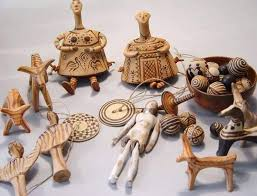
Toys and Games: Children played with a variety of toys made from terracotta, wood, and cloth.
Rattles: Known as platage in Greece and crepitaculum in Rome, these were used to soothe the baby and ward off evil spirits.
Dolls and Vehicles: Girls played with terracotta or wooden dolls with articulated limbs, while both boys and girls enjoyed miniature wheeled carts, spinning tops, and hoops.
Knucklebones (Astragaloi): Played with the ankle bones of sheep or goats, this was a favorite game of both skill and fortune-telling across the Mediterranean.
2. Education in Ancient Greece
Greek education varied significantly depending on the city-state, though both emphasized preparation for civic life.
Athens and Paideia: From the age of seven, Athenian boys began their formal education. They learned reading, writing, and arithmetic under the grammatistes, and music and poetry under the kitharistes. Physical training took place in the palaestra, preparing them for both civic and military life.
Sparta and the Agoge: Spartan education was entirely state-run and focused on military readiness. From the age of seven, both boys and girls were placed in the agoge, where the focus was placed on physical endurance, military discipline, and survival skills rather than academic studies.
The Role of Girls: In most Greek city-states, girls received an informal education at home focusing on domestic tasks, such as weaving and spinning, while Spartan girls received physical and cultural training similar to boys.
3. Education in Ancient Rome
Roman education was heavily influenced by Greek traditions but evolved to serve the needs of the Roman Republic and Empire.
Early Education: Until the age of seven, children were taught the basics of morality, reading, and writing at home by their parents, particularly the mother.
Primary School (Ludi Magister): Boys and some girls attended primary school to learn reading, writing, and basic arithmetic. Students wrote on wooden wax tablets using a metal stylus.
Secondary School (Grammaticus): Wealthy boys advanced to study Greek and Latin literature, focusing on epic poetry, history, and geography.
Rhetorical Training: For young elite men, the highest level of education involved studying rhetoric and public speaking under a rhetor, which was essential for a career in law or politics.
4. Milestones in Childhood Development
The passage of childhood to adulthood was celebrated through distinct ceremonies that marked physical and civic growth:
Acceptance into the Household: In Greece, this occurred during the Amphidromia and Dekate, while in Rome, the dies lustricus (usually the eighth or ninth day after birth) served as the naming and purification ceremony.
The Roman Toga: For Roman boys, the transition to young adulthood was marked around age 14 to 16 by the Liberalia festival, where they exchanged the child's toga praetexta for the adult male toga virilis.
Dedication of Toys: Both Greek and Roman youths would dedicate their childhood toys and locks of hair to the gods before entering adulthood.