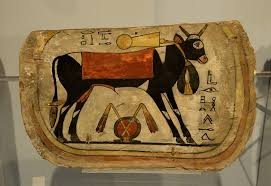
The Apis Bull was perhaps the most significant sacred animal in ancient Egypt, serving as a living manifestation of the god Ptah, and later, in the Ptolemaic period, merging with Osiris to become the Serapis. Unlike animals that were simply associated with deities, the Apis was believed to be an actual, physical vessel for the divine—a "living god" that walked, breathed, and lived within the temple precincts.
I. Selection and Identification
The Apis Bull was not chosen at random. It had to be a very specific bull with distinctive black-and-white markings that symbolized the divine connection. According to ancient accounts, such as those by Herodotus, the bull needed:
The Black Body: It had to have a black coat with a white triangle on its forehead.
Unique Markings: It required the image of an eagle (or vulture) on its back, double hairs on its tail, and a mark in the shape of a scarab beetle under its tongue.
The Search: When an Apis Bull died, the priesthood would embark on a nationwide search to find its successor—a calf possessing these exact biological markers. Once discovered, the new Apis was kept in a special stable, fed the finest food, and treated with regal reverence.
II. The Cultic Role
The Apis Bull functioned as an intermediary between the people and the divine.
Oracular Power: People sought out the Apis to divine the future. The bull's behavior—the path it took, the rooms it entered, or the way it accepted food—was interpreted by priests as prophetic signs regarding the health of the harvest, the fate of the pharaoh, or the outcome of military campaigns.
Manifestation of Ptah: As the "Living Image of Ptah," the creator god of Memphis, the Apis Bull was central to the religious and political life of the capital. It was believed to embody the creative force of the universe itself.
Royal Connection: The Pharaoh’s legitimacy was often linked to the Apis. Ceremonies involving the bull were designed to showcase the King’s piety and his role as the maintainer of the Ma’at (divine order).
III. Life and Death: The Serapeum
The life of an Apis Bull was one of unparalleled luxury, but its death marked a moment of national mourning equivalent to the loss of a Pharaoh.
The Funeral: Upon death, the bull was mummified with the same elaborate rituals as a human of high status. Its organs were placed in canopic jars, and its body was adorned with jewelry and gold.
The Serapeum at Saqqara: The bull was interred in the Serapeum, a massive, labyrinthine underground tomb complex at Saqqara. This site contains immense granite sarcophagi, some weighing over 60 tons, which were carved with breathtaking precision. The scale of these burials—buried deep in the rock in these massive stone boxes—testifies to the extraordinary resources the Egyptian state dedicated to the cult.
The Transition: The burial was not the end; it was merely a transition. The Apis Bull was believed to become the Osiris-Apis in the afterlife, ensuring the prosperity of the land for the next generation.
IV. Evolution into Serapis
During the Hellenistic period, under the rule of the Ptolemies, the cult of the Apis Bull was merged with the Greek god Osiris to create Serapis. This was a calculated move by the Greek rulers to bridge the cultural and religious divide between the Greek-speaking elite and the indigenous Egyptian population. The cult of Serapis became incredibly popular throughout the Roman Empire, eventually becoming a dominant religious force that integrated Egyptian mysticism with Hellenistic theological structures.
The cult of the Apis Bull represents the profound Egyptian belief that the divine was not distant or abstract, but tangible and present. It challenged the human-centric focus of many other ancient religions by placing a beast at the center of the state's most important religious, oracular, and political rituals.