The Villa of Oplontis, often referred to as "Villa A" or the "Villa of Poppaea," is arguably the most significant villa otium (leisure villa) discovered in the Vesuvian region. Located in modern-day Torre Annunziata, this massive residential complex serves as a primary archaeological laboratory for understanding the intersection of immense political wealth, architectural ambition, and sophisticated artistry in the mid-1st century CE.
I. Imperial Aspirations and Architectural Scale
Spanning over 11,000 square meters, the Villa of Oplontis was designed to be an immersive environment of leisure and status. Unlike the smaller, utilitarian villa rustica (farmhouse villas) that characterized the surrounding Italian countryside, Oplontis was built for display, relaxation, and the consolidation of elite power.
The Poppaean Connection: A fragmentary amphora bearing the inscription "Secundo Poppaeae Aug. l." (belonging to Secundus, a freedman of Poppaea Augusta) strongly suggests that the villa was owned by or associated with Poppaea Sabina, the second wife of the Emperor Nero. This association elevates the site from a wealthy estate to a potential imperial residence, offering a rare glimpse into the private life of the Roman ruling class.
Spatial Design: The layout is a masterpiece of architectural geometry, characterized by a series of grand atria, peristyles (colonnaded gardens), and sprawling dining suites. The architecture was intentionally porous; rooms were designed to facilitate fluid movement between interior living spaces and the surrounding garden landscape, reflecting the Roman obsession with light, air, and nature.
II. The Pinnacle of Ancient Mural Painting
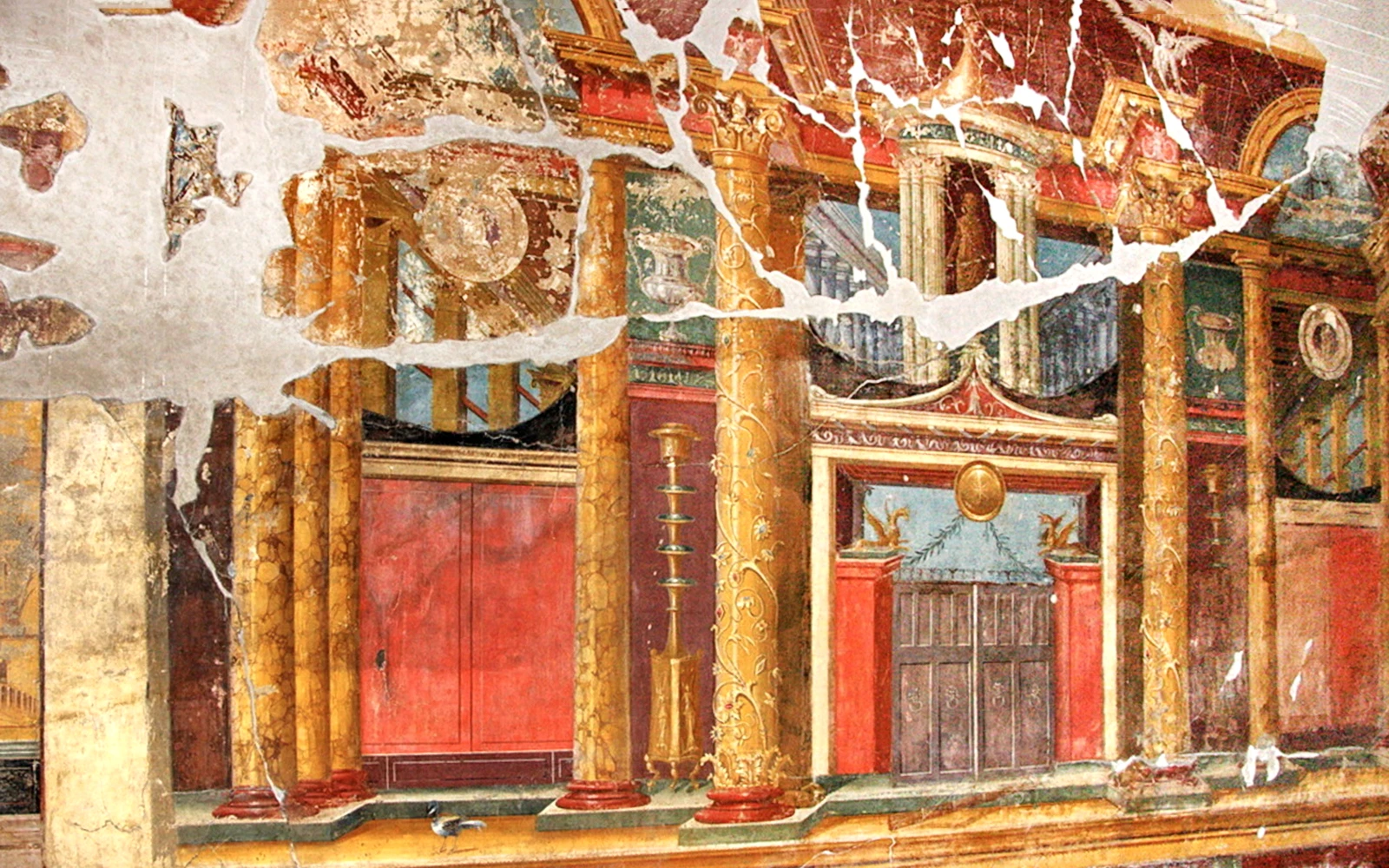
The Villa of Oplontis contains what many art historians consider the finest, most extensive, and best-preserved cycle of Second and Third Style Roman wall paintings in existence.
The Illusion of Space: The artists employed advanced "Second Style" architectural illusionism. By painting complex, three-dimensional perspectives—featuring columns, balconies, and distant vistas—they visually "erased" the thick stone walls, effectively expanding the rooms into infinite, imagined worlds.
The Garden Room (Oecus): In the garden-facing halls, the frescoes are so precise that botanists have been able to identify the specific flora—including oleander, viburnum, and various fruits—that were planted not only in the frescoes but likely in the actual villa gardens.
Pigment and Technique: The murals feature an extravagant use of precious minerals, including cinnabar (mercury sulfide), a deep, vibrant red that was among the most expensive pigments in the ancient world. The use of such materials indicates that cost was no object, as the owner sought to create an environment that radiated prestige and cultural enlightenment.
III. Infrastructure and Engineering of Leisure
Beyond the aesthetic, the villa was a marvel of Roman hydraulic and thermal engineering.
The Great Swimming Pool: The central courtyard features a massive, rectangular open-air pool (approx. 60 by 17 meters). This was not merely a functional element; it was the visual and social heart of the villa. Surrounded by porticos and decorated with fountains and statues, it served as a stage for aristocratic life, where the elite could engage in the otium (leisure) activities—reading, philosophy, and conversation—that defined the Roman concept of a "good life."
Private Thermae: The villa housed a private bath complex, complete with a caldarium (hot room), tepidarium (warm room), and frigidarium (cold room). The use of hypocaust systems—underfloor heating powered by external furnaces—ensured that the villa remained climate-controlled year-round, allowing the owners to retreat to their seaside paradise regardless of the season.
Domestic Seclusion: The villa’s layout was meticulously planned to segregate the elite from the operational aspects of the estate. A complex network of kitchens, bakeries, and slave quarters was tucked away, ensuring that the labor required to sustain such luxury remained entirely invisible to the residents and their guests.
IV. A Snapshot of Abandonment
The eruption of Mount Vesuvius in 79 CE entombed the villa, but with a unique twist. Archaeologists have determined that at the time of the eruption, the villa was undergoing major structural renovations.
The "Empty" Estate: Because the villa was partially empty of furniture and household objects, researchers have a rare, unobstructed view of the Roman building techniques themselves. We can see the skeletal structure of the masonry, the application of various plaster layers, and the preparatory designs for the frescoes.
Biological Preservation: The thick blanket of volcanic ash preserved not just the stone, but the organic footprint of the villa. Excavations have revealed preserved carbonized wood from garden trellises and, most remarkably, the original planting soil, which has provided definitive data on how the Romans managed their topsoil to support such an immense garden-estate.
The Villa of Oplontis stands as a monument to the Roman aristocratic lifestyle—a world that was as visually spectacular as it was socially exclusionary. It captures a moment in time where nature, architecture, and art were perfectly synthesized to project the ultimate expression of imperial identity.