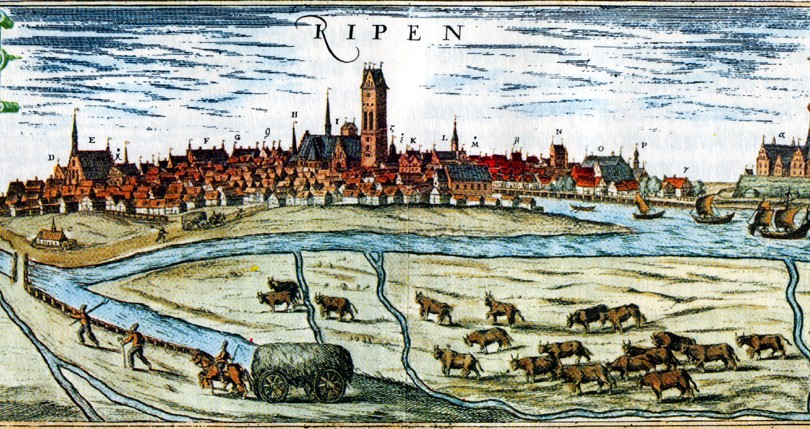
While popular culture frequently depicts the Vikings exclusively as fierce, ax-wielding raiders, the historical reality of the early Scandinavian world was deeply rooted in commerce, craft, and international trade. At the absolute epicenter of this economic network was the town of Ribe, located on the marshy western coast of the Jutland peninsula in modern-day Denmark.
Established nearly three decades before the infamous 793 CE raid on Lindisfarne, Ribe stands as the oldest town in Scandinavia. It served as the crucial prototype for the early Viking market, transforming Scandinavia from a collection of isolated, agrarian tribal chieftainships into a dominant macroeconomic force in medieval Europe.
1. The Strategic Geography of a Trade Hub
Before the 8th century, Scandinavian trade was largely seasonal, informal, and mobile. Merchants traded goods directly from the hulls of their ships or at temporary beach landings. Around 704–710 CE, an influential, highly organized political authority—likely an early Danish king like Ongendus (Angantyr)—decided to centralize this traffic by founding a permanent, regulated market on the banks of the Ribe River.
The geography of Ribe was a masterclass in economic strategy:
The North Sea Gateway: Located just a few miles inland from the Wadden Sea, the site was safely protected from harsh maritime storms and unpredictable pirate raids, yet completely accessible to deep-draft merchant ships.
The Intersectional Junction: Ribe sat exactly where maritime trade routes from the North Sea met the ancient overland trade routes running south into the wealthy Christian markets of the Frankish Carolingian Empire.
2. Urban Planning: The Grid of the Artisans
The founding of Ribe marked a radical architectural and social revolution: the birth of Scandinavian urban planning. Archaeologists excavating the oldest layers of the town discovered that the market was not left to grow organically or chaotically. Instead, it was laid out according to a strict, pre-planned geometric design.
The Linear Plots: Royal surveyors divided a long, flat strip of land parallel to the river into uniform, narrow rectangular plots, each measuring roughly 20 to 26 feet wide.
The Wooden Boardwalks: To combat the wet, muddy marshland terrain, the entire market area was stabilized by laying down heavy wooden boardwalks and woven wicker mats, creating the region's first paved public streets.
The Boundary Ditches: Each individual plot was separated from its neighbor by a small, shallow drainage ditch. Artisans rented these specific plots from the king or local chieftain, who in turn provided legal protection, enforced market peace, and collected a standardized tax on all commercial transactions.
3. The Industrial Production of Ribe
Ribe was not just a point of exchange; it was a high-density manufacturing powerhouse. The waterlogged soil has perfectly preserved the organic raw materials, failed casts, and industrial waste of highly specialized craftsmen who traveled from across the Germanic world to set up workshops:
The Bronze Casters
Artisans at Ribe perfected the art of mass-producing intricate jewelry using hollow lost-wax casting. Archaeologists have recovered thousands of fragments of clay molds, crucibles, and droplets of spilled molten metal. These workshops turned out thousands of standardized bronze tortoise brooches and animal-head ornaments, which were eagerly purchased by Norse traders to be sold to women across the Viking world.
The Bead Makers
Ribe was world-renowned for its sophisticated glassworking industry. Craftspeople gathered broken fragments of Roman mosaic tiles (tesserae) and imported glass vessels from the Frankish Rhineland, melting them down in specialized clay kilns.
   [ Imported Frankish Glass / Roman Tiles ] ───► Melted in High-Heat Clay Kilns
                                                          │
   [ Skilled Italian/Near-Eastern Artisans ] ───► Drawn into Intricate Glass Rods
                                                          │
   [ MASS-PRODUCED MULTICOLORED BEADS ] ───────► Exported as Global Viking Currency
They drew the molten glass into long rods and cut them to create brilliant, multicolored glass beads. These beads became an incredibly stable form of currency, traded deep into the Baltic, Russia, and the Islamic Caliphate.
Comb Makers and Leatherworkers
The market was filled with the pungent smell of boiling animal bone and tanning hides. Highly skilled artisans collected red deer antlers to slice, file, and rivet into elaborate, fine-toothed pocket combs. Antler was chosen because its fibrous structure resisted snapping, making these combs highly prized luxury personal hygiene items.
4. The Invention of Scandinavian Coinage: The Sceattas
As the volume of international trade in Ribe skyrocketed during the 8th century, the traditional Nordic barter system—relying on exchanging cows, grain, or hack-silver by weight—became too clumsy for rapid market transactions. Ribe solved this problem by introducing Scandinavia's very first localized currency system.
Around 720 CE, the market began minting and circulating small, thick silver coins known as sceattas (specifically the "Wodan/Monster" type).
These coins featured a stylized, bearded human head on the obverse (often interpreted as the god Odin or Wodan) and a mythical, backward-looking crested monster on the reverse. The systematic presence of these uniform silver coins across the Ribe plots proves that the town had transitioned into a fully monetized market economy long before the traditional start of the Viking Age, allowing merchants to buy food, rent workshops, and pay taxes using a trusted, state-regulated currency.
5. The Catalyst for the Viking Expansion
The structural success of Ribe provided the exact economic blueprint for subsequent famous Viking trading towns like Hedeby (Germany), Birka (Sweden), and Kaupang (Norway).
By establishing a permanent urban space where pagan Norsemen, Christian Franks, Anglo-Saxons, and Frisian merchants could safely interact under the protection of market law, Ribe acted as a structural bridge. It infused Scandinavia with unprecedented wealth, foreign silver, and advanced technologies—such as specialized sail-weaving techniques and sophisticated iron metallurgy. Ultimately, it was the immense commercial wealth and seafaring networks forged in early markets like Ribe that provided the resources, ships, and geographical intelligence that launched the historic Viking voyages across the globe.