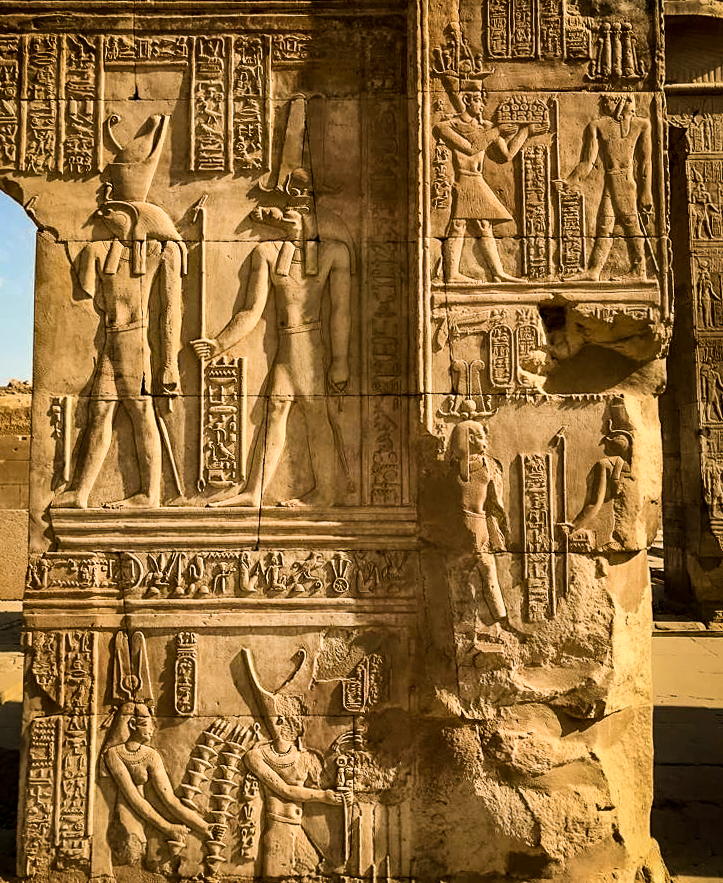
Rising directly from the eastern banks of the Nile River, roughly 30 miles north of Aswan, stands the Temple of Kom Ombo. Built during the Ptolemaic Dynasty (180–47 BCE) with later Roman additions, this temple is unique in the ancient world.
While almost all Egyptian temples were dedicated to a single deity or a traditional triad, Kom Ombo was designed as a perfectly symmetrical double temple. It was built to appease two entirely separate, conflicting theological forces: Horus the Elder (Haroeris), the benevolent god of light, and Sobek, the terrifying, unpredictable crocodile god of the Nile.
1. The Geography of Fear: Why the Crocodile?
To understand Kom Ombo, one must understand its specific geographic location. In antiquity, the loop of the Nile River surrounding the town of Ombo was a natural, swampy haven for thousands of Nile crocodiles. These massive predators posed a constant, deadly threat to local fishermen, farmers, and washing women.
Rather than trying to eradicate the threat, the ancient Egyptians engaged in a classic strategy of religious pacification. They deified the creature as Sobek, viewing the crocodile as the living manifestation of the Nile's raw, chaotic, and creative power.
By worshipping Sobek at Kom Ombo, the Egyptians believed they could tame his ferocity, ensure the annual fertile flooding of the Nile, and transform a deadly predator into a fierce divine protector of the pharaoh.
2. Architectural Symmetry: The Dual Design
The theological challenge of housing two rival gods under one roof was solved by the Ptolemaic architects through an absolute commitment to axial symmetry. The temple is literally split down the middle along a central line, creating two parallel sacred spaces running side-by-side.
Everything in the temple is perfectly duplicated:
Two Entrances: The front pylon features two identical monumental gateways. The left gateway was used exclusively for rituals honoring Horus, while the right gateway belonged to Sobek.
The Shared Spaces: The temple features a shared outer courtyard and two successive hypostyle halls. However, even within these communal rooms, the columns and reliefs on the northern half are dedicated to Horus, while the southern half is entirely dominated by Sobek.
Twin Sanctuaries: At the deepest, most sacred core of the complex sit two identical, mirror-image inner sanctuaries (naos). Here, the cult statues of the two gods sat side by side, separated only by a thick stone partition wall.
3. The Cult of Sobek and the Sacred Crocodiles
The southern wing of Kom Ombo was a living, breathing habitat for real crocodiles. The temple complex featured a sacred, deep stone basin connected directly to the Nile, known as the Crocodile Well.
Here, temple priests raised a single, physically pristine crocodile chosen to be the living earthly vessel of Sobek. This "sacred crocodile" was pampered with ultimate luxury: adorned with gold earrings and bracelets on its forefeet, and fed a rich diet of choice meats, cakes, and honey by the priests.
When this sacred animal died, it was treated with the exact same funerary honors as a high-ranking human noble. The body was painstakingly mummified, wrapped in fine linen sheets, and laid to rest in a dedicated subterranean animal cemetery nearby.
Today, the modern Crocodile Museum, located right outside the temple exit, houses dozens of these exceptionally preserved ancient crocodile mummies, ranging from massive adults over 15 feet long to tiny, fragile hatchlings and fossilized crocodile eggs.
4. Science on the Nile: Medicine and the Nilometer
Beyond its dark, reptilian theology, Kom Ombo functioned as a major hub for ancient Egyptian science, mathematics, and medicine. Two specific features on the temple grounds highlight this empirical legacy:
The Surgical Reliefs
Carved onto the back of the temple’s inner enclosure wall is one of the most famous medical inscriptions in the world. The relief depicts a highly advanced kit of medical and surgical instruments being presented to a seated god.
Egyptologists have identified highly specific tools within this stone catalog, including scalpels, bone saws, forceps, dental probes, retractor hooks, surgical scissors, and scales for weighing medicinal dosages. This relief suggests that the outer courtyards of Kom Ombo likely operated as a major regional hospital and medical school under the priesthood.
The Deep Nilometer
Located just outside the northern wall is a massive, circular stone well plunging deep into the bedrock. This was a Nilometer.
Priests would look down into the well to read calibrated numerical marks carved into the stone walls, allowing them to measure the exact height of the Nile’s water table during the flood season. If the Nilometer showed a high water level, it predicted a bumper crop harvest, allowing the pharaoh's tax collectors to calculate the coming year's agricultural taxes with mathematical precision.
5. Summary of the Dual Theology
Northern Axis (Horus the Elder): Represents light, cosmic order (Ma'at), rational medicine, and solar protection. Associated with healing and divine kingship.
Southern Axis (Sobek): Represents the dark, fertile waters of the Nile, raw physical power, fertility, and unpredictable chaos. Associated with military might and pacifying the wild.
The Temple of Kom Ombo stands as a fascinating monument to Egyptian pragmatism. Rather than ignoring the terrifying realities of their environment or viewing nature as a singular benevolent force, the builders of Kom Ombo crafted a dual architecture that allowed humanity to walk the fine line between light and dark, science and fear, safely on the banks of the Nile.