The reign of Emperor Constantine the Great (306–337 CE) stands as one of the most critical turning points in world history. By halting the brutal persecution of Christians and personally adopting the faith, Constantine initiated the transformation of the Roman Empire from a pagan superpower into a Christian state.
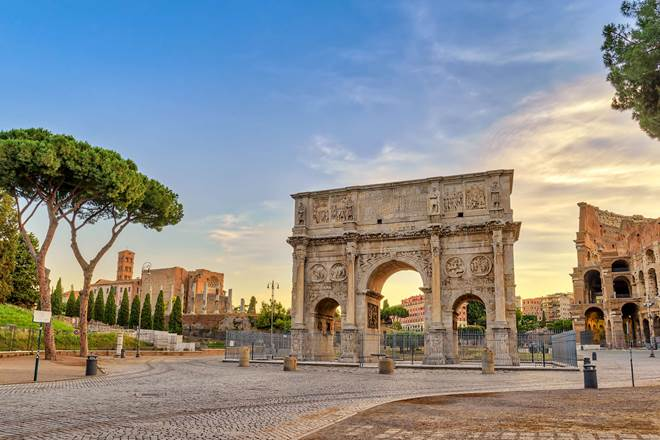
This dramatic religious and political shift is frozen in stone at the heart of Rome’s monumental center through the Arch of Constantine. Erected in 315 CE to celebrate his ten-year jubilee and his definitive victory at the Battle of the Milvian Bridge, this triumphal arch acts as a fascinating, contradictory bridge between Rome's classical pagan past and its medieval Christian future.
1. The Crucible: The Milvian Bridge and the Vision
In the early 4th century, the Roman Empire was fractured by a chaotic civil war. Constantine marched on Rome to confront his rival, Maxentius, who held the capital.
According to the Christian historian Eusebius, on the afternoon of October 27, 312 CE—the day before the historic Battle of the Milvian Bridge—Constantine looked up at the sun and witnessed a miraculous vision: a cross of light emblazoned against the sky, accompanied by the Greek words En Touto Nika ("In this sign, conquer").
Constantine ordered his soldiers to paint the Chi-Rho (a monogram of the first two letters of Christ’s name in Greek, $\chi$ and $\rho$) onto their shields. The next day, Constantine’s forces smashed Maxentius’s army, driving them into the Tiber River.
The very next year, in 313 CE, Constantine co-issued the Edict of Milan, which granted absolute religious toleration to Christians across the empire, legally ending centuries of state-sanctioned martyrdom.
2. The Arch of Constantine: Architectural Recycling
Standing directly alongside the Colosseum, the Arch of Constantine is the largest surviving triumphal arch from antiquity. However, it is structurally unique because it is a massive architectural collage.
Instead of carving entirely new reliefs, Constantine’s architects engaged in spolia—the systematic stripping of older, iconic monuments dedicated to Rome’s greatest 2nd-century "Good Emperors": Trajan, Hadrian, and Marcus Aurelius.
The Trajanic Reliefs: Massive battle scenes showing Roman soldiers crushing barbarians were taken from Trajan's Forum and repurposed to frame Constantine’s victories.
The Hadrianic Roundels: Large, circular reliefs showing Hadrian hunting wild boars and sacrificing to pagan gods like Apollo and Diana were set into the brickwork.
The Aurelian Panels: Rectangular reliefs depicting Marcus Aurelius executing military duties and practicing traditional civic virtues were mounted on the upper attic level.
Why Reuse Old Art?
For centuries, art historians viewed this heavy reliance on spolia as a symptom of artistic decline, assuming 4th-century Rome simply lacked skilled sculptors. Modern archaeology, however, views it as a brilliant stroke of political propaganda.
By physically stitching the stone bodies of Trajan, Hadrian, and Marcus Aurelius to his own monument, Constantine was telling the public that he was the spiritual and political heir to Rome's golden age. Furthermore, his artisans carefully recarved the stone faces of the past emperors to match Constantine’s distinct, wide-eyed portrait.
3. The Shift in Art: The Constantinian Frieze
Directly underneath the smooth, classical Hadrianic roundels runs a narrow, horizontal band of completely original 4th-century sculpture: the Constantinian Frieze.
The stylistic contrast between the older reused art and Constantine’s new art is jarring. While the 2nd-century panels focus on realistic anatomy, fluid movement, and three-dimensional depth, the Constantinian carvings are flat, rigid, and highly geometric. Figures are short, blocky, and arranged in repetitive, static rows.
This change was not an accident; it marks the birth of Late Antique and Medieval Art. The focus shifted away from the physical realism of the pagan world toward a highly legible, symbolic language. On the frieze, Constantine sits perfectly centered, elevated, and larger than the uniform crowd below him. The art no longer cared about matching physical reality; its sole job was to communicate absolute hierarchy, divine authority, and the immovable order of the state.
4. The Deliberate Religious Ambiguity
Given Constantine's status as the champion of Christianity, the arch features a glaring omission: there is not a single explicit Christian symbol on it. There are no crosses, no Chi-Rhos, and no mentions of Jesus Christ.
Instead, the monument features a highly calculated, deliberate religious ambiguity designed to appease both a deeply conservative, pagan Roman Senate and an expanding Christian populace.
The Inscription: On the central attic inscription, the Senate wrote that Constantine defeated the tyrant Maxentius "instinctu divinitatis"—"by the prompting of the divinity." This phrase was genius compatibilism. A pagan viewer could interpret it as the traditional sun god (Sol Invictus) or Jupiter, while a Christian viewer knew exactly which unnamed, singular God it referred to.
The Sun God Presence: The arch prominently features reliefs of Sol Invictus, the Unconquered Sun, driving his chariot across the sky. Constantine was an expert syncretist; for the first half of his reign, he seamlessly blended the imagery of Christ with the imagery of the Sun God, even declaring Sunday (the day of the sun) as the official Roman day of rest.
5. Moving the Center: From Rome to Constantinople
Ultimately, the Arch of Constantine represents a farewell to the old capital. Constantine quickly realized that Rome, with its deep-seated pagan traditions, entrenched senatorial elite, and outdated geographic position, could no longer serve as the command center for a reformed, Christian empire.
In 330 CE, Constantine officially moved the capital of the empire eastward to the ancient Greek city of Byzantium, completely rebuilding it and naming it after himself: Constantinople (modern-day Istanbul).
While the city of Rome began its slow slide into the Middle Ages, the Arch of Constantine stood as a permanent stone anchor left behind—a monument that utilized the stolen architectural triumphs of Rome's pagan peak to legitimize the ruler who would dismantle it in favor of a global Christian empire.