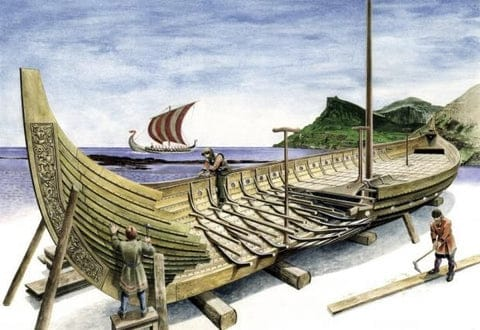
The supreme catalyst for the Viking Age was not a political ideology or a religious upheaval—it was a technological masterpiece of naval engineering: the Viking Longship.
At the absolute core of Scandinavian maritime supremacy was a specialized construction method known as the clinker-built (or lapstrake) technique. This engineering tradition produced vessels that were uniquely lightweight, exceptionally strong, and incredibly flexible, allowing the Norsemen to cross the open, violent waters of the Atlantic while also navigating shallow, inland river networks deep within Europe.
1. The Anatomy of Clinker Construction
For centuries, Mediterranean shipbuilders relied on carvel construction, where wooden hull planks were placed flush, edge-to-edge, over a heavy, pre-built internal skeleton. The Vikings inverted this process entirely, building the shell of the ship first.
In clinker construction, the hull planks (strakes) are laid down starting from the keel and worked upward. Crucially, each new plank overlaps the upper edge of the plank beneath it.
The Fastening Process
To bind these overlapping planks together, Viking shipwrights used a highly effective fastening system:
Iron Rivets: They drilled small holes through the overlapping sections of the oak or pine strakes and drove square-sectioned iron rivets (roving nails) through them. On the inside of the hull, they placed a small, flat iron washer called a rove over the tip of the nail and hammered it flat, effectively clamping the two planks together in an unbreakable, watertight grip.
Waterproof Caulking: Before tightening the rivets, the shipwrights stuffed a mixture of tarred animal hair (usually horsehair or sheep's wool) or moss into the overlapping joints to serve as a highly durable waterproof sealant.
2. Cleaving the Wood: The Radial Splitting Technique
The strength of a clinker-built ship began long before a single rivet was driven; it started with how the Vikings harvested their timber.
Viking craftsmen did not use saws to cut logs into planks. Saws cut straight through a tree regardless of the wood's natural grain, which severs the internal fibers and creates brittle, easily cracked boards. Instead, the Vikings utilized radial splitting.
Using iron wedges, wooden mallets, and axes, shipwrights split massive green oak logs down the center, then into quarters, eighths, and sixteenths, radiating outward from the central pith like the spokes of a bicycle wheel.
This produced thin, wedge-shaped planks that followed the tree's natural, continuous grain. These planks were remarkably strong, highly resistant to splitting, and naturally warped less when drying, allowing the hull to be incredibly thin—often just an inch thick—without sacrificing structural integrity.
3. The Skeleton: Internal Flexibility
Only after the outer shell of overlapping strakes was fully built up did the shipwrights insert the internal framework.
They fitted curved wooden ribs (wrongs) across the inside of the hull to provide cross-sectional support. However, instead of rigidly nailing or bolting these ribs to the hull, the Vikings traditionally tied them to the strakes using flexible cleat ties made of spruce roots, leather thongs, or willow withes.
   [Outer Hull Strake] ─── (Overlaps next strake)
          │
     [Iron Rivet] ─────── (Clamps planks tight)
          │
   [Flexible Tie] ─────── (Binds strake loosely to inner rib)
          │
   [Internal Rib] ─────── (Provides cross-sectional support)
This deliberate lack of rigid internal fastening was a stroke of engineering genius. When a Viking longship encountered massive ocean waves, the entire hull did not resist the water with rigid brute force; instead, it twisted, flexed, and bent with the contours of the sea. This organic elasticity prevented the hull from snapping under the violent hydrostatic pressure of the North Atlantic.
4. The Keel and the True Steer-Board
The backbone of the entire structure was the keel, carved from a single, massive, straight-grained oak tree. The keel was shaped like a broad "T" or "Y" to provide a rock-solid anchor for the strakes while acting as a structural shock absorber if the ship ran aground.
To propel and steer these flexible hulls, the Vikings integrated two crucial features:
The Keel’s Hydrodynamics: The deep, solid keel acted as a massive underwater fin. This allowed the longship to handle a colossal square sail without capsizing, enabling the ship to sail efficiently into the wind (tacking) rather than just running before it.
The Steer-Board: Longships did not have central rudders. Instead, they utilized a large, wing-shaped steering oar fixed exclusively to the right-hand side of the stern. This custom-engineered oar was attached via a flexible leather strap and a wooden block, allowing the helmsman highly responsive control. This side of the ship became known as the stýriborð—the linguistic origin of our modern nautical term starboard.
5. Strategic Dominance: Deep Oceans and Shallow Rivers
The ultimate synthesis of radial splitting, clinker planking, and internal flexibility resulted in a vessel with a radically low draft (the depth of the ship below the waterline).
Even a massive, 100-foot-long troop transport carrying dozens of fully armored warriors drew only about three feet of water.
This structural duality changed the face of medieval warfare:
The Ocean Crossing: The flexibility of the clinker hull allowed them to survive fierce ocean storms, paving the way for voyages to Iceland, Greenland, and Newfoundland.
The Shallow Raid: The ultra-shallow draft meant the ships could sail straight over coastal sandbars and navigate shallow river networks deep into the continental interiors of France, England, and Russia.
The Instant Beaching: Longships did not require deep-water harbors or docks. They could be rowed directly onto any flat, sandy beach. Warriors could leap straight out of the bows into battle, and if a retreat was necessary, the perfectly symmetrical design allowed the ship to be rowed backward instantly without turning around.
The clinker-built technique was so structurally successful that it remained the dominant boat-building tradition of Northern Europe for over a millennium. Today, the iconic lines of the clinker hull—immortalized in recovered archaeological treasures like the Oseberg and Gokstad ships—stand as a testament to an era when a simple shift in woodworking geometry allowed a seafaring culture to redraw the geopolitical map of the Western world.