The Valley of the Queens (known in Arabic as Biban el-Harim—"Gate of the Harems") is one of the most significant archaeological landscapes in the Theban Necropolis. Situated on the west bank of the Nile near Luxor, it serves as the final resting place for the wives and children of the Pharaohs of the 18th, 19th, and 20th Dynasties, offering a unique, poignant contrast to the grand, public-facing monuments of the Kings in the nearby Valley of the Kings.
I. Historical Context and Purpose
While the kings built vast, complex tombs designed to facilitate their transition into the solar cycle, the Valley of the Queens served a more specialized role. It was the primary burial ground for the Royal Great Wives (the "Queens") and the royal princes, but it also functioned as a repository for high-ranking members of the court.
Dynastic Evolution: The valley became the preferred royal burial site starting in the 18th Dynasty, but it reached its zenith during the Ramesside period (19th and 20th Dynasties). During this era, the tombs became increasingly elaborate, featuring intricate decorations that reflected the religious and spiritual importance of the queens in the maintenance of cosmic order.
The "Valley of the Children": A significant portion of the valley's ~90 known tombs belong to royal princes—the sons of Ramesses III, for example, are buried in large, highly decorated tombs that rival those of the queens.
II. The Masterpiece: The Tomb of Nefertari (QV66)
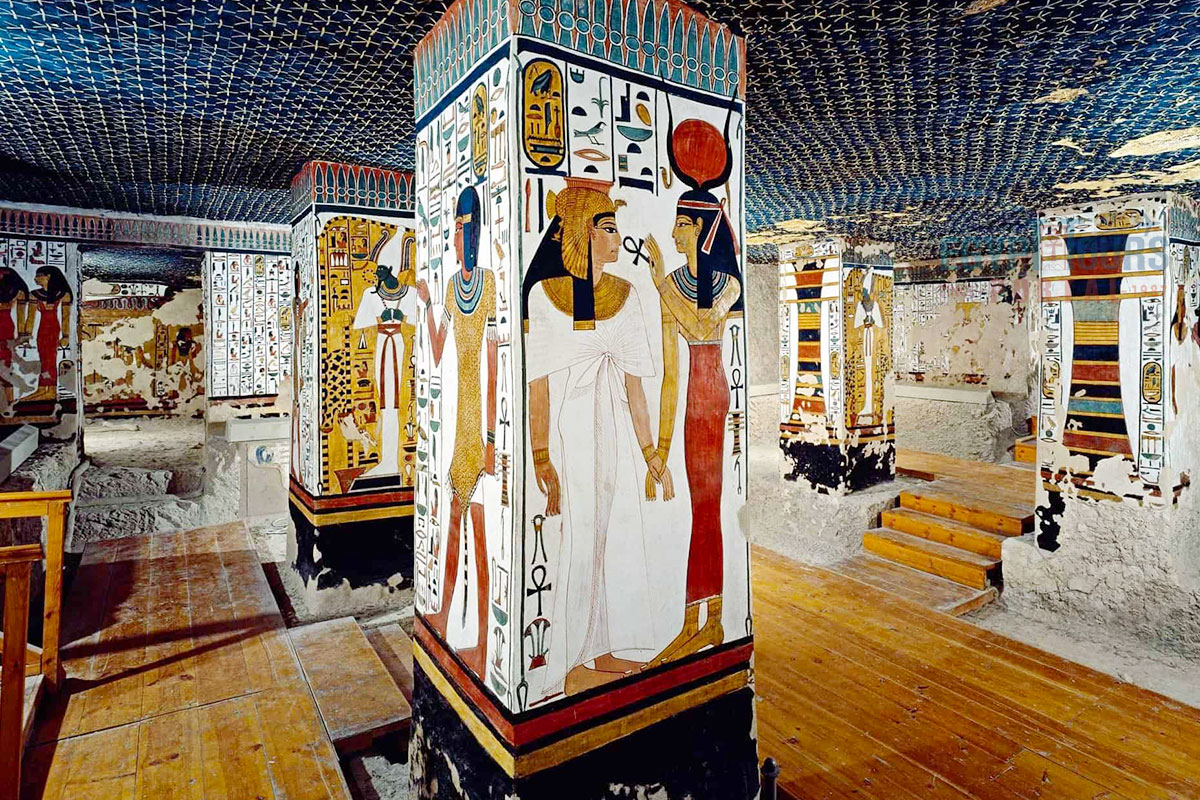
The undisputed highlight of the Valley is QV66, the tomb of Nefertari, the favorite wife of Ramesses II. Often described as the "Sistine Chapel of Ancient Egypt," its preservation and artistic quality are unparalleled.
The Aesthetics of Divinity: The walls are adorned with incredibly vibrant, high-relief paintings that depict Nefertari in the company of the gods—most notably Isis, Hathor, and Osiris. Unlike the more austere tomb decorations of the kings, Nefertari’s tomb focuses on her role as a divinely sanctioned partner in the afterlife, highlighting her beauty, grace, and spiritual status.
Color Palette: The use of Egyptian blue, ochre yellow, and cinnabar red remains exceptionally vivid. The painters used a unique technique of creating slightly raised reliefs before applying paint, giving the figures a tactile, three-dimensional quality that seems to move under the flicker of torchlight.
Spiritual Journey: The scenes trace the queen's journey through the Book of the Dead, guiding her through the treacherous trials of the afterlife and ultimately confirming her successful union with the solar deity.
III. Construction and Engineering
The tombs in the Valley of the Queens were carved directly into the limestone cliffs of the Theban hills, a process requiring precise engineering and artistic foresight.
The Deir el-Medina Connection: The artistry and construction of these tombs were the work of the master craftsmen from the village of Deir el-Medina. These were not mere laborers, but highly skilled artists who lived in a self-contained community, passing down their techniques for carving, plastering, and painting through generations.
Geological Challenges: The rock in the Valley of the Queens is of poorer quality than the limestone found in the Valley of the Kings. Because the rock is friable and prone to crumbling, the workers had to apply a thick layer of fine plaster over the walls before painting, which is why the tomb decorations are so incredibly detailed and smooth.
IV. Cultural Significance
The Valley of the Queens serves as a vital record of the status of women in the New Kingdom. The prominence of these tombs—and the fact that they were often commissioned by the kings as an act of profound devotion—proves that these women held significant political, religious, and social influence. They were not merely consorts; they were integral to the legitimacy of the Pharaoh and the stability of the state.
Unlike the King's tombs, which are often heavily concerned with the solar cycle and the struggle against darkness, the tombs in the Valley of the Queens often focus on the protective, nurturing, and fertile aspects of the divine, reflecting a more intimate connection between the deceased and the pantheon.