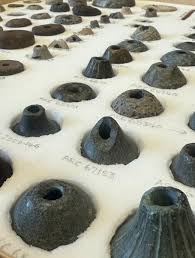
The textile industry was a cornerstone of Viking Age society, functioning not merely as a craft but as a vital economic engine, a medium for social expression, and a essential technology for survival in the harsh North Atlantic environment. Because textiles were largely organic and have decayed over the centuries, archaeologists rely heavily on the durable stone and clay tools—specifically loom weights and spindle whorls—to map the scale and reach of this industry.
I. The Engine of Production: Loom Weights
The warp-weighted loom was the standard weaving apparatus across Viking Scandinavia. Unlike modern looms where the cloth is held horizontally, this loom stood nearly vertical.
Function: Bundles of warp threads (the vertical yarns) were suspended from an upper beam and held taut by loom weights tied to the bottom. This tension was critical; if the weights were too light, the tension was insufficient for a strong weave, and if too heavy, the threads would snap.
Archaeological Value: Because these weights were typically made of fired clay or stone, they survive in the archaeological record where wooden loom frames do not. The weight and consistency of these finds allow archaeologists to determine the type of fabric produced—lighter weights correspond to fine clothing, while heavier ones indicate the production of coarse, durable wadmal (a dense woolen cloth used for sails, heavy blankets, and daily wear).
Standardization: In larger settlements and trading hubs like Hedeby or Birka, the discovery of uniform, mass-produced ceramic weights suggests that textile production was moving beyond purely domestic needs toward a more organized, commercial scale.
II. The First Step: Spindle Whorls
Before weaving could begin, raw wool or flax had to be spun into thread using a drop spindle.
Mechanism: A spindle consists of a wooden rod (shaft) and a spindle whorl (a weighted disk). The whorl acts as a flywheel, providing momentum to the spin and maintaining the tension required to twist fibers into consistent yarn.
Material and Status: Whorls were crafted from locally available materials like bone, antler, wood, amber, or stone (especially soapstone in Norway). Because spinning was a constant, repetitive task, whorls are found in virtually every Viking Age settlement. Their decoration can sometimes indicate the personal status of the spinner, as these were often cherished, individual tools.
Technological Precision: The size and weight of the whorl directly determined the quality of the yarn. A skilled spinner could manipulate the weight of the whorl to produce either fine, thin thread for luxury garments or thick, sturdy yarn for heavy-duty textiles.
III. Social and Economic Significance
Textiles were far more than just "clothing." They were a fundamental component of the Norse economy and social hierarchy:
Currency and Trade: In regions like Iceland, cloth was so vital and standardized that it functioned as a legitimate currency. Legal standards regulated the "thread count" and quality of this cloth, which was used to pay taxes, settle fines, and purchase goods in international markets.
Gendered Power: Textile production was almost exclusively the domain of women. The tools of the trade—the loom, the sword beater (used to pack weft threads), and the spindle—are iconic markers of female identity in the archaeological record. In the Norse worldview, the power to weave was seen as profound; in sagas and myths, fate itself is often described as being "woven" by female figures like the Norns.
A Strategy for Survival: Textile production allowed the Vikings to adapt to a changing climate. During the cooling periods of the medieval era, archaeological evidence shows that Norse communities shifted their fiber sources—incorporating goat hair or even arctic hare fur into their wool—to create thicker, warmer fabrics.
IV. Specialized Tools of the Trade
Beyond the primary weights and whorls, the Viking textile "toolkit" included:
Sword Beaters: Smooth, sword-shaped tools of bone or wood used to beat the weft threads upward, ensuring a tight, high-quality weave. These have occasionally been mistaken for weapons by early archaeologists when found in graves.
Tablet Weaving: A specialized technique using small, perforated cards to create narrow, intricate, and highly decorative bands. These were often used to edge garments, serving as a clear indicator of status and regional identity.
The textile industry was an invisible infrastructure that enabled the Viking Age; without the ability to produce large quantities of sailcloth for their ships or warm, durable woolens to endure Arctic winters, the expansion of the Norse world across the North Atlantic would have been impossible.