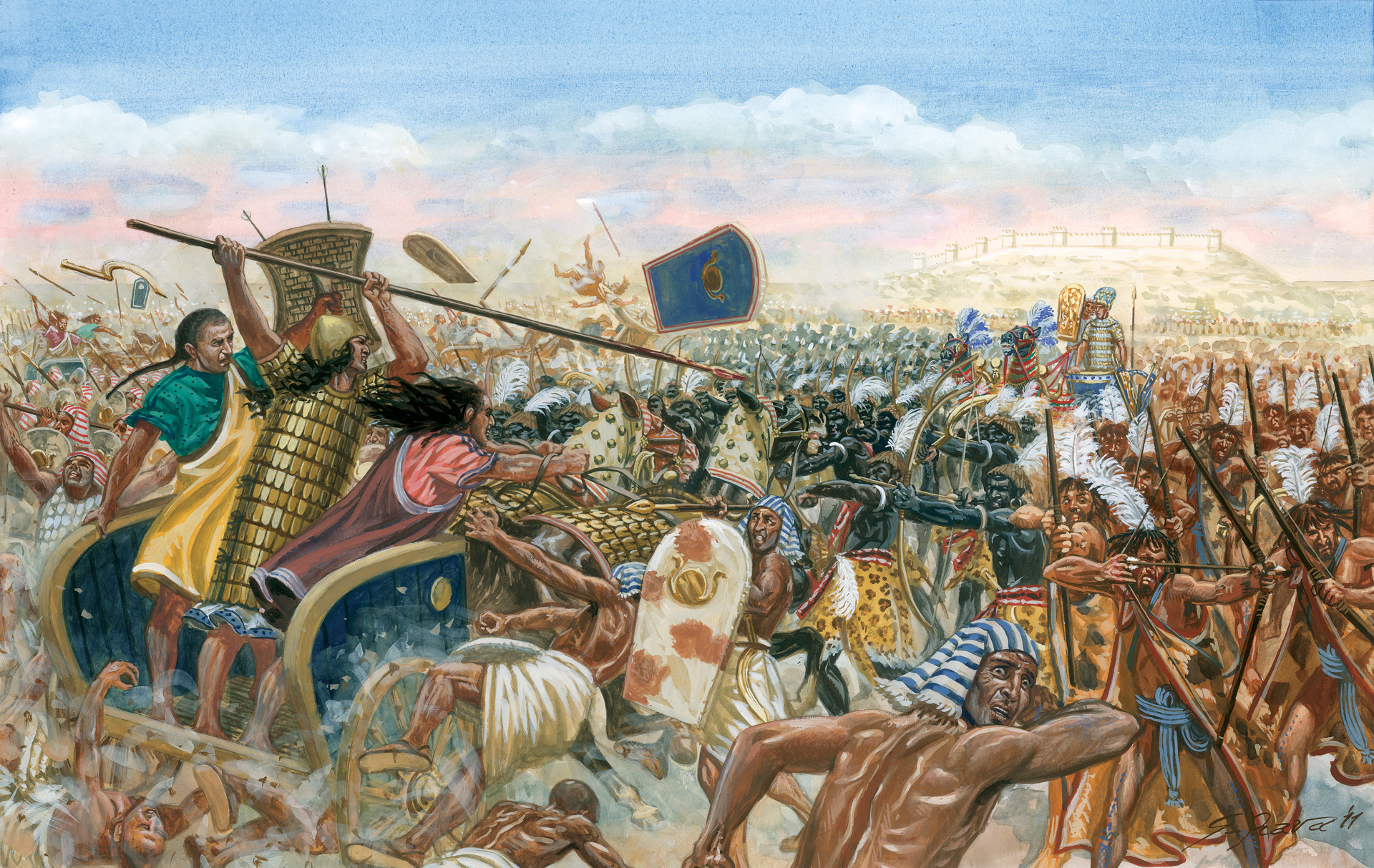
The Battle of Kadesh, fought around 1274 BCE between the Egyptian Empire under Ramesses II and the Hittite Empire under Muwatalli II, stands as one of the most significant military engagements of the ancient world. While it was a tactical stalemate, it resulted in what historians widely recognize as the world’s first recorded international peace treaty—a document that remains a masterpiece of ancient diplomacy.
I. The Conflict: Ambition and Miscalculation
The battle was fought over the strategically vital city of Kadesh in modern-day Syria, a key hub on the trade routes connecting the Mediterranean to the Near East.
The Trap: Ramesses II, eager to reclaim territory lost to the Hittites, marched his army toward Kadesh. Believing false intelligence provided by Hittite double agents, he was led to think the Hittite army was far away. In reality, the massive Hittite force was waiting in ambush behind the city.
The Near-Disaster: When the Hittite chariots launched a surprise attack on the Egyptian Ra division, the Egyptian army was caught in disarray. Ramesses narrowly avoided total defeat, personally rallying his troops and holding the line until reinforcements from the coastal Amurru territory arrived.
The Stalemate: The battle continued for hours with immense casualties on both sides. By the end of the day, neither side had secured a decisive victory, and both forces were too depleted to continue. Ramesses returned to Egypt claiming a grand personal victory, while the Hittites maintained their hold on Kadesh.
II. The Diplomacy: The First International Treaty
The realization that neither empire could decisively crush the other led to a period of uneasy tension, culminating in the Eternal Treaty (or the Treaty of Kadesh) signed about 15 years later.
The Negotiators: The treaty was negotiated between Ramesses II and the new Hittite king, Hattusili III.
Key Provisions:
Non-Aggression: Both empires pledged to maintain a permanent state of peace and to never invade each other's territory.
Mutual Defense: The treaty included a defensive alliance; if either king were attacked by a third party or faced internal rebellions, the other promised to provide military assistance.
Extradition: Perhaps most remarkably, the treaty established an early framework for extradition, requiring both parties to return political fugitives and defectors to their country of origin.
Enduring Legacy: The text of this treaty is so sophisticated that it was inscribed on the walls of the Karnak Temple in Egypt. A copy of the Hittite version (on a clay tablet) was also discovered in the Hittite capital of Hattusa in modern-day Turkey. Today, a reproduction of this treaty hangs in the United Nations headquarters in New York as a symbol of the world's oldest enduring diplomatic agreement.
III. The Strategic Evolution of Chariot Warfare
Kadesh also marked the peak of chariot technology in the Bronze Age.
Design Shift: The Egyptians used lighter, faster, two-man chariots designed for agility and precision archery. The Hittites utilized heavier, three-man chariots (a driver, a shield-bearer, and a warrior) designed to function like "heavy tanks" to break enemy infantry lines.
Intelligence: The battle demonstrated the critical importance of military intelligence and scouting, as the entire conflict was decided by a successful deception campaign. Kadesh essentially functioned as a "final exam" for Bronze Age tactical doctrine, showcasing both the power and the severe limitations of chariot-based armies.
The Battle of Kadesh serves as a bridge between the era of raw conquest and the era of sophisticated, state-level diplomacy. It shows a moment when two great superpowers realized that the cost of total war was simply too high, shifting their competition from the battlefield to the negotiating table.