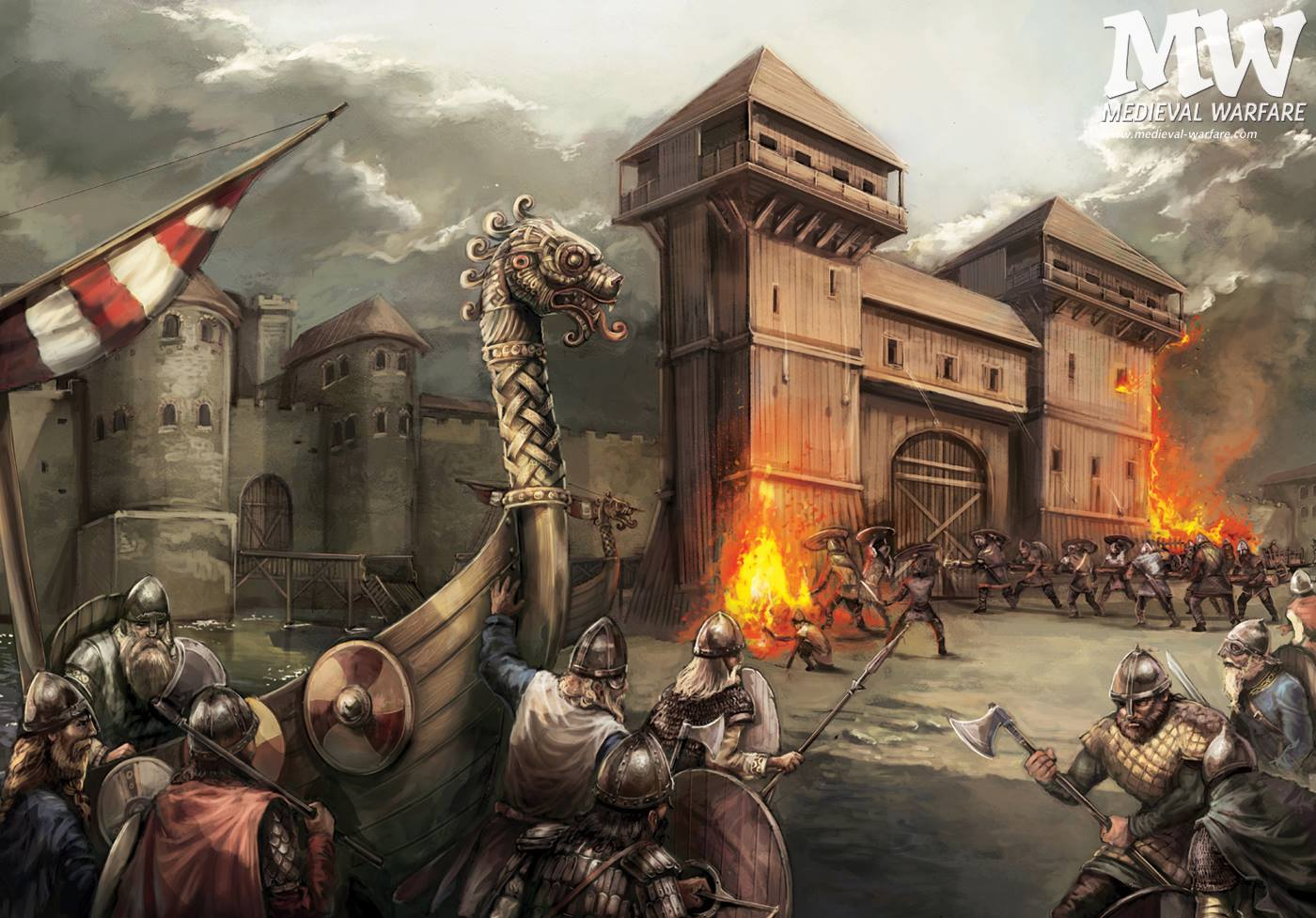
The Siege of Paris in 845 AD was a defining moment in the early Viking Age, marking one of the most successful and profitable raids conducted by Norse forces in Western Francia.
I. The Force and the Commander
In March 845, a fleet of approximately 120 Viking ships—carrying an estimated 5,000 warriors—entered the Seine River. The expedition was led by a Norse chieftain named Reginherus (or Ragnar). While popular culture and some later sagas frequently identify this individual with the legendary Ragnar Lodbrok, historians maintain a distinction between the semi-mythical saga hero and the historical figure who led this specific raid.
II. The Strategic Failure of the Franks
The success of the Viking force was largely due to the political instability of the Carolingian Empire. King Charles the Bald, grandson of Charlemagne, was embroiled in civil wars against his own brothers, which severely depleted his defensive resources and military focus.
Tactical Advantage: Upon hearing of the approaching fleet, Charles the Bald assembled a Frankish army, but he divided it into two separate forces, one for each bank of the Seine. The Vikings, displaying superior tactical awareness, attacked one of these divisions, quickly overwhelming them. To terrorize the remaining Frankish forces, the Vikings hanged 111 prisoners on an island in the Seine in full view of the other Frankish division.
The "Siege": The city of Paris—at the time primarily contained on the Île de la Cité—was effectively undefended. There was no true "siege" in the conventional sense of battering down massive fortifications, as the city lacked the complex defensive walls it would develop in later centuries. The Vikings entered the city with little resistance on Easter Sunday, March 29, 845, and began to plunder the region.
III. The Danegeld Precedent
The withdrawal of the Vikings was not the result of a military victory by the Franks, but rather a pragmatic, if costly, financial transaction.
The Ransom: King Charles the Bald agreed to pay the Vikings a ransom of 7,000 French livres (approximately 2,570 kg) of silver and gold to cease their attacks and withdraw.
A Lasting Legacy: This payment is widely cited as the first of thirteen such tributes—later known as Danegeld—paid by the Frankish kings to Viking raiders. While it bought immediate peace, the ransom ultimately served to incentivize further raids by demonstrating the extreme profitability of extorting the Frankish crown.
IV. The Human Cost
Despite their material success, the raid was not without its own tragedies for the Vikings. Many of the warriors reportedly succumbed to a plague (often identified as dysentery) that broke out in their camp during the occupation. Historical accounts suggest that even the leader, Ragnar, was deeply affected by the loss of his men and the psychological strain of the campaign, which he later reportedly attributed to the divine wrath of Saint Germain of Paris.