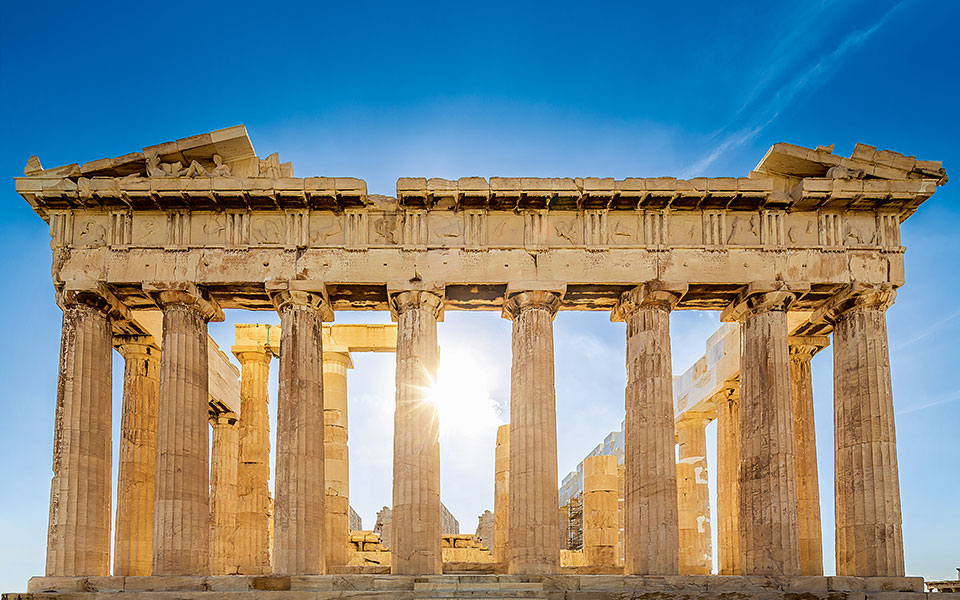
Ancient Greek Architecture: The Optical Illusions of the Parthenon
The Parthenon, standing atop the Athenian Acropolis, is often cited as the pinnacle of Doric architecture. However, its reputation for perfection is a bit of a trick. Built between 447 and 432 BCE by the architects Iktinos and Kallikrates, the temple contains almost no straight lines. The Greeks understood that a perfectly "true" geometric building would appear sagging, distorted, or fragile to the human eye. To correct this, they employed a series of sophisticated "optical refinements"
1. Entasis: The Swelling of the Columns
If a column were a perfect cylinder, the human eye would perceive it as being slightly concave—as if it were "pinched" in the middle and under too much weight.
The Solution: The architects gave the columns a subtle outward curve, or "swelling," known as entasis.
The Effect: This slight bulge makes the columns appear straight and strong, as if they are actively "muscling" up to support the massive weight of the roof.
mikroman6
2. Curvature of the Horizontal Lines
On a building as large as the Parthenon, a perfectly flat base (the stylobate) would appear to sag in the middle when viewed from a distance.
The Solution: The entire floor of the Parthenon is actually a shallow dome. The center of the long sides is about 11 centimeters (4.3 inches) higher than the corners, and the short sides rise by about 6 centimeters.
The Result: To someone standing at a distance, the foundation looks perfectly level. If it were actually flat, it would look like it was bowing downward toward the earth.
3. The Lean: Vertical Inclination
To the human eye, tall vertical parallel lines often appear to "fan out" at the top, making the building look like it is about to burst outward.
The Solution: Every column in the Parthenon leans slightly inward. If you were to extend the lines of the columns upward, they would all meet at a single point approximately 2.4 kilometers (1.5 miles) in the air.
Corner Reinforcement: The corner columns are actually about 2.5% thicker than the others. Because they are seen against the bright sky rather than the dark interior of the temple, "irradiation" would make them look thinner if they were the same size as the rest.
4. The Triglyphs and the Corner Problem
In the Doric order, the frieze consists of alternating triglyphs (three-grooved panels) and metopes (sculpted panels). Standard rules dictated that a triglyph should sit centered over every column.
The Problem: At the corners, this rule would leave a "dangling" half-metope, which looked architecturally weak.
The Adjustment: The architects slightly moved the corner triglyphs toward the ends and "contracted" the space between the last two columns. This subtle shift in spacing (intercolumniation) is almost invisible to the casual observer but creates a sense of solid, closed boundaries for the structure.