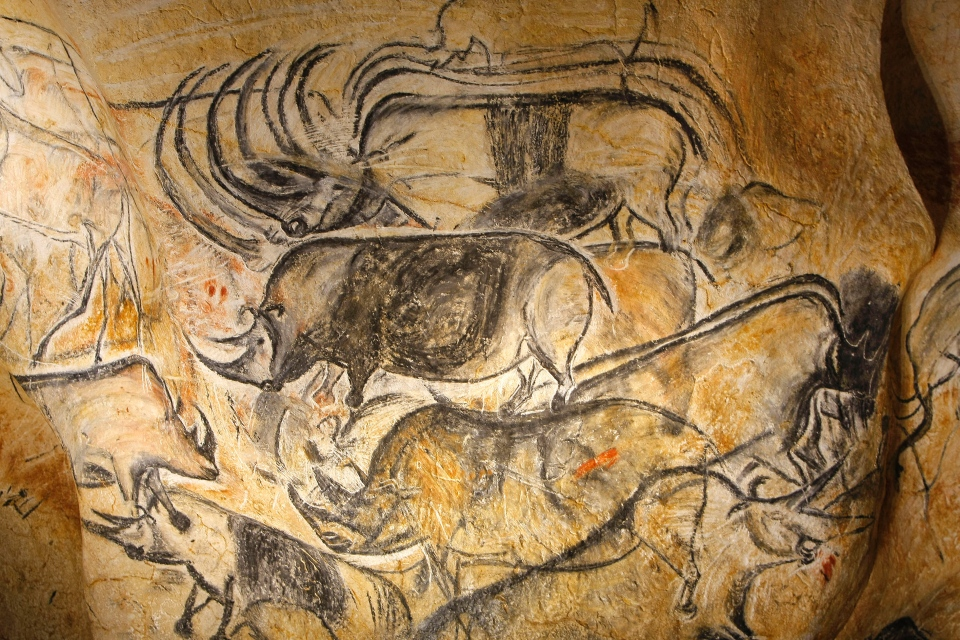
The Grotte Chauvet: Exploring the Oldest Known Figurative Cave Paintings
Discovered in 1994 by a team of three speleologists led by Jean-Marie Chauvet, the Chauvet-Pont-d'Arc Cave in southern France is one of the most significant archaeological sites in human history. Its discovery pushed back the timeline of advanced human artistic expression by thousands of years, revealing that our ancestors were master artists as early as the Upper Paleolithic.
1. A Time Capsule in Limestone
The cave was sealed by a rockfall approximately 21,000 years ago, creating a pristine "time capsule" that preserved not only the paintings but also the footprints of children and animals, and even the remains of cave bears.
Dating the Art: Using radiocarbon dating, scientists determined the cave was occupied during two distinct periods: the Aurignacian (c. 37,000 to 33,500 years ago) and the Gravettian (c. 31,000 to 28,000 years ago).
The "Lascaux" Comparison: Before Chauvet, the famous Lascaux Cave (c. 17,000 years old) was considered the peak of prehistoric art. Chauvet proved that humans were creating equally sophisticated art nearly 20,000 years earlier.
2. The Masterpieces of the Deep
The artwork in Chauvet is remarkably different from other Paleolithic caves in terms of both technique and subject matter.
The Bestiary of Predators: While most cave art focuses on hunted animals like deer or bison, Chauvet features a high percentage of dangerous predators: lions, panthers, bears, and hyenas.
The Panel of Lions: This massive mural depicts a pride of lions in a hunting stance. The artists used sophisticated shading and overlapping techniques to create a sense of depth and movement.
The Panel of Horses: This panel showcases a remarkable use of charcoal to create anatomical detail and "stumping" (smudging) to provide three-dimensional volume to the horses' heads.
3. Advanced Techniques and "Pre-Cinema"
The Chauvet artists utilized the natural contours of the cave walls to give their paintings life.
The Illusion of Movement: By painting an animal with multiple sets of legs or heads in slightly different positions, the artists created a "strobe-light" effect. When viewed by the flickering light of a torch, these animals would appear to run or shake their heads.
Preparation of the "Canvas": Unlike later caves where artists painted directly onto the stone, the Chauvet artists often scraped the walls clean of debris and film before painting, creating a bright, smooth surface that enhanced the vibrancy of the pigments.
4. Human Presence and Ritual
The cave was not a dwelling; it was likely a sacred or ritualistic space.
Hand Stencils: One of the most haunting features is a series of "positive" and "negative" handprints. One specific individual, identifiable by a slightly crooked pinky finger, left prints throughout the cave, allowing us to follow a single human's journey through the darkness 30,000 years ago.
The Venus and the Sorcerer: In the deepest part of the cave, painted on a hanging limestone pendant, is a depiction of a female lower body (the "Venus") intertwined with a bison-headed figure (the "Sorcerer"). This suggests a complex mythological or shamanic belief system.To protect the fragile environment and prevent the growth of mold (which damaged Lascaux), the original cave is closed to the public. However, a stunning, full-scale replica called Chauvet 2 was opened nearby, allowing visitors to experience the awe of the "First Artists."