Introduction: The Topography of the Divine
To the ancient Greeks, myths were not abstract fables confined to scrolls; they were historical realities anchored directly into the physical landscape. The gods were thought to inhabit the very valleys, mountains, and springs that the Greeks passed every day. Wherever a strange geological anomaly occurred—a deep cave, a jagged peak, or a sulfuric spring—the Greeks recognized a portal to the divine and built a sanctuary to mark it.
Through the lens of classical archaeology, excavating these sacred sites reveals how deeply myth and architecture were intertwined. Sanctuaries like Delphi, Olympia, and Eleusis were meticulously engineered to amplify the mythical identity of the landscape. By studying the physical ruins, votive offerings, and temple layouts, historians can trace how the Greeks translated their cosmic pantheon into stone, transforming the natural topography of Greece into a physical map of the divine.
1. The Oracle of Apollo at Delphi: The Center of the Universe
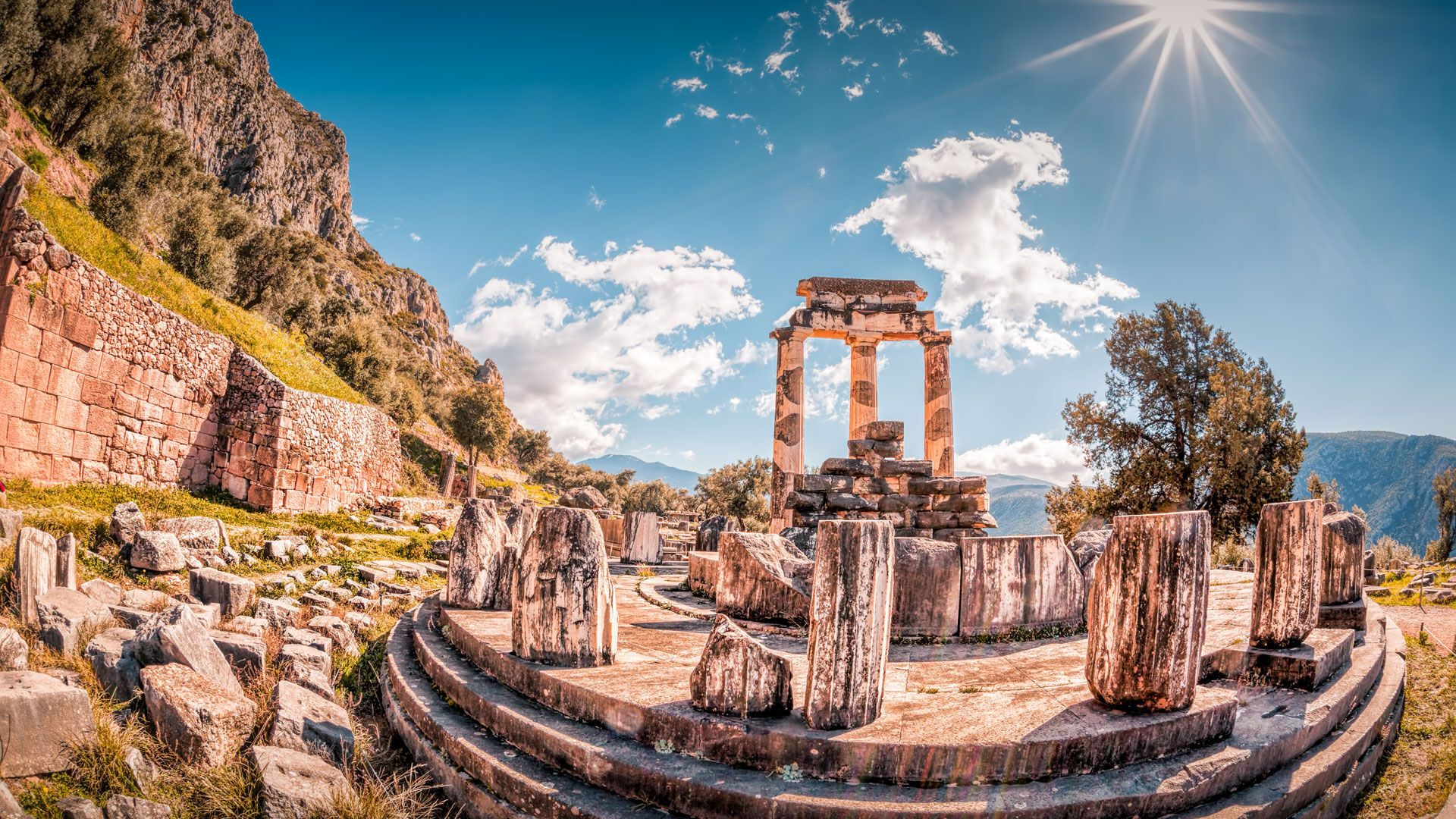
Perched precariously on the dramatic, rocky slopes of Mount Parnassus sits Delphi, the panhellenic sanctuary of Apollo. In Greek mythology, this was the Omphalos—the literal navel of the earth—discovered by Zeus when he released two eagles from opposite ends of the cosmos and they crossed paths over this exact spot.
The Myth of the Python: Long before Apollo claimed the site, the mountain fissure was guarded by Python, a monstrous serpent child of Gaia (the Earth Mother). Apollo descended from Mount Olympus, slew the beast with his golden arrows, and buried its body beneath the temple floor. The site was renamed Delphi (from delphys, meaning womb), and Apollo established his oracle there to purge his blood-guilt.
The Sacred Fissure: The core of the archaeological site is the Adyton—the inner, subterranean chamber beneath the Temple of Apollo. Here sat the Pythia, the high priestess, suspended over a natural chasm on a bronze tripod. Excavations by geologists and archaeologists have revealed that the temple sits directly atop the intersection of two major geological fault lines (the Delphi and Kernaria faults). This cross-faulting caused bituminous limestone to frictionally heat, releasing low concentrations of ethylene and methane gas into the chasm, which likely induced the trance-like, prophetic states of the priestess.
The Treasury Route: As consultants walked up the Sacred Way toward the oracle, they passed an architectural gauntlet of civic treasuries built by competing city-states. These structures were packed with spoils of war, serving as a material reminder that every political move in the Greek world was validated by Apollo's divine voice.
2. The Sanctuary of Zeus at Olympia: The Cosmic Throne
Located in the fertile, green valley of Elis in the western Peloponnese, Olympia was the supreme religious sanctuary dedicated to Zeus, the king of the gods.
The Pelopion and the Chariot Race: While the site is famous for the Olympic Games, its oldest archaeological core is the Pelopion, a small, enclosure tomb dedicated to the hero Pelops. According to myth, Pelops won the local kingdom—and the hand of Princess Hippodamia—by defeating her murderous father, King Oenomaus, in a high-stakes chariot race by replacing the king's bronze axle pins with beeswax. The Olympic Games were established to honor Pelops' victory and Zeus' oversight of oaths.
The Temple of Zeus: Constructed in the 5th century BC, this monumental Doric temple was designed to reflect cosmic order. The east pediment sculptures froze the moment right before Pelops' mythical chariot race, warning athletes against cheating under the eyes of Zeus.
The Phidian Workshop: Excavators discovered the literal workshop of the master sculptor Phidias just outside the temple core. Inside the ruins, archaeologists found terra-cotta molds, ivory scraps, tools, and a small black cup inscribed with the words "I belong to Phidias." This workshop was where Phidias engineered one of the Seven Wonders of the Ancient World: the 40-foot-tall Chryselephantine Statue of Zeus. Crafted from sheets of pure gold and ivory over a wooden core, the statue sat enthroned inside the temple, scaled so large that the writer Strabo noted that if Zeus were to stand up, he would unroof the temple.
3. The Cave of Psychro (Dictean Cave): The Birth of a King
High in the Lasithi Plateau of Crete sits the Dictean Cave (or Psychro Cave), a deep, dramatic limestone cavern packed with stalactites and subterranean pools.
The Myth of the Infanticide: According to Hesiod's Theogony, the Titan Cronus, terrified of a prophecy that he would be overthrown by one of his children, swallowed his newborn offspring whole. When Rhea gave birth to her sixth child, Zeus, she tricked Cronus by handing him a stone wrapped in swaddling clothes. She then hid the infant Zeus deep inside this Cretan cave.
The Kouretes Warriors: To drown out the cries of the baby god, local mythological warriors known as the Kouretes performed a frenzied, loud dance outside the cave entrance, clashing their bronze shields and spears together whenever the infant wept.
The Bronze Votive Horde: Excavations inside the dark, watery depths of the cave validated its status as a premier Bronze Age pilgrimage site. Archaeologists recovered thousands of votive offerings dating back to the Minoan era, including bronze double-axes (labrys), miniature shields, bronze statuettes of bulls, and intricately carved libation tables trapped within the stalagmite formations, proving that the cave had been revered as a womb of divine power for over a thousand years before classical Greece emerged.
4. The Telesterion at Eleusis: The Portals of Demeter and Hades
Located just 11 miles northwest of Athens along the Sacred Way sat Eleusis, the home of the Eleusinian Mysteries—the most secretive, profound religious cult of the ancient Mediterranean.
The Abduction of Persephone: Myth tells us that Hades, god of the underworld, tore open the earth at Eleusis to abduct Demeter’s daughter, Persephone. Grieving and desperate, Demeter (the goddess of agriculture) wandered the earth in the guise of an old woman, eventually resting at Eleusis by the "Maiden's Well." Out of despair, she withheld her agricultural blessings, plunging the earth into the first barren winter.
The Telesterion Chamber: Unlike traditional Greek temples designed to be viewed from the outside, the Telesterion was a massive, square initiation hall engineered from the inside out. It featured a forest of internal columns supporting a roof that could hold thousands of initiates huddled together in absolute, windowless darkness.
The Plutonion Cave: Directly adjacent to the Telesterion sits the Plutonion—a shallow, triangular limestone cave that the Greeks identified as the physical gate of Hades through which Persephone ascended and descended every year. During the secret night-time initiation rituals, high priests would emerge from this dark cave into a blazing wall of torchlight to reveal a single ear of reaped wheat, a visual guarantee to the initiates that life could blossom directly out of the dark soils of death.
5. The Sanctuary of Poseidon at Sounion: The Maritime Sentinel
Jutting dramatically into the Aegean Sea at the absolute southernmost tip of the Attic peninsula sits Cape Sounion, dominated by the gleaming white marble ruins of the Temple of Poseidon.
The Contest for Athens: Sounion marked the territorial boundary of Athens' maritime empire. In myth, Poseidon was fiercely competitive with Athena for control of Attica. While Athena won the capital city by planting the first olive tree, Poseidon maintained his fierce grip on the jagged coastal headlands, striking the rock with his trident to create a saltwater spring.
The Tragedy of Aegeus: Sounion is the tragic geographic anchor of the myth of Theseus and the Minotaur. King Aegeus of Athens stood on the cliffs of Sounion, scanning the horizon for his son’s returning ship from Crete. Theseus had forgotten his promise to swap his ship's black sails for white ones to signal his survival. Seeing the black sails, Aegeus despaired and threw himself off the Sounion cliff into the water below, giving the Aegean Sea its permanent name.
The Agri-Marble Engineering: The 5th-century BC temple was constructed out of local Agrileza marble. Unlike Athenian marble packed with iron that turns golden over time, Sounion marble lacks iron, meaning it remains a stark, brilliant white. The architects cut fewer flutes into the columns to prevent erosion from the constant, corrosive sea spray, ensuring the temple stood as a permanent, bright beacon visible to sailors miles out at sea, signaling that they were entering the protected waters