Introduction: The Subterranean Church
Beneath the bustling streets, suburban villas, and ancient highways of Rome lies a vast, silent labyrinth of volcanic tuffs. Stretching for hundreds of miles across multiple tiers, the Roman Catacombs serve as the premier archaeological repository of early Christian society. Constructed primarily between the 2nd and 5th centuries AD, these subterranean cemeteries were excavated out of absolute necessity, driven by a profound cultural clash over how to treat the dead.
For centuries, a persistent popular myth maintained that the catacombs were secret, underground hideouts where Christians huddled to escape imperial persecution. Archaeological excavations have thoroughly debunked this narrative; the catacombs were public, legally recognized communal cemeteries well known to Roman authorities. What makes them an unparalleled cultural treasure is their dual role as the birthplace of Christian art. On these dark, damp volcanic walls, a marginalized, developing community transitioned away from classical pagan iconography, inventing a brand-new visual language of hope, resurrection, and spiritual salvation that ultimately reshaped the artistic trajectory of Western civilization.
1. The Geological and Cultural Catalyst
The creation of the catacombs was born from a convergence of Rome’s unique geology and a radical shift in religious theology.
The Tuff Advantage: The landscape surrounding Rome is dominated by tufo, a soft, porous volcanic rock formed by ancient eruptions. When freshly exposed to air, tuff is remarkably soft and can be easily carved out using basic iron pickaxes. However, once exposed to the atmosphere over time, it undergoes a chemical dehydration process that hardens it, allowing engineers to cut deep, vertical shafts and multi-tiered galleries without the structure collapsing.
The Clash of Burial Practices: Traditional Roman society practiced cremation, viewing the burning of the body as a clean, standard method of releasing the soul. Christians, however, fiercely rejected cremation. Influenced by Jewish tradition and the literal belief in the future bodily resurrection of the dead at the Second Coming, they mandated inhumation (burial of the intact body).
The Real Estate Crisis: As the Christian population of Rome swelled in the 2nd century, the community faced a severe crisis. Roman law strictly forbade burials within the city walls (pomerium) for sanitary reasons. Surface land along the major consular roads like the Via Appia was tightly controlled and prohibitively expensive. To bury thousands of bodies intact without purchasing massive tracts of surface land, Christian communities began digging straight down into the volcanic bedrock.
2. Subterranean Engineering: The Anatomy of a Catacomb
The catacombs were planned, engineered, and managed by a highly specialized guild of Christian laborers known as fossors (fossores). These subterranean miners acted as a combination of cemetery architects, gravediggers, and low-ranking clergy.
The Ambulacra (Galleries): Fossors began by sinking a vertical staircase down into the earth. From the base, they tunneled out long, narrow corridors called ambulacra, typically measuring just 3 to 4 feet wide. As space ran out, they dug deeper into the floor, creating multiple vertical levels of galleries connected by steep stairs, sometimes reaching up to five tiers deep.
The Loculi (Slot Graves): The walls of the ambulacra were packed with rows of rectangular, shelf-like slots called loculi. Bodies were wrapped in simple linen shrouds dusted with preservatives like Myrrh and tucked into these slots. The opening was then sealed shut with terra-cotta tiles or marble slabs, bound tightly with lime mortar to prevent the spread of odors.
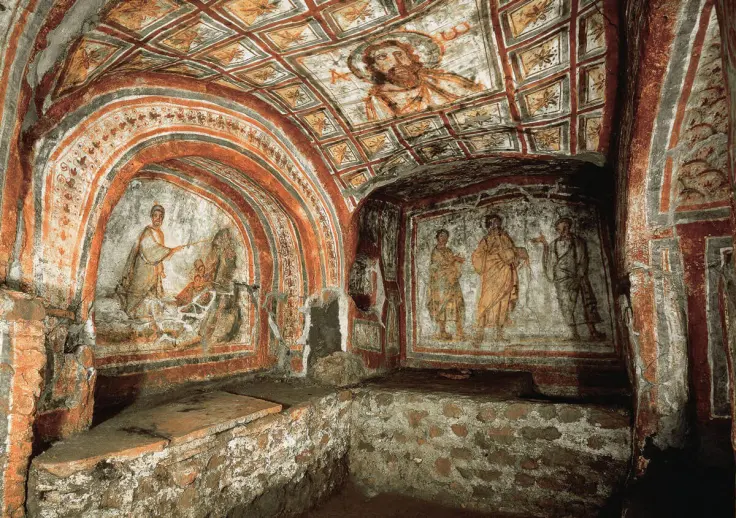
The Cubicula (Chambers): For wealthy families or prominent martyrs, fossors cut out private, square burial chambers called cubicula off the main corridors. These rooms functioned as private family chapels.
The Arcosolium (Arched Tombs): Within the cubicula, the elite were buried in arcosolia—luxurious tombs featuring a recessed, semi-circular arch carved directly into the wall above a sarcophagus-like chest, providing an ideal canvas for high-quality fresco paintings.
3. The Birth of Christian Iconography: Cryptic Coding
Because Christianity remained an illicit religion (religio illicita) until the Edict of Milan in 313 AD, early Christian art in the catacombs had to operate on two levels. It used a system of cryptic, symbolic coding that looked completely innocent to pagan Roman inspectors but carried deep, theological meaning to baptized believers.
The Good Shepherd: The most ubiquitous figure in early catacomb art, such as those found in the Catacomb of Priscilla, is a young, clean-shaven man carrying a sheep across his shoulders. To a pagan, this was a familiar, pastoral artistic motif representing humanitas or seasonal harmony. To a Christian, it was a direct visual citation of the Gospel of John: "I am the good shepherd; the good shepherd lays down his life for the sheep."
The Ichthys (The Fish): Because the Greek word for fish, $\text{I-X-Θ-Y-Σ}$, formed an acronym for "Jesus Christ, Son of God, Savior" ($\text{I}\eta\sigma o\tilde{\upsilon}\varsigma$ $\text{X}\rho\iota\sigma\tau\text{ó}\varsigma$ $\text{Θ}\epsilon o\tilde{\upsilon}$ $\text{Y}\iota\text{ó}\varsigma$ $\Sigma\omega\tau\dot{\eta}\rho$), drawing a simple fish silhouette on a tomb marker was a shorthand confession of faith.
The Anchor: Outwardly resembling a standard maritime symbol, the anchor was used in the catacombs as a disguised cross, symbolizing the hidden hope of salvation holding the soul steady through the storms of life and death.
The Orant Position: Frescoes frequently depict figures standing with their arms extended out wide, palms facing upward in prayer. This ancient gesture, known as the orant stance, represented the soul of the deceased experiencing the peace of paradise, praying for the living family members left behind on earth.
4. Biblical Narratives of Salvation
As the art evolved, full narrative scenes began appearing on the ceilings of the cubicula. Rather than focusing on the suffering or death of Christ—crucifixion scenes are notably absent in early catacomb art—the artists focused exclusively on stories of miraculous deliverance from death, pulling themes from both the Old and New Testaments.
Jonah and the Whale: Typically depicted in a multi-paneled cycle, Jonah is shown being thrown overboard, swallowed by a great sea monster (rendered as a classical mythological sea dragon or ketos), vomited out after three days, and resting under a gourd vine. This narrative was heavily utilized because Christ himself had cited Jonah as the definitive prefiguration of his own resurrection.
The Three Hebrews in the Fiery Furnace: Taken from the Book of Daniel, this scene shows three young men standing in the middle of raging flames, unhurt, with their arms raised in the orant position. It served as a powerful metaphor for the Christian community's survival through the fires of imperial persecution.
The Raising of Lazarus: The premier New Testament motif shows Jesus tapping a swaddled, mummy-like Lazarus with a magic-like wand, commanding him to step out of his tomb. It was placed directly adjacent to burial slots as an absolute visual guarantee to the grieving family that the person buried within would experience the exact same resurrection.
5. Ritual and Remembrance: The Refrigerium
The catacombs were not gloomy places of abandonment; they were active spaces of ritual remembrance where the living and the dead remained in continuous contact.
The Funerary Banquet: On the anniversary of a loved one's death, or on the feasts of prominent martyrs, families descended into the catacombs to hold a commemorative ritual meal known as the refrigerium (refreshment).
The Infrastructure of Feasting: Many cubicula were excavated with stone benches (triclinia) built right into the walls, allowing family members to recline and dine directly alongside the tombs of their ancestors.
The Libation Tubes: Some marble slabs sealing the loculi were engineered with small, vertical lead pipes or holes. During the refrigerium, family members would literally pour wine, milk, and honey down into the pipe, symbolically feeding the deceased loved one below and sharing the meal across the barrier of death.
6. The Post-Constantinian Shift and Ruin
Following the legalization of Christianity under Emperor Constantine, the functional role of the catacombs underwent a dramatic transformation.
The Cult of the Martyrs: Christians grew obsessed with being buried as close as possible to the tombs of celebrated martyrs (tumulum sanctorum), believing their proximity would grant them spiritual protection on Judgment Day. This led to massive structural alterations, as fossors violently cut new loculi into existing, priceless frescoes to squeeze in new bodies near holy sites.
The Above-Ground Migration: Constantine and his successors began building massive, open-air basilicas directly over the entryways of the most famous catacombs (such as San Sebastiano and Sant'Agnese). Over time, the elite abandoned underground burial entirely, preferring to be buried inside the prestigious floorboards of these new above-ground churches.
The Relic Evacuations: By the 8th and 9th centuries AD, as the Roman Empire collapsed and the unguarded suburban catacombs were repeatedly plundered by invading Lombards and Goths, successive Popes ordered a total evacuation. Armies of workers dug up the bones of thousands of anonymous Christians and packed them into carts, transferring them inside the safety of the city walls to be distributed among Rome's urban churches. The entries to the catacombs were sealed, forgotten, and swallowed by overgrowth for centuries, effectively freezing this pristine archaeological archive of early Christian life until its accidental rediscovery during the Renaissance.