The transformation of Athenian ceramic art during the 6th and 5th centuries BCE represents one of the most spectacular leaps in the history of visual art. Centered in the Kerameikos (the potters' quarter of Athens), ancient artisans advanced from rigid, geometric patterns to fluid, hyper-detailed human narratives.
This artistic evolution is defined by two revolutionary, opposing techniques that dominated the Mediterranean luxury market: Black-Figure and Red-Figure pottery.
1. The Canvas: The Three-Phase Firing Process
Before exploring the styles, it is essential to understand the chemistry that made them possible. Ancient Greek pottery did not use colored paints or glazes. Instead, the rich black and orange-red colors were achieved through a highly sophisticated, single-firing process that manipulated the oxygen levels inside the kiln.
This Three-Phase Firing relied entirely on an iron-rich liquid clay slip applied by the artist:
Phase 1: Oxidizing (The Fire): The kiln was heated to roughly 800°C with plenty of ventilation. Oxygen flooded the chamber, turning both the raw pot and the painted clay slip a uniform, vibrant red color ($Fe_2O_3$, ferric oxide).
Phase 2: Reducing (The Smothering): The potter closed the ventilation holes and tossed green wood or damp leaves into the fire, raising the temperature to 950°C. This created a smoky, oxygen-starved environment rich in carbon monoxide. The entire vessel turned jet-black ($Fe_3O_4$, magnetic iron oxide), and the painted slip chemically vitrified (melted into a smooth, glassy, impermeable layer).
Phase 3: Re-oxidizing (The Cooling): The ventilation gates were reopened, allowing oxygen back into the cooling kiln. The unpainted, porous clay absorbed the oxygen and turned back to its natural, terracotta orange-red. However, the vitrified black slip was completely sealed; it could not re-absorb oxygen and remained a glossy, deep metallic black.
2. The Black-Figure Style (c. 620–500 BCE)
Developed originally in Corinth but perfected to its absolute zenith in Athens (Attica), the Black-Figure technique dominated the 6th century BCE.
The Technique
The artist painted the silhouettes of figures onto the unbaked, red clay vessel using the iron-rich liquid slip. Once dry, the artist used a sharp, metal stylus to physically incise (scratch) fine lines through the black slip, revealing the raw red clay underneath. This allowed them to render internal details like muscles, eyes, armor patterns, and hair strands.
Key Characteristics and Masters
The Look: Figures appear as stark, sharp black silhouettes against an orange-red background. Painters often added white slip to represent women's skin and purple-red slips to accent garments or blood.
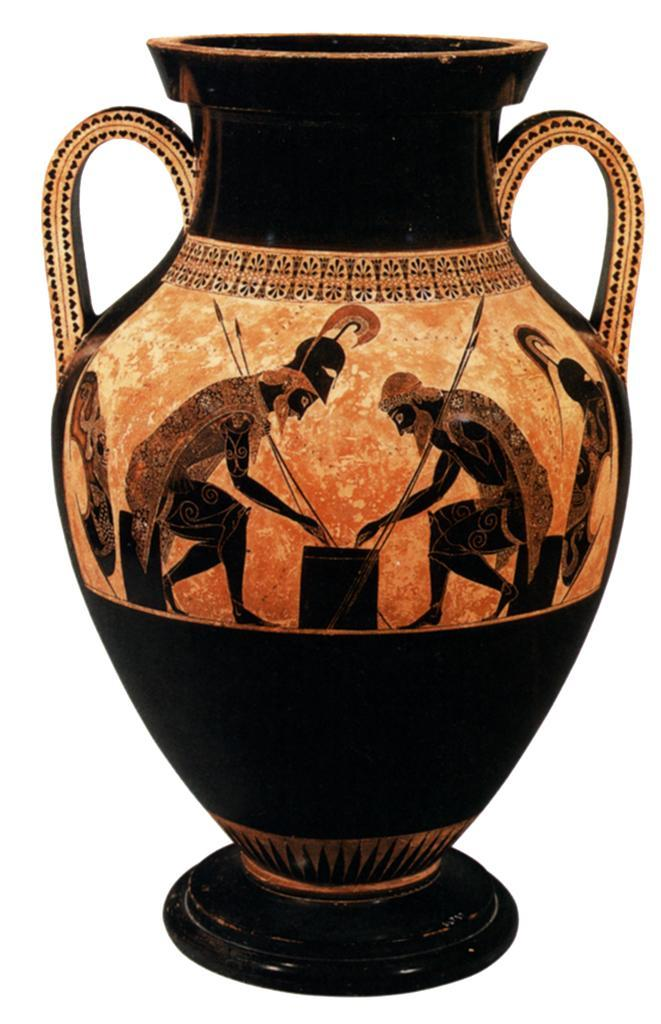
Exekias (The Master): The undisputed genius of black-figure was Exekias. His most famous work, the Vatican Amphora, depicts the heroes Achilles and Ajax playing a board game during a break from the Trojan War. Exekias captured unprecedented psychological tension purely through the precision of his incised lines, tracing microscopic details into their cloaks and hair.
3. The Red-Figure Style (c. 530–400 BCE)
Around 530 BCE, an anonymous craftsman in the workshop of the potter Andokides asked a radical question: What happens if we invert the entire process? This intellectual pivot birthed the Red-Figure style, which quickly rendered black-figure obsolete.
The Technique
Instead of painting the figures, the artist drew the outlines of the characters and then painted the entire background black, leaving the figures themselves as the raw, unpainted red clay.
Crucially, instead of using a sharp stylus to scratch away details, the artist used fine, delicate brushes or hair-tipped syringes to draw anatomical lines directly onto the red figures using varying thicknesses of the liquid slip.
The Artistic Revolution
By replacing the rigid stylus with a fluid brush, red-figure shattered the boundaries of Bronze and Archaic art:
Anatomical Realism: Artists could now vary the dilution of the slip. A thick application created a bold, raised black line, while a watered-down glaze created a soft, golden-brown wash perfect for rendering subtle muscle definition, soft drapery folds, and individual strands of hair.
Foreshortening and Perspective: For the first time in Western art, figures were no longer trapped in strict profile views. Painters like Euphronios experimented with foreshortening—drawing limbs, shields, and torsos twisting in three-dimensional space, capturing realistic movement and overlapping perspective.
4. Summary of Artistic Differences
Black-Figure Technique: Figures are painted black; details are scratched in with a sharp stylus; art style is rigid, monumental, and formal.
Red-Figure Technique: Background is painted black; details are drawn on with a fluid brush; art style is dynamic, capturing perspective, realism, and daily life.
5. The "Pioneer Group" and the Potter's Pride
The transition to red-figure sparked an era of intense, playful competition among Athenian artists. A group of contemporary painters, calling themselves the Pioneer Group (including Euphronios, Euthymides, and Phintias), used their pottery as a canvas for artistic experimentation and personal rivalries.
They moved beyond purely mythological battles to paint raw, contemporary scenes of Athenian life: sweaty wrestlers at the gymnasium, chaotic drinking parties (symposia), and artisans working in workshops.
They were highly literate and frequently signed their pots with phrases like "Euphronios egrapsen" (Euphronios painted it). On one famous amphora, Euthymides painted a group of revellers dancing and proudly inscribed a direct taunt to his chief rival across the workshop floor: "As Euphronios never could!"
Through this intense commercial and artistic rivalry, the potters of Athens transformed utilitarian kitchenware into the premier luxury export of the ancient world, establishing the foundational rules of perspective and anatomy that would later guide the high art of Western civilization.