The Mycenaean Greeks—the Late Bronze Age warriors who dominated the Aegean from roughly 1600 to 1100 BCE—built an empire on more than just military conquest. At its peak, Mycenaean civilization operated as a highly centralized, bureaucratic commercial machine.
Driven by the palatial administrative centers like Mycenae, Pylos, and Tiryns, the Mycenaeans established an aggressive maritime trade network. The lifeblood of this economic empire relied on the mass production and export of two highly lucrative, interconnected commodities: luxurious perfumed oils and the standardized, high-quality pottery used to transport them across the ancient world.
1. The Palatial Command Economy
To understand Mycenaean trade, one must look at the Linear B tablets—the oldest surviving written records in the Greek language. These clay tablets, recovered from palace archives, reveal that the manufacture of perfumed oil was a strictly controlled state monopoly.
The palaces functioned as massive command centers. Royal scribes meticulously recorded every ingredient allocated to the industry. The tablets catalog large deliveries of olive oil from local farmers, which were then handed over to state-employed aleiphoozoi (perfume-boilers) working within the palace workshops.
The scribes also tracked the purchase of imported luxury ingredients used to scent the oils, including coriander, sage, cyperus, rose petals, and costly resins imported from the Near East.
2. The Science of Bronze Age Perfume
Mycenaean perfumed oil was not a volatile, alcohol-based liquid like modern perfume. Instead, it was an oil-based unguent.
Because essential oils cannot be easily distilled in olive oil without breaking down, Mycenaean chemists used a sophisticated two-step manufacturing process:
Stypsis (Pre-treatment): Artisans first treated the raw olive oil with astringents like wild olive leaves, wine, or fenugreek. This process stripped the olive oil of its natural, heavy scent and thickened its consistency, allowing it to better absorb and hold delicate fragrances.
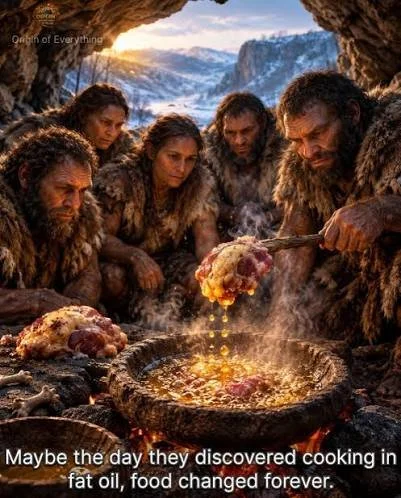
Infiltration: The treated oil was then heated in large bronze cauldrons over a slow fire, where fragrant herbs, roots, and flowers were steeped into the liquid.
Once cooled and strained, the resulting product was a thick, heavily scented, and highly durable luxury ointment. It was used by Mediterranean elites for daily hygiene, body massage, masking sweat, and as an essential component in religious rituals and elite funerals.
3. The Stirrup Jar: The Universal Shipping Container
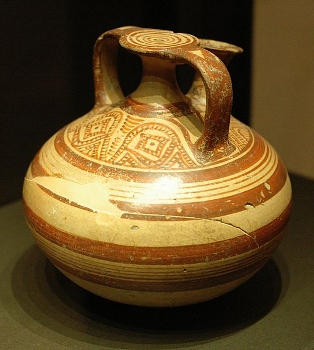
A luxury liquid is only as good as the vessel that carries it. To export this valuable oil across treacherous sea routes without spoilage or leakage, the Mycenaeans engineered a specialized, revolutionary ceramic vessel: the Stirrup Jar (false-necked amphora).
The stirrup jar was a masterpiece of utilitarian design:
The False Neck: The central neck of the jar was completely sealed shut, flanked by two sturdy handles that resembled a horse's stirrup. This allowed handlers to securely tie or rope multiple jars together in a ship's hold.
The Off-Center Spout: A separate, narrow pouring spout was positioned off to the side. This small aperture allowed users to pour out the expensive oil drop by drop, preventing waste, and could be easily plugged with a small piece of clay or wax to create an airtight seal for long voyages.
4. Mass Production and the Pottery Trade
Mycenaean pottery workshops turned out these vessels on an unprecedented, industrial scale. Utilizing the fast-moving potter's wheel and advanced kilns, they created a highly standardized product.
The Mycenaean Ceramic Style
Unlike the fluid, naturalistic, and spontaneous art of the earlier Minoans, Mycenaean pottery was highly disciplined, geometric, and uniform. Popular shapes included the stirrup jar, the alabastron (flat-bottomed ointment jars), and the elegant, long-stemmed kylix (drinking chalice).
They decorated these vessels with stylized, abstract marine motifs—such as highly geometric octopuses and nautiluses—or charging chariots painted in dark, iron-rich slips against a pale clay background.
The Brand Identity of the Bronze Age
The consistency of Mycenaean pottery was so absolute that it created an international "brand identity." Whether a merchant purchased a jar of oil in Egypt, Cyprus, or Sicily, the distinctive Mycenaean ceramic style instantly guaranteed the high quality of the luxury product inside.
5. Mapping the Maritime Trade Routes
Armed with these cargo-ready jars, Mycenaean merchant ships integrated themselves into the complex, globalized trade networks of the Late Bronze Age.
The Levantine Coast and Cyprus: Cyprus acted as a massive international trading hub. The Mycenaeans flooded Cyprus with perfumed oils and fine tableware, exchanging them for raw copper ingots shaped like oxhides, which were vital for the manufacture of bronze weaponry back in Greece.
New Kingdom Egypt: Mycenaean stirrup jars have been excavated in massive numbers at Akhetaten (Amarna), the capital of Pharaoh Akhenaten. The Egyptians highly prized Mycenaean oils for cosmetic use, trading them for gold, alabaster, and linen.
The Western Mediterranean: Mycenaean pottery has been recovered as far west as Sicily, Sardinia, and the Italian boot, demonstrating that their economic reach extended well beyond the wealthy kingdoms of the East.
6. The Uluburun Shipwreck: A Snapshot of Commerce
The ultimate archaeological proof of this vibrant trade network comes from the Uluburun Shipwreck, a late 14th-century BCE merchant vessel discovered off the coast of modern Turkey.
The ship’s cargo represents a physical cross-section of the Bronze Age economy. Alongside ten tons of Cypriot copper and a ton of tin, archaeologists recovered dozens of Mycenaean stirrup jars. Chemical analysis of the residues inside these jars confirmed they originally held Aegean olive oil and resinous perfumes, proving that Mycenaean luxury goods traveled alongside the most vital raw materials of the ancient world.
Through this sophisticated marriage of chemical engineering and ceramic mass production, the Mycenaeans transformed simple olive oil into a high-value global currency. This trade network didn't just fill the palace treasuries with gold and copper; it distributed Mycenaean material culture across thousands of miles of coastline, ensuring their artistic and commercial legacy dominated the Mediterranean centuries before their civilization collapsed into the Dark Ages.