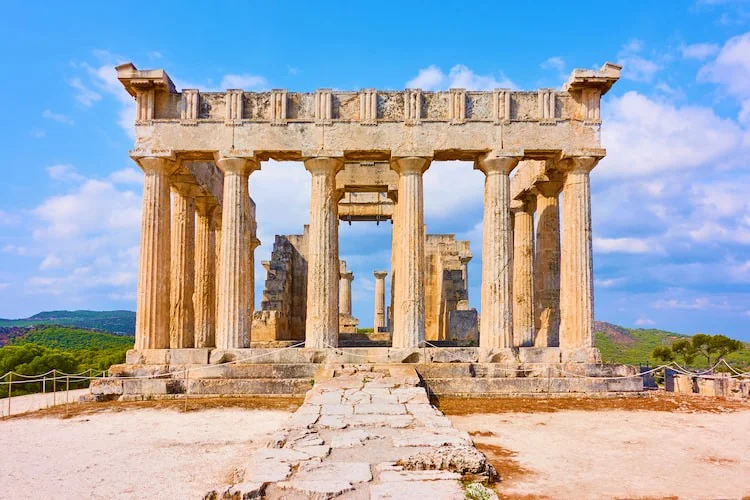
The Temple of Aphaia, perched high on a pine-covered ridge on the island of Aegina, stands as one of the most brilliant architectural and sculptural masterpieces of Archaic Greece. Looking out over the Saronic Gulf toward Athens, this remarkably well-preserved sanctuary marks the precise structural pivot point where traditional, rigid Archaic design evolved into the fluid harmony of the Classical style.
What makes this temple truly captivating to historians and archaeologists is its dedication to a mysterious, highly localized goddess found nowhere else in Greece, alongside the dramatic, competitive story told by its famous pediment sculptures.
1. The Mysterious Goddess: Who was Aphaia?
While major temples throughout Greece were usually dedicated to pan-Hellenic heavyweights like Zeus, Apollo, or Athena, the people of Aegina directed their highest devotion on this ridge to Aphaia.
According to local mythology recorded by the writer Pausanias, Aphaia was originally a beautiful Cretan semi-divinity named Britomartis, a favorite companion of the huntress goddess Artemis. To escape the aggressive, unwanted romantic advances of King Minos of Crete, Britomartis leaped off a cliff into the sea.
She was rescued by the nets of Aeginetan fishermen, but when one of the fishermen also became infatuated with her, she fled up into the remote mountain groves of Aegina. When her pursuers closed in, she miraculously vanished into thin air.
The Invisible Lady: The local population deified her on the spot, naming her Aphaia, which translates directly from ancient Greek as "The Invisible One" or "The Vanished One." Her cult was ancient, dating back to prehistoric times as a fertility and nature goddess. As Aegina grew into a dominant maritime and political power in the 6th century BCE, the islanders completely rebuilt her rustic mountain shrine into a grand, stone sanctuary to showcase their wealth and independent identity.
2. Architectural Mastery: The Transition to Classical Harmony
The temple we see standing today was constructed around 500–475 BCE, built directly over the charred remains of an earlier Archaic temple that had burned down.
Constructed out of local Poros limestone (originally coated in a fine, smooth plaster made of marble dust and painted in vibrant colors), the building is a Doric peripteral temple, featuring a grid of 6 columns across the front and back, and 12 columns running down the sides ($6 \times 12$).
The architecture of the Temple of Aphaia is a masterclass in early optical refinement, showing that Greek architects were moving away from rigid mathematical formulas to design for the flaws of human vision:
The Inward Lean: To prevent the heavy stone building from appearing top-heavy or unstable to a viewer standing below, the exterior columns are engineered with a subtle inward inclination.
The Corner Thickening: The columns on the absolute corners of the temple are made slightly thicker than the inner columns. This adjustment compensated for the fact that corner columns are silhouetted against the bright, open sky, which visually tricks the human eye into making them look thinner than they actually are.
The Double-Tiered Cella: Inside the inner chamber (cella) where the sacred cult statue stood, the architects designed a beautiful, space-saving layout featuring two internal rows of columns arranged in a double tier—one smaller set of columns stacked directly on top of a larger lower set—to support the heavy wooden roof beams without blocking the interior view.
3. The Great Pediment Rivalry: Archaic vs. Classical Style
The absolute artistic climax of the Temple of Aphaia lies in its pediments—the large, triangular gables at the eastern and western ends of the roof line line. These pediments housed a series of life-sized, free-standing marble sculptures that were discovered in 1811 and are now housed in the Glyptothek in Munich, Germany.
Both pediments depict a legendary military theme highly dear to Aeginetan pride: the Trojan Wars. Specifically, they showcase Aeginetan heroes like Telamon and Ajax fighting alongside Heracles and King Agamemnon against the Trojans.
Remarkably, the two pediments were carved just a couple of decades apart, yet they represent a massive, tectonic shift in the history of Western art.
The West Pediment (c. 500 BCE) – The Late Archaic Style
The West Pediment was carved first. Even though the scenes depict a violent, chaotic bloodbath of warriors clashing with spears, the sculptures are bound by rigid Archaic conventions.
The Dynamic: The figures move along a flat, two-dimensional plane, looking like stiff puppets frozen in place.
The Archaic Smile: Most famously, a fallen warrior on the far left, depicted with an arrow sticking straight out of his chest, lies dying while staring directly out at the audience with a blank, eerie, and stylized Archaic smile. To the Archaic sculptor, the smile was a symbolic convention used to show that the character was alive and conscious, completely overriding the physical and psychological reality of agony and death.
The East Pediment (c. 480 BCE) – The Early Classical (Severe) Style
The East Pediment was carved later, likely to replace an earlier set damaged during a military conflict. In the short span of roughly twenty years, Greek art completely transformed.
The Dynamic: The figures on the East Pediment break free of the flat plane, twisting, lunging, and collapsing in realistic, three-dimensional space with complex anatomical movement (contrapposto).
The Psychological Realism: The dying warrior on the East Pediment does not smile. He faces down toward the earth, his body heavily sagging into his shield, his leg muscles straining, and his face contorted in a realistic, stoic expression of pain and fading strength. The art had abandoned stiff symbolism to capture genuine human psychology and physical gravity.
4. The Sacred Triangulation of the Saronic Gulf
Beyond its internal architecture, the Temple of Aphaia participates in a grand, regional geographic design. In the 20th century, topographers and historians noted that the Temple of Aphaia on Aegina forms a nearly perfect isosceles triangle with two of the greatest sanctuaries on the Greek mainland: the Parthenon on the Athenian Acropolis and the Temple of Poseidon at Sounion.
                         [ The Parthenon (Athens) ]
                                    / \
                                   /   \
                                  /     \
                                 /       \
                                /         \
    [ Temple of Aphaia (Aegina) ] --------- [ Temple of Poseidon (Sounion) ]
This phenomenon, often referred to as the Sacred Triangle of the Aegean, demonstrates that classical Greek sanctuaries were not built at random. Their placement was carefully calculated based on visual sightlines, territorial boundaries, and sacred geometry, ensuring that a sailor navigating the treacherous waters of the Saronic Gulf was almost always within visual layout of a major monument of divine protection.
The Temple of Aphaia stands as a vital missing link in our understanding of antiquity. By preserving the exact architectural transition where the stiff, symbolic rules of the Archaic age gave way to the humanism, anatomy, and psychological depth of the High Classical era, this mountain sanctuary ensures that the name of the "Invisible Goddess" remains permanently etched into the story of human art.