Unlike their successors on the Greek mainland, who worshipped a highly patriarchal pantheon led by thunderbolt-wielding Zeus, the Bronze Age Minoans of Crete directed their highest spiritual devotion toward the feminine.
At the absolute center of Minoan religion was a powerful, multi-faceted nature deity often referred to by historians as the Mother Goddess or Great Goddess. Her cult dominated palatial life, driving a religious culture that celebrated fertility, the natural world, cosmic sovereignty, and the ecstatic connection between humanity and the divine.
1. Epiphany and Nature: The Identity of the Goddess
The Minoans did not leave behind readable mythological texts—their script, Linear A, remains untranslated. Consequently, our entire understanding of the Mother Goddess comes from their vibrant, exceptionally preserved visual art.
Minoan art suggests that the Mother Goddess was not a distant, abstract celestial entity, but an immanent force deeply woven into the earth, the sea, and the sky. She frequently appears in multiple specialized iconography roles:
The Mistress of Animals (Potnia Theron): The Goddess is routinely depicted flanked by heraldic lions, griffins, or hunting hounds, demonstrating her absolute sovereignty over the wild, untamed forces of nature.
The Mountain Mother: In many seal impressions, she is shown standing proudly atop a rugged mountain peak, holding out a staff of authority while priests or worshippers bow below her.
The Vegetation Goddess: She is frequently depicted sitting beneath sacred trees (such as olive or fig trees), receiving offerings of fruits and grain, tying her cult directly to agricultural fertility and the cyclical rebirth of the seasons.
2. Iconic Manifestations: The Snake Goddesses
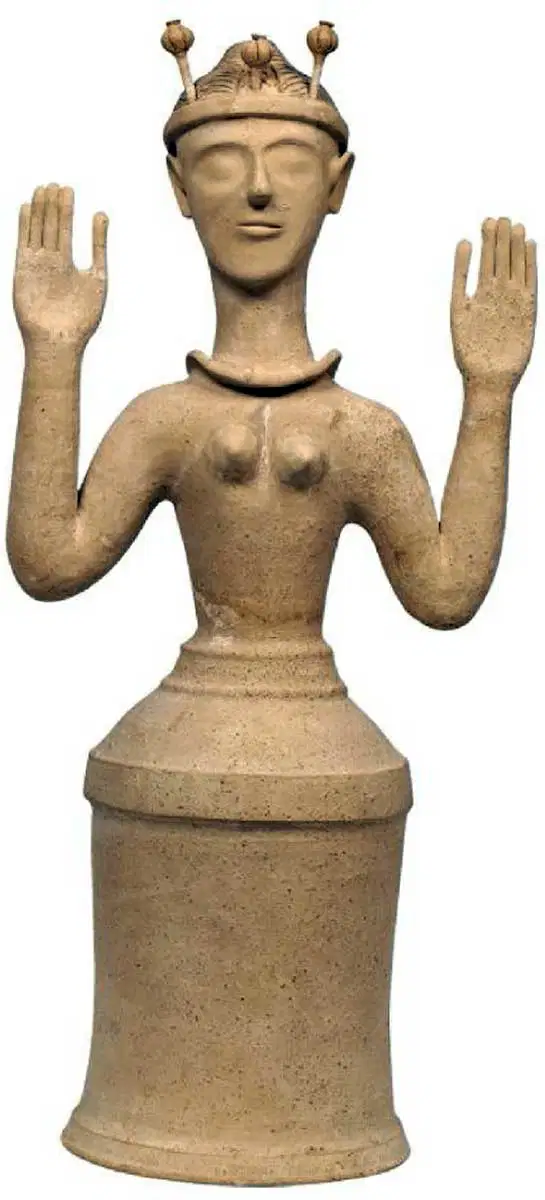
The most famous physical representations of this cult are the faience Snake Goddess figurines excavated from the temple repositories of the palace of Knossos, dating to around 1600 BCE.
These figurines offer an intimate look at the symbolic vocabulary of the cult:
The Chthonic Snakes: The goddess (or her high priestess) holds writhing snakes aloft in her bare hands. In the ancient Mediterranean, the snake was a profound chthonic (earth-bound) symbol. Because snakes shed their skins, they represented rebirth, immortality, and the cyclic nature of life, while also linking the goddess to the deep, subterranean forces of the earth (crucial for an island prone to earthquakes).
The Feline Crown: On one prominent figurine, a small leopard or cat sits perched atop her elaborate headdress, re-emphasizing her dominion over animal life.
The Flounced Skirt and Exposed Breasts: She wears the traditional, high-status Minoan court dress, featuring an intricately layered, flounced skirt and a tight bodice that exposes her bare breasts. This stylistic choice underscored her role as a source of universal nourishment, maternity, and life-giving fertility.
3. Ritual Spaces: From Peaks to Palaces
The Minoans did not construct massive, isolated temples like the later classical Greeks. Instead, the cult of the Mother Goddess operated within the natural landscape and the architectural hearts of their communities.
Peak Sanctuaries and Sacred Caves
The Minoans traveled out of their cities to worship the goddess at peak sanctuaries—open-air shrines built on the summits of prominent mountains, such as Mount Juktas. Here, worshippers lit massive bonfires and left behind clay votive offerings shaped like human limbs, cattle, and sheep, praying for healing or agricultural abundance.
They also descended into deep, dark sacred caves (like the Psychro Cave, traditionally associated with the birth of Zeus in later myth). In these damp, stalactite-filled underworld caverns, they deposited costly bronze daggers, double axes, and pottery filled with honey and oil directly into the rock crevices.
Palatial Shrines
Within palaces like Knossos and Phaistos, the goddess occupied central, subterranean rooms known as Lustral Basins and Pillar Crypts.
The Pillar Crypts were dark, windowless rooms centered around one or two massive stone pillars incised with sacred symbols. Priests would pour liquid offerings (libations) of wine, milk, or bull's blood into channels carved into the stone floor surrounding the pillar, feeding the goddess within the structural foundations of the state.
4. Ecstatic Rituals and the Sacred Epiphany
Minoan religious worship was a highly dynamic, participatory affair. To communicate with the Mother Goddess, her priestesses and worshippers engaged in ecstatic rituals designed to trigger a divine epiphany—the literal, temporary manifestation of the goddess on earth.
Sacred Tree-Shaking and Rock-Clasping: Gold signet rings depict ecstatic priestesses violently shaking sacred trees or weeping over large boulders. These physical acts were meant to draw the cosmic energy of the goddess out of the natural object.
Ecstatic Dance: Large frescoes depict crowds of women performing highly stylized, rhythmic circle dances in open-air palace courtyards. Accompanied by flutes and lyres, these frenzied dances likely induced altered states of consciousness, allowing the high priestess to channel the voice and presence of the deity.
5. The Double Axe (Labrys) and Sacred Bull
The cult of the goddess was flanked by two ubiquitous, powerful symbols whose true meanings remain a subject of intense academic debate:
The Labrys: The double-headed axe was the supreme holy symbol of the Minoan world. Giant bronze labryes mounted on stepped bases stood inside every shrine. Crucially, the double axe is almost exclusively held by women or the goddess herself in Minoan iconography, suggesting it functioned as a scepter of feminine spiritual authority rather than a weapon of war.
The Bull: While the bull represented raw, masculine strength, cosmic storm power, and sacrifice, it remained subordinate to the feminine in Minoan art. In the famous bull-leaping frescoes, young men and women acrobatically vault over the charging beast together, transforming a wild, dangerous force into a sacred, ritualized performance dedicated to the entertainment of the Goddess.
6. The Transition: The Mycenaean Synthesis
When the highly militaristic Mycenaean Greeks conquered Crete around 1450 BCE, they did not wipe out the cult of the Mother Goddess. Instead, they absorbed her into their own evolving religious system.
Linear B tablets from Knossos and Pylos list offerings made to the Potnia (the Mistress or Lady), showing that the Mycenaeans adopted the Minoan goddess of nature, but partitioned her into specialized, localized deities. This Bronze Age fusion permanently shaped the classical Greek pantheon, splitting the multi-faceted Minoan Mother Goddess into distinct mythological figures: Demeter inherited her agricultural fertility, Artemis took her sovereignty over wild animals, and Athena adopted her protective, urban palace authority.