The reign of Emperor Domitian (81–96 CE)—the final ruler of the Flavian Dynasty—is often remembered through the lens of political tyranny, paranoia, and his ultimate assassination. However, beneath his dark reputation as a ruthless autocrat sits the legacy of a monumental builder who permanently reshaped the architectural landscape of Rome.
Following a catastrophic fire in 80 CE that gutted large swathes of the city, Domitian embarked on an aggressive, highly theatrical rebuilding campaign. The absolute crown jewel of this architectural renewal was the Stadium of Domitian (Stadium Domitiani). Built as Rome's very first permanent venue for Greek-style athletics, its unique footprint survives perfectly intact today as one of the world's most famous urban spaces: the Piazza Navona.
1. The Greek Import: A Stadium for Athletics
Before Domitian, Roman public entertainment was dominated by blood sports and high-speed crashes. Gladiatorial combat took place in amphitheatres (like his family's Colosseum), and chariot racing filled the massive Circus Maximus. Domitian, who was deeply fascinated by Greek culture, wanted to introduce the Roman public to the Certamen Capitolinum—a prestigious, multi-disciplinary festival modeled directly after the ancient Olympic Games.
To house these footraces, wrestling matches, boxing bouts, and javelin throws, he commissioned a brand-new architectural typology for the capital: a Greek-style stadium.
Unlike the Circus Maximus, which was designed for horses and featured a central stone barrier (spina), Domitian's stadium was custom-built for human athletes:
The Footprint: It featured a long, rectangular track with one perfectly flat end (where the starting gates stood) and one curved, semi-circular end, forming a distinct, elongated "U" shape.
The Scale: Built out of fine travertine stone, brick, and high-quality concrete, the stadium could pack in an estimated 30,000 spectators.
The Structural Arcades: To support the heavy tiers of marble seats (cavea), Domitian’s architects utilized a grand double layer of open concrete arches, a structural design borrowed directly from the nearby Colosseum.
2. From Ancient Stadium to Baroque Plaza: The Metamorphosis
Domitian's stadium survived the fall of the Western Roman Empire, but as Rome's population plummeted during the Middle Ages, the massive stone structure fell into ruin. However, instead of being completely demolished, the stadium underwent a fascinating process of urban fossilization.
During the Renaissance and Baroque eras, poor Romans and wealthy popes alike began building houses, palaces, and churches directly on top of the stadium's ruins:
The Foundation Effect: Rather than digging new foundations through the massive, reinforced concrete underpinnings of the ancient spectator stands, builders simply used the curved Flavian masonry as a ready-made, rock-solid base for their new walls.
The Preservation of the Arena: Because the central athletic track was wide, flat, and surrounded by these new buildings, it was never built upon. Instead, it was naturally preserved as an open-air public marketplace, festival ground, and square.
This structural evolution is why Piazza Navona matches the exact millimeter-for-millimeter dimensions, orientation, and elongated "U-shape" of Domitian's original 1st-century athletic arena.
3. Traces of Domitian in the Modern Square
If you walk through Piazza Navona today, you are walking directly on the ancient running track, though the modern street level sits roughly 16 feet (5 meters) higher than it did in antiquity due to centuries of accumulated debris. However, the ancient stadium is far from invisible:
The Subterranean Arcades
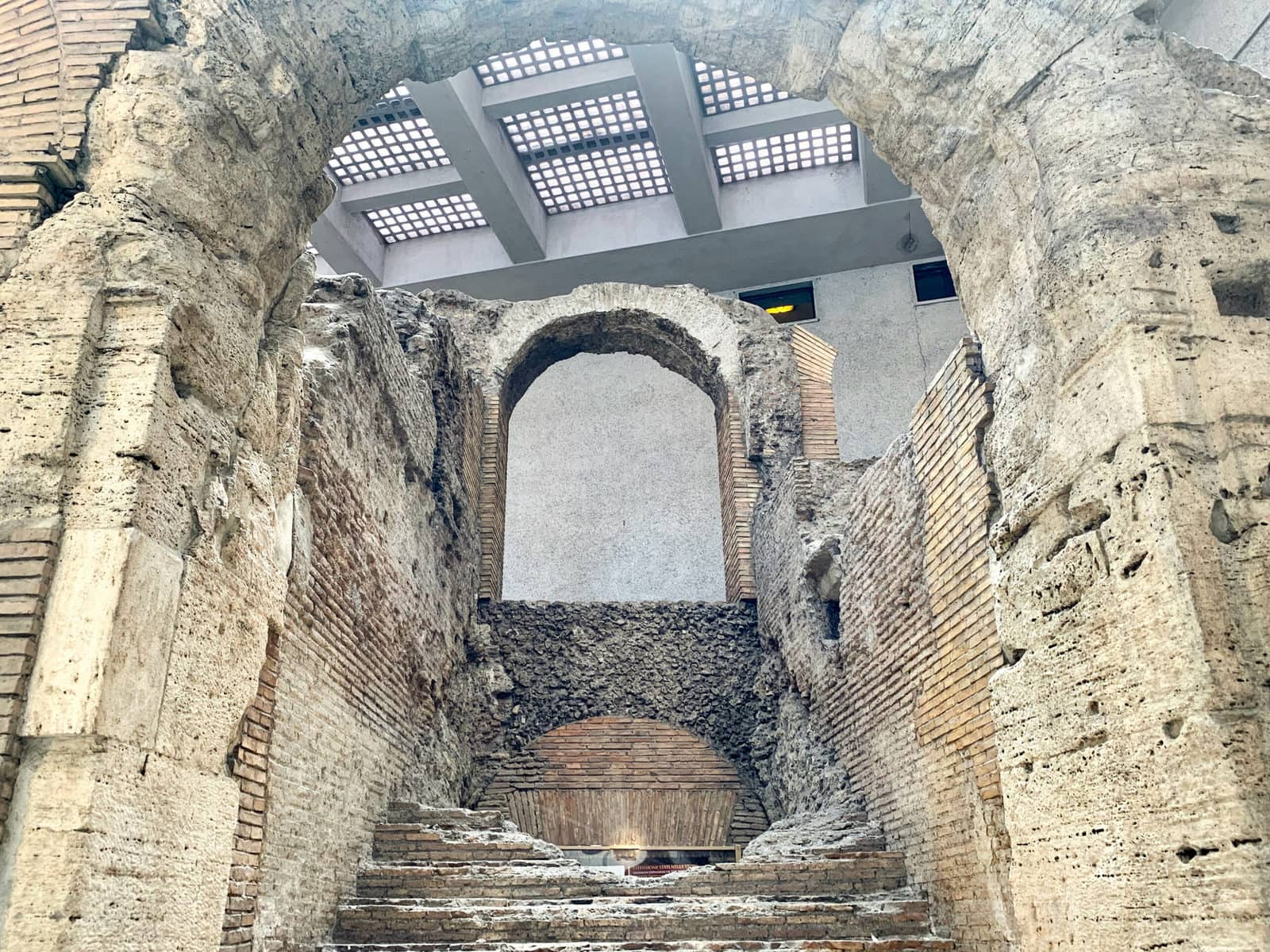
At the northern, curved end of the piazza (underneath Piazza di Tor Sanguigna), visitors can descend into a state-of-the-art underground archaeological site. Here, the raw, brick-faced concrete vaults, travertine pillars, and ancient staircases that once held up 30,000 screaming Roman sports fans are completely exposed and preserved.
Bernini’s Fountain of the Four Rivers
In the absolute center of the piazza stands Gian Lorenzo Bernini’s Baroque masterpiece, the Fountain of the Four Rivers (1651). Perched atop the fountain is a massive Egyptian obelisk. This obelisk was originally carved in Egypt on the orders of Domitian himself, decorated with hieroglyphs praising his divine rule, and used to anchor his imperial monuments before being relocated to the piazza centuries later.
Sant'Agnese in Agone
The stunning Baroque church that dominates the western side of the square, designed by Francesco Borromini, sits precisely where the ancient stadium's interior vaulted chambers once stood. The church is dedicated to Saint Agnes, a young Christian girl who, according to Church tradition, was stripped naked and martyred inside one of the stadium's brothels or taverns located underneath the seating tiers during the persecutions of Diocletian.
Domitian’s architectural legacy proves that even the most hated political figures can inadvertently gift the world enduring beauty. While the Senate eagerly erased his name from public inscriptions following his assassination, they could not erase his concrete. By importing Greek athletic design into the heart of the capital, Domitian carved out a spatial vacuum in the topography of Rome that refused to close—transforming a 1st-century Flavian arena into one of the most vibrant urban living rooms in human history.