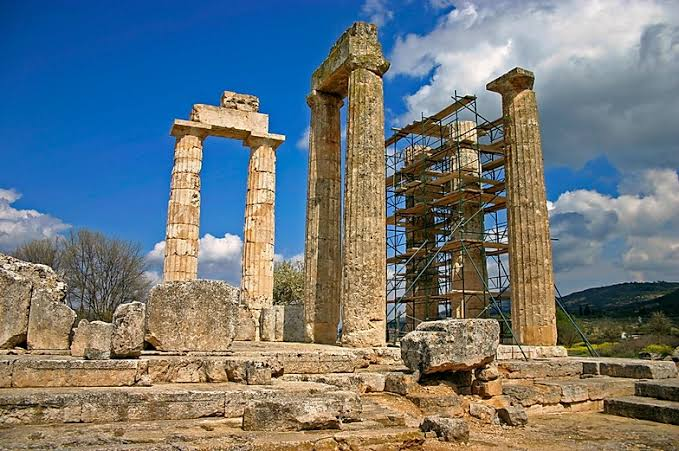
The Sanctuary of Zeus at Nemea, nestled in a tranquil, vineyard-heavy valley of the Peloponnese, was one of the four great panhellenic athletic centers of the ancient Greek world. Alongside Olympia, Delphi, and Isthmia, Nemea hosted the prestigious Nemean Games, where athletes from across the Greek diaspora competed for glory and a crown of wild celery.
At the absolute physical and spiritual heart of this sacred precinct stood the Temple of Nemean Zeus. Constructed during the late Classical period (c. 330–300 BCE), this temple is a brilliant architectural marvel that showcases the evolution of Greek structural engineering, blending traditional design with bold spatial innovations.
1. Architectural Synthesis: The Three Orders Under One Roof
The Temple of Zeus at Nemea is celebrated by architectural historians as a masterclass in spatial economy and stylistic synthesis. Built primarily out of local limestone coated in a fine, marble-like stucco, the temple reflects a transitional era in Greek architecture where builders began moving away from the heavy, massive proportions of the High Classical era toward lighter, more dramatic interiors.
The architects achieved this by remarkably integrating all three of the classic Greek architectural orders into a single building:
The Exterior (Doric): The outer colonnade (peristyle) featured a $6 \times 12$ column configuration. These Doric columns are among the tallest and most slender of their style in the Greek world, possessing a height-to-base ratio ($6.34:1$) that gives the exterior a remarkably elegant, vertical grace rather than the stocky, muscular appearance of older Doric temples.
The Interior Lower Tier (Corinthian): Upon stepping inside the central room (cella), a visitor was met by a freestanding, U-shaped colonnade. The lower tier of these interior columns featured beautifully carved Corinthian capitals adorned with acanthus leaves, introducing a highly decorative flair to the sacred space.
The Interior Upper Tier (Ionic): Resting directly on top of the Corinthian columns was a second, smaller tier of Ionic columns. This double-tiered internal design allowed the architects to support a soaring wooden roof without cluttering the interior space with a massive, solid wall.
2. The Cryptic Space: The Mystery of the Adyton
The most unique and structurally fascinating feature of the Temple of Zeus at Nemea is located at the very back of the cella. Instead of a flat, solid rear wall, the floor drops down via a formal stone staircase into a sunken, semi-subterranean chamber known as an Adyton (meaning "not to be entered").
While most Greek temples featured a flat floor plan, Nemea’s sunken adyton served an intimate, highly restricted ritual function. Because Nemea was a panhellenic sanctuary heavily tied to chthonic (earth-based) mythologies and the mourning of dead heroes, archeologists hypothesize that this subterranean space was utilized for:
Thematic Divination: Oracular consultations or prophetic rituals linked to the subterranean world.
Secret Oaths: High-stakes political or athletic oaths sworn by judges and athletes in a secluded, solemn environment away from the public gaze.
The Myth of Opheltes: Ritual acts commemorating the infant prince Opheltes, whose tragic death by a serpent in a bed of celery supposedly sparked the founding of the Nemean Games.
3. The Athletic Infrastructure: The Stadium and the Tunnel
A panhellenic temple cannot be understood in isolation; it operated as the engine for a massive, regional athletic infrastructure. Located roughly 400 meters southeast of the temple sits the Stadium of Nemea, constructed during the exact same building boom in the late 4th century BCE.
The relationship between the temple and the stadium was cemented by a brilliant piece of civil engineering: The Vaulted Entry Tunnel.
   [ TEMPLE SANCTUARY ] ────► Athletes Process and Purify Themselves
                                        │
                             (The Vaulted Stone Tunnel)
                                        │
   [ THE STADIUM TRACK ] ◄─── Vaulted Arch Creates a Dramatic Internal Portal
Before a race, athletes would gather at the temple precinct to sacrifice to Zeus. They would then march down a sacred pathway and enter a fully enclosed, 36-meter-long stone tunnel covered by a perfect barrel vault.
This tunnel acted as an ancient locker room and a structural portal. Athletes would wait inside the dark, echo-heavy stone vault, scratching their names into the soft limestone blocks (graffiti that is still clearly visible today, including the ancient Greek word AKANTOU—"Of Acanthus"). When their names were called by the herald, they would burst out of the tunnel’s arched opening into the blinding sunlight of the stadium track, facing up to 40,000 roaring spectators.
4. Summary of Nemean Architectural and Civic Paradigms
Stylistic Innovation: Rejection of heavy, stocky Doric proportions; utilization of exceptionally tall, slender exterior columns combined with an internal double-tiered system of Corinthian and Ionic elements.
Ritual Space (Adyton): A unique, subterranean sunken chamber at the rear of the temple, creating an intimate, restricted space for oracular, political, or chthonic mourning rituals.
Engineering Engineering: Integration of the sanctuary through a monumental, barrel-vaulted stone tunnel that linked the spiritual heart of the temple directly to the physical competition of the stadium.
Panhellenic Purpose: Functioned not as a civic temple for a single city-state, but as a neutral, international athletic center where war was paused under a sacred truce (Ekecheiria) to honor Zeus through physical human excellence.
The Temple of Zeus at Nemea stands as a vital monument to the brilliance of late Classical Greek architecture. By boldly weaving together the three distinct architectural orders, carving out a subterranean sanctuary of deep religious mystery, and engineering a vaulted stone portal that physically linked the realm of the gods to the running track of the athletes, the builders of Nemea created more than a house for a deity. They engineered a dynamic, interactive space where the concepts of physical training, engineering precision, and spiritual devotion were permanently fused into the landscape of the Greek world.