During the Bronze Age, while the kingdoms of Egypt and Mesopotamia dominated the fertile river valleys of the Near East, a unique, seafaring maritime civilization flourished on the Mediterranean island of Crete: The Minoans (c. 3000–1450 BCE). Centered around sprawling, unfortified architectural complexes—most famously the Palace of Knossos—Minoan culture was characterized by its immense wealth, global trade networks, and a remarkably vibrant artistic style.
The absolute pinnacle of Minoan artistic expression was their revolutionary use of frescoes to decorate the interior plaster walls of their palaces, shrines, and elite villas. Unlike the rigid, monumental, and war-centric art of contemporary Near Eastern empires, Minoan frescoes celebrate the natural world, fluid human movement, and deep religious devotion, offering an invaluable visual window into a sophisticated society that left behind no readable historical texts.
1. The Chemistry of Preservation: The Buon Fresco Technique
The word fresco derives from the Italian word for "fresh," and the Minoans were among the very first civilizations to master the highly demanding technique of Buon Fresco (true fresco). This chemical process required immense speed and precision from the palace artists.
Instead of simply painting on a dry, finished wall, Minoan craftsmen applied their pigments directly to a freshly laid layer of wet lime plaster (intonaco).
The Chemical Bond: As the wet plaster dried, it underwent a chemical reaction with the air, carbonating and trapping the mineral paint pigments directly inside the crystalline structure of the wall itself. The paint did not sit on top of the wall; it became a permanent, structural part of the plaster.
The Pigment Palette: Because the highly alkaline wet lime would destroy organic dyes, Minoan artists relied exclusively on natural, earth-derived mineral pigments:
Red and Yellow: Sourced from iron ochres mined from volcanic soils.
Blue: Made from costly imported lapis lazuli or an artificial copper-silicate compound known as Egyptian Blue.
White: Created using pure, unpainted lime plaster.
Black: Derived from ground charcoal or shale.
When artists needed to add fine details after the plaster had dried, they utilized the Fresco Secco (dry fresco) technique, using an organic binder like egg white or animal glue. However, it is the true buon fresco sections that survived over 3,500 years of earthquakes, fires, and volcanic ash.
2. Iconography and Themes: A World of Movement and Grace
While Egyptian art utilized a strict, mathematical grid system to depict human figures in rigid, unchanging poses, Minoan artists favored curved lines, organic asymmetry, and a sense of dynamic, looping movement. Their thematic focus was radically distinct from their neighbors.
The Marine Style: A Thalassocracy Celebrated
As an island nation whose survival depended entirely on naval dominance and maritime trade, the Minoans possessed a deep obsession with the ocean. Palace walls were transformed into vibrant, indoor aquariums.
The famous Dolphin Fresco from the Queen’s Megaron at Knossos depicts playfully curving dolphins swimming alongside schools of small fish. Other frescoes showcase highly stylized octopuses wrapping their tentacles around rocks, sea urchins, and floating nautiluses. These paintings were not mere decorations; they were a visual celebration of the thalassocracy—the Minoan empire of the sea.
Courtly Life and the Sacred Bull-Leaping
Minoan frescoes provide our best look at Bronze Age clothing, hairstyles, and social hierarchies. Elite Minoan women are consistently depicted occupying high-status positions as priestesses or courtly ladies, dressed in elaborate, tiered skirts and open-front bodices, their hair styled in complex, beaded tresses.
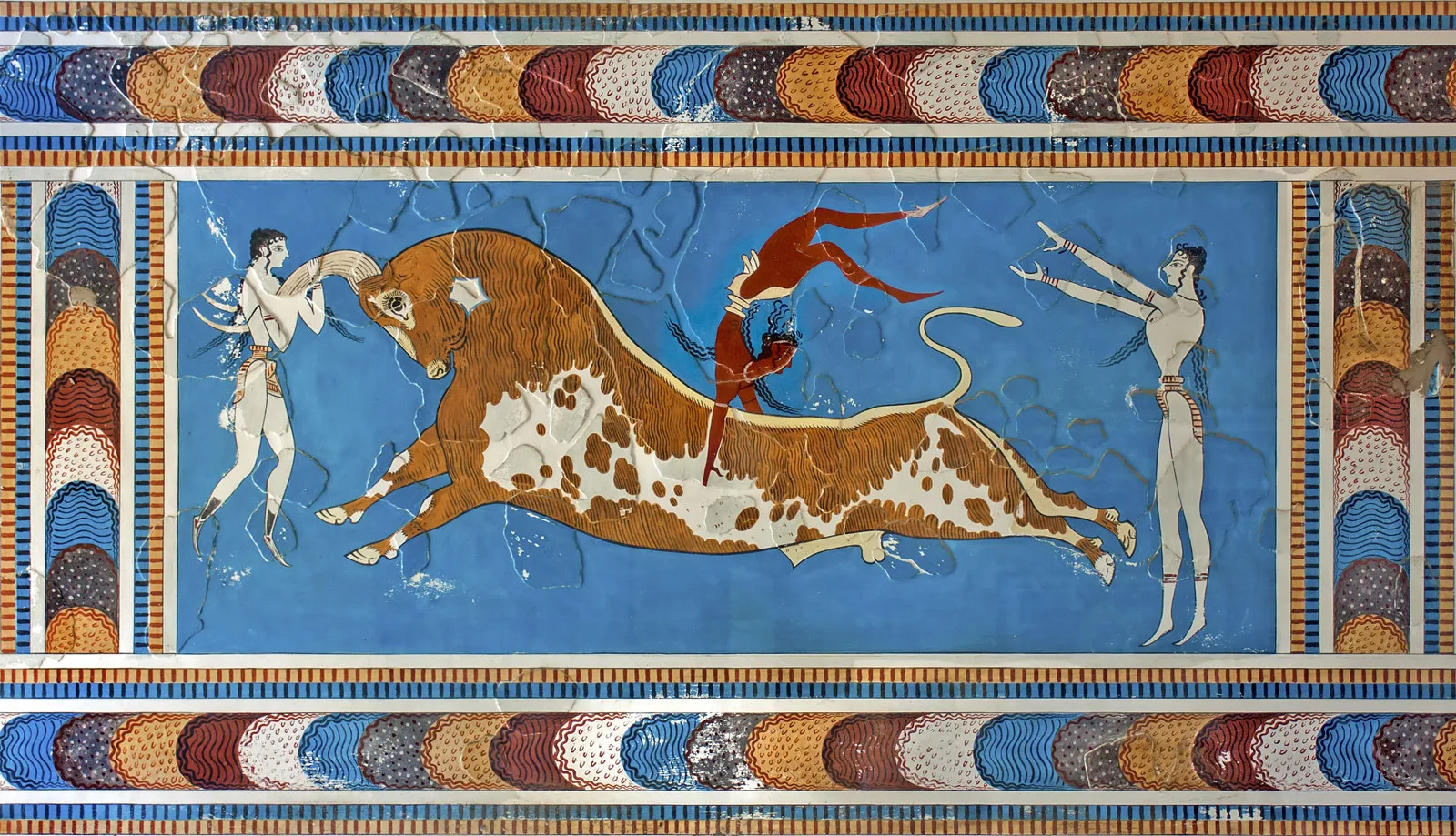
The most famous narrative painting is the Bull-Leaping Fresco (Taureador Fresco). Set against a vivid blue background, it depicts a massive, charging structural bull caught in mid-gallop. Three young acrobats—two women (painted with traditional white skin) and one man (painted with dark reddish-brown skin)—perform a high-stakes religious ritual. One figure holds the bull's horns, another flips directly over the beast's back, and a third prepares to land, demonstrating a culture that valued acrobatic agility, athletic courage, and a deep, ritualistic relationship with nature.
3. Spatial Illusions: Integrating Architecture and Nature
Minoan architects did not design rooms with heavy, oppressive stone walls. Instead, they built palaces featuring open-air lightwells, polythyron pier-and-door partitions, and grand colonnades designed to let light and wind circulate freely.
The frescoes were engineered to work in perfect harmony with this open architecture. Rather than trapping the viewer inside a room, the wall paintings acted as optical illusions designed to blur the boundary between the interior palace and the exterior natural landscape.
   [ Open-Air Lightwells ] ───► Cast Shifting Sunlight onto Polished Plaster
                                          │
                              (The Spatial Illusion)
                                          │
   [ Naturalistic Frescoes ] ─► Blurs Room Boundaries / Brings the Aegean Landscape Indoors
In the Spring Fresco discovered at Akrotiri (a Minoan-influenced settlement on Santorini), an entire room is wrapped in a continuous painting of undulating red and yellow volcanic hills covered in blooming red lilies, while swallows swoop and dive through the air. When sunlight cast through an open lightwell hit these walls, the room felt completely open to the Aegean landscape, transforming the masonry of the palace into a living, breathing ecosystem.
4. Summary of Minoan Artistic Paradigms
Technique (Buon Fresco): Applying natural mineral pigments directly to wet, fresh lime plaster, creating a permanent chemical bond that preserved the artwork across millennia.
Thematic Style: Rejection of warfare, military triumphs, and static royal monuments; heavy focus on natural fluidity, marine life, and athletic religious rituals.
Color and Gender Conventions: Utilization of specific color profiles, notably using dark red-brown skin tones for men and fair white skin tones for women in communal depictions.
Architectural Harmony: Continuous, wrap-around wall designs combined with natural light sources to eliminate visual boundaries and bring the natural environment inside the living space.
The legacy of Minoan frescoes marks a monumental shift in the history of Western art. By replacing the stiff, linear militarism of Bronze Age empires with an artistic language rooted in spontaneity, curves, and a passionate love for life, the painters of Crete established a tradition of naturalism that would deeply influence Mycenaean Greece, classical antiquity, and eventually the wall-painting traditions of the Roman world. Through the vibrant red of their ochres and the deep blue of their lapis lazuli, the Minoans successfully captured the fleeting movement of a swallow, the leap of an acrobat, and the pulse of the sea, holding them perfectly still for eternity.