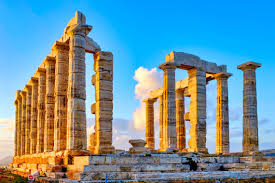
The Temple of PoseidonClick to open side panel for more information at Cape Sounion is one of the most iconic landmarks of the ancient Greek world. Perched on a jagged cliff 60 meters above the Aegean Sea, the sanctuary served not only as a place of worship for the god of the sea but as a powerful visual sentinel for ships approaching Athens.
I. Architectural Significance and Strategic Design
Constructed during the mid-5th century BCE (around 444–440 BCE)—roughly the same time the Parthenon was rising in Athens—the temple stands as a pinnacle of Classical Doric architecture.
The Doric Order: The temple features a classic peripteral design, originally consisting of 38 columns. Despite the harsh coastal environment, which has weathered the stone over two millennia, many of the columns remain standing, their stark, white marble silhouettes creating a dramatic contrast against the deep blue of the Aegean.
Engineering for the Environment: Unlike the temples in the heart of Athens, which were constructed largely of Pentelic marble, the architect of Sounion utilized local Agrileza marble. This stone contains a higher mineral content that makes it more resistant to the salt-laden winds and extreme erosion characteristic of the Sounion peninsula.
Visible Authority: The site was chosen with calculated intent. Visible from far out at sea, the temple functioned as a beacon and a physical manifestation of Athenian naval hegemony. Sailors would see the columns from miles away, serving as a reminder of Athens' reach, piety, and the protection of the god of the sea.
II. The Sanctuary in Context
The sanctuary was more than just the temple building itself; it was a complex space for navigation and sacrifice.
Sacred Space: Excavations have revealed a much older, 6th-century BCE Archaic temple that was destroyed by the Persians in 480 BCE, indicating that this promontory had served as a sacred site long before the Classical temple was built.
The "Beacon" of the Aegean: The location was vital for the Athenian grain supply coming from the Euxine Sea (the Black Sea). The temple essentially functioned as the final landmark for Athenian merchants and military fleets navigating the treacherous currents around the southern tip of Attica.
The Heroic Graffiti: One of the most humanizing aspects of the site is the collection of ancient and historical graffiti etched into the marble columns. This includes signatures from travelers spanning from the Classical era to the 19th century—most famously, a carving attributed to Lord Byron, who visited in the early 1800s.
III. The Rituals of the Sea
As the sanctuary of Poseidon, the site was the destination for periodic public festivals and smaller, individual dedications.
Offerings: Archeological evidence suggests a vast array of votive offerings, including bronze figurines, pottery, and jewelry, placed by sailors and merchants hoping for "fair winds" and safe passage through the unpredictable Aegean.
Divine Relationship: For an Athenian population whose survival relied on sea-based trade and naval military power, the Temple of Poseidon was not an abstract religious site; it was a critical component of state security. Appeasing Poseidon was effectively a matter of economic and political survival.
IV. Preservation and Modern Legacy
The temple has undergone significant conservation efforts to maintain its structural integrity against the relentless coastal erosion. Today, it is recognized not just as a religious site, but as one of the best-preserved examples of an ancient Greek sanctuary integrated into a natural landscape. The combination of the ruined columns, the verticality of the cliffside, and the vast expanse of the Aegean makes it a singular experience of the ancient Mediterranean.