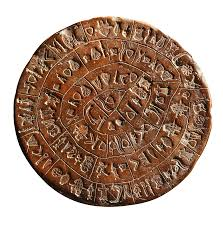
The Phaistos Disc, discovered in 1908 by Italian archaeologist Luigi Pernier within the Minoan palace of Phaistos on the island of Crete, remains one of the most compelling archaeological enigmas of the Bronze Age. Dating to the Middle Minoan period (roughly 1700 BCE), this terracotta object continues to defy all definitive attempts at decipherment, serving as a focal point for debates on early literacy, linguistic evolution, and the limits of archaeological evidence.
I. Physical Characteristics and Manufacturing
The disc is roughly 15 centimeters in diameter and is covered on both sides with a total of 242 signs, arranged in a spiral pattern that leads from the rim toward the center.
The First "Printed" Document: Perhaps the most radical feature of the disc is its method of creation. Rather than inscribing the signs by hand into the soft clay, the creator used individual pre-formed stamps to press the symbols into the surface. This technique, essentially a form of prehistoric movable type, suggests a high level of technical sophistication and intentional standardization that is otherwise unknown in the Minoan or wider Mediterranean context.
The Symbols: There are 45 distinct signs, depicting human figures, animals, plants, tools, and abstract forms. The level of detail—from the distinct headdresses of the figures to the specific botanical features of the plants—indicates a highly structured and conventionalized set of icons, rather than random doodling.
II. The Riddle of Decipherment
Because the disc is a "hapax legomenon"—an artifact that occurs only once—archaeologists and linguists lack the comparative data necessary to break the code. Without a bilingual text (like the Rosetta Stone) or a larger corpus of similar inscriptions, interpretation remains speculative.
Linguistic Hypotheses: Theories regarding the language are exhaustive. Some scholars argue it is an early form of Greek; others suggest it is related to Luwian (an Anatolian language), Egyptian, Libyan, or even a completely lost, isolated Minoan tongue.
Content Theories: Interpretations of the meaning are equally varied. Suggestions include:
A Hymn or Liturgy: Given the palace-temple context of Phaistos, many believe it to be a religious or ritual text.
A Calendar: The spiral structure has led some to propose that the signs represent astronomical data or a calendar cycle.
A Board Game: A more pragmatic theory suggests the disc represents the board for an early form of a game like Senet or a precursor to the Royal Game of Ur.
A Map or Treaty: Some have interpreted the signs as a topographical guide or a diplomatic treaty between local city-states on Crete.
III. The Problem of Authenticity
The fact that the disc was discovered in a relatively "clear" archaeological layer, and that no other similar objects have ever been found in the subsequent 118 years of intensive Cretan archaeology, has led some skeptics to suggest it might be a clever 20th-century forgery. However, the majority of the academic community accepts it as genuine, pointing to the sophistication of the manufacturing and the nature of the clay as consistent with the Middle Minoan II period. The lack of "sister" artifacts is likely a function of the fact that Minoan writing, as seen in Linear A and Cretan Hieroglyphics, was almost certainly recorded on perishable materials (like parchment or papyrus) that have long since vanished, leaving the disc as a rare, accidental survival.
IV. Cultural Context: The Minoan Literacy Gap
The Phaistos Disc serves as a stark reminder of how much of the Minoan intellectual world is lost to time. We know the Minoans were literate—they utilized at least three distinct scripts (Cretan Hieroglyphs, Linear A, and the Phaistos Disc script)—but because their primary administrative records were likely kept on impermanent media, we are left with only the "exceptions" that were fired in the fires that destroyed their palaces. The disc is not just a mystery of linguistics; it is a monument to the fragility of human records.
The disc remains a tantalizing "what-if" of history. It forces us to confront the fact that even in highly organized societies, the most important records may be the ones most susceptible to the decay of time.
Given your deep interest in how ancient societies managed their information and administrative structures, would you be interested in exploring the decipherment of Linear B—the only deciphered script from this era—or perhaps comparing the logistics of Minoan bureaucratic systems to those of their contemporary counterparts, the Mycenaeans?