Ancient Greek Warfare: The Trireme and Athenian Naval Power
Introduction
Ancient Greek warfare was shaped not only by powerful armies but also by advanced naval forces. Among the most important military innovations was the trireme, a fast and maneuverable warship that became the foundation of Athenian naval dominance during the 5th century BCE. The strength of Athens at sea helped it build an empire, protect trade routes, and achieve major victories against its enemies.
The Trireme
A trireme was a long, narrow warship powered primarily by human rowers. The name comes from the Greek word triērēs, meaning "three-fitted," referring to its three tiers of oars.
Characteristics of the Trireme
Approximately 35–40 meters long.
Carried around 170 rowers arranged in three levels.
Could reach speeds of about 7–8 knots.
Equipped with a bronze-covered ram at the bow.
Designed for speed, agility, and ramming attacks rather than carrying large numbers of soldiers.
Combat Tactics
The primary weapon of the trireme was its ram. Captains attempted to:
Ram enemy ships below the waterline.
Break enemy oars to disable movement.
Outmaneuver opponents through superior speed and coordination.
Success depended heavily on the skill and endurance of the rowers.
Rise of Athenian Naval Power
The city-state of Athens recognized the importance of sea power early in its history. After the discovery of silver mines at Laurion, Athens used the wealth to build a large fleet of triremes.
Reasons for Athenian Naval Strength
Access to financial resources from silver mines.
Strategic location near the Aegean Sea.
Strong maritime trade network.
Large population capable of providing trained rowers.
Effective leadership and naval planning.
The Persian Wars
Athenian naval power reached prominence during the Greco-Persian Wars.
Battle of Salamis (480 BCE)
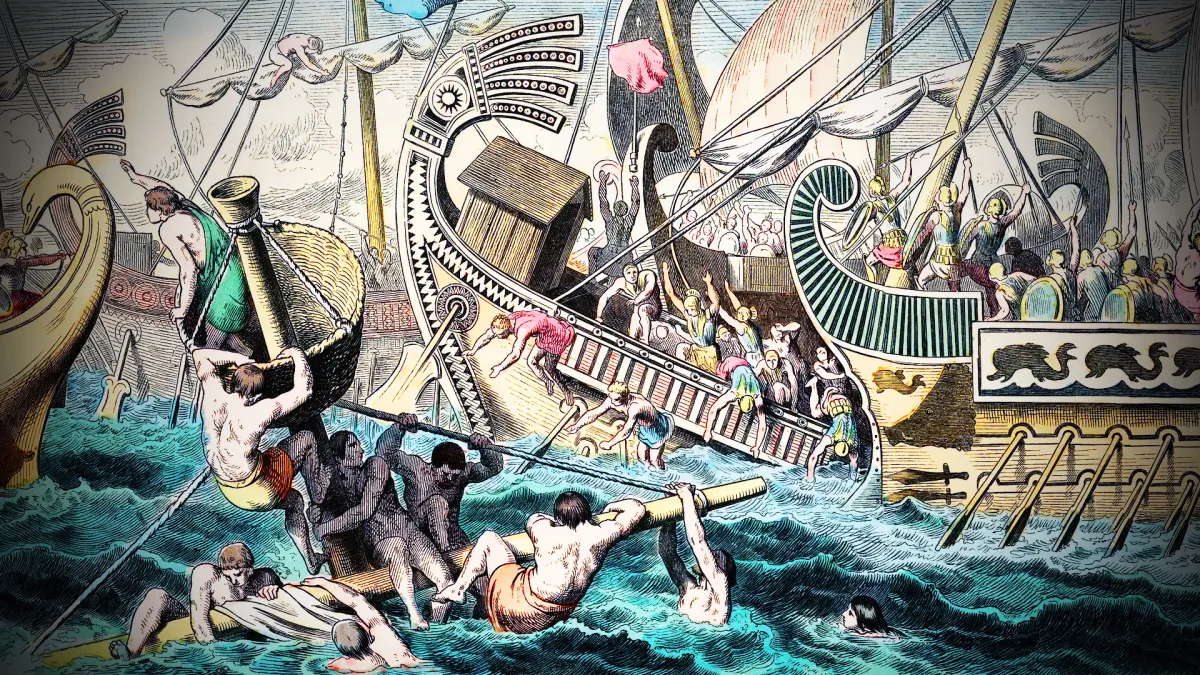
One of the most famous naval battles in history was the Battle of Salamis.
In this battle:
The Greek fleet, led largely by Athens, faced the massive Persian navy.
The narrow straits of Salamis limited Persian maneuverability.
Greek triremes used their speed and tactical advantages to destroy many Persian ships.
The victory helped prevent Persian conquest of Greece.
The Battle of Salamis demonstrated how superior naval tactics could defeat a larger force.
The Delian League and Athenian Empire
After the Persian Wars, Athens formed the Delian League, originally created to defend against future Persian attacks.
Over time:
Member states contributed ships or money.
Athens controlled the league's resources.
The league evolved into an Athenian maritime empire.
Athenian fleets protected trade routes throughout the Aegean.
Naval power allowed Athens to project influence far beyond its own territory.
The Peloponnesian War
The importance of the trireme became evident again during the Peloponnesian War (431–404 BCE).
Athens vs. Sparta
Athens relied on naval superiority.
Sparta possessed stronger land forces.
Athenian fleets supplied the city and conducted raids along enemy coastlines.
Long-term warfare and strategic setbacks eventually weakened Athens.
Despite its eventual defeat, Athens demonstrated how naval power could sustain a state even when facing a superior land army.
Legacy of the Trireme
The trireme became one of the most influential warships of the ancient world. Its design inspired later Mediterranean naval developments and showcased the importance of speed, coordination, and tactical maneuvering in naval warfare.
Historical Significance
Revolutionized naval combat.
Enabled Athenian dominance in the Aegean Sea.
Contributed to major Greek victories.
Supported the growth of Athenian democracy and empire.
Became a symbol of Ancient Greek military innovation.
Conclusion
The trireme was more than just a warship—it was the foundation of Athenian power. Through its fleet of triremes, Athens defended Greece, expanded its influence, and became one of the most powerful city-states of the ancient world. The success of Athenian naval strategy demonstrates how technological innovation and skilled leadership can shape the course of history.