Although modern technology is often viewed as a recent development, archaeological discoveries reveal that ancient engineers were capable of creating surprisingly sophisticated machines.
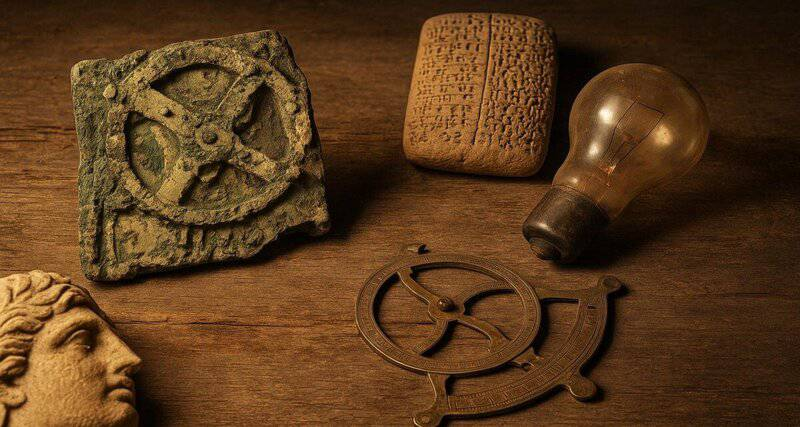
The most famous example is the Antikythera Mechanism, discovered in a shipwreck near the Greek island of Antikythera in 1901. This intricate bronze device contains dozens of precisely crafted gears.
Researchers eventually determined that the mechanism functioned as an astronomical calculator capable of predicting eclipses, planetary movements, and calendar cycles. In many ways, it resembles a mechanical computer thousands of years ahead of its time.
Another remarkable invention is the Aeolipile, described by the engineer Hero of Alexandria in the first century CE. This device used steam pressure to spin a rotating sphere, demonstrating principles similar to those used in modern steam engines.
Ancient engineers also developed complex water-powered machines, automated temple doors, and intricate clockwork mechanisms.
Many historians believe that technological experimentation was far more widespread in antiquity than previously assumed. Unfortunately, because many ancient devices were made from fragile materials such as wood or bronze, they did not survive long enough to be widely studied.
These discoveries remind us that ancient civilizations possessed remarkable creativity and engineering skill. In some cases, technological knowledge may have been lost when empires collapsed or when intellectual traditions disappeared.
The study of ancient machines continues to reveal how innovative early engineers truly were—and how much of their ingenuity remains hidden in the fragments of the archaeological record.