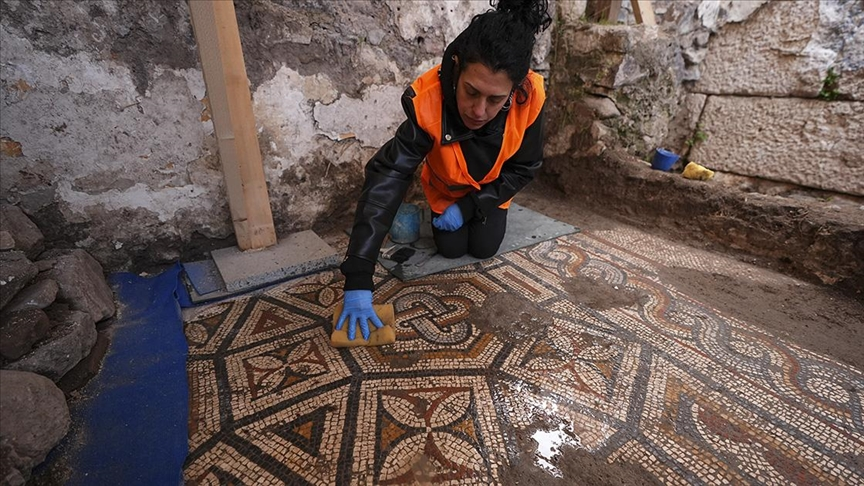
Archaeologists excavating in central İzmir have uncovered an exceptional mosaic-floored room in the ancient city of Smyrna. At its center is a striking Solomon’s Knot motif, thought to have functioned as a protective symbol against envy and the “evil eye” during Late Antiquity. The find was made along the North Street of the Smyrna Agora as part of the Turkish Ministry of Culture and Tourism’s year-round Heritage for the Future Project.
The mosaic floor, measuring approximately 3 by 4 meters, is composed of interwoven geometric panels and vegetal patterns, with the symbolic knot placed prominently at the centre. Excavation director Prof. Dr. Akın Ersoy of İzmir Katip Çelebi University noted that this is the first mosaic pavement discovered at the site in almost 70 years, underscoring both its rarity and its scientific importance.
A Planned City of the Hellenistic World
Rebuilt according to a new urban plan after the time of Alexander the Great, Smyrna became one of the eastern Mediterranean’s most significant port cities. Now known as İzmir, it prospered under Hellenistic, Roman, and Byzantine rule, developing into a major centre of trade, culture, and civic activity. The Smyrna Agora, the focus of current excavations, served as the city’s political, commercial, and administrative heart.
Recent archaeological work has concentrated on the Agora and the ancient theatre, uncovering architectural layers that trace Smyrna’s uninterrupted urban life over many centuries. The newly discovered mosaic room is located along one of the city’s principal streets, which appears to have remained in use well into the Late Roman period, between the 4th and 6th centuries CE.
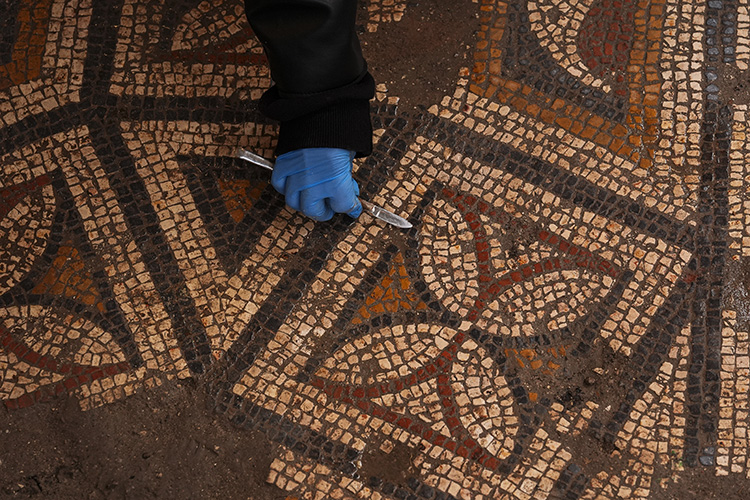
Excavations in Smyrna revealed the site’s first mosaic pavement discovered in nearly 70 years, under the direction of Prof. Dr. Akın Ersoy of İzmir Katip Çelebi University.
Protective Symbols Against Envy and Misfortune
Prof. Ersoy explains that the building’s original function whether it served as a private home or a public space has yet to be clearly determined. Even so, the mosaic’s imagery offers valuable insight into the cultural beliefs of the period. In Late Antiquity, mosaics often featured protective symbols thought to guard occupants or visitors against jealousy, bad luck, or malicious intent. At the centre of this floor is the Solomon’s Knot, an ancient geometric design formed by two interlaced closed loops. Appearing in Roman villas, synagogues, early Christian churches, and later Islamic and Byzantine art, the motif is commonly understood to represent eternity, harmony, wisdom, and spiritual protection. Across Mediterranean cultures, it was also associated with the idea of binding or neutralising harmful forces, much like amulets used to ward off the “evil eye.”
In the Smyrna example, the knot is surrounded by smaller cross-like forms and decorative patterns. Ersoy notes that many such motifs began as purely ornamental designs but gradually acquired religious and cultural meanings as new belief systems spread through the region. Whatever their specific interpretation, he stresses that “they were understood as protective signs meant to safeguard either the building itself or the people who used it.”
A Space Reused 1,500 Years Later
Among the most striking aspects of the find is evidence of the building’s later reuse. Archaeological traces show that the mosaic floor was reopened and put back into use during the 19th century, probably by nearby residents or a non-Muslim hospital that once operated in the area. Mortar from later walls was found directly on top of the mosaic, suggesting that the ancient floor was deliberately preserved and incorporated into newer structures some 1,500 years after it was first laid.
This reuse reflects Smyrna’s long-standing tradition of urban continuity, in which successive communities adapted and reoccupied earlier buildings rather than abandoning them. Ersoy adds that further excavations planned for 2026 may uncover additional rooms or adjoining architectural spaces connected to the mosaic area.
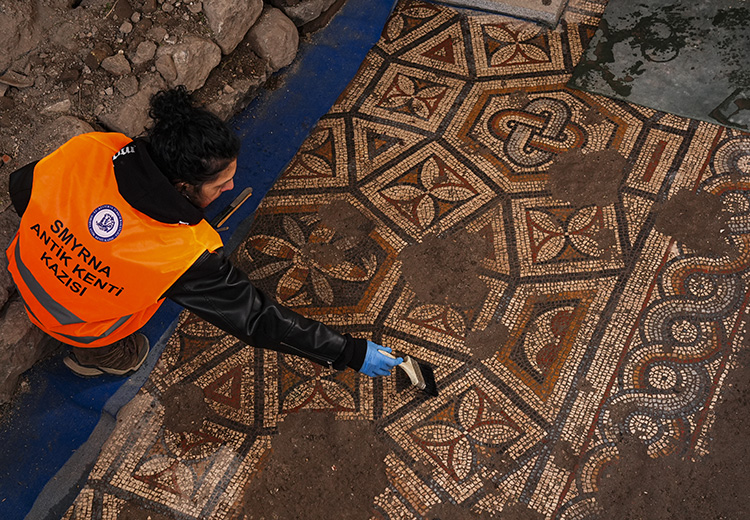
Measuring roughly 3 by 4 meters, the mosaic floor features interlaced geometric panels and vegetal designs, with the symbolic knot positioned prominently at its center.
Cultural Legacy Beneath Modern İzmir
The find highlights Smyrna’s character as a deeply layered archaeological landscape, where traces of ancient urban life lie beneath the modern city. From its Hellenistic street grid to Roman roads, Byzantine churches, Ottoman neighbourhoods, and 19th-century civic buildings, Smyrna is one of the few Mediterranean cities in which millennia of architecture coexist within a single urban space.
Excavations continue today with the support of the İzmir Metropolitan Municipality, the Yaşar Education and Culture Foundation, the İzmir Chamber of Commerce, and Güzel Enerji. Each new discovery such as the mosaic room centred on the enduring Solomon’s Knot adds another chapter to the story of a city where art, belief, and everyday life have remained closely intertwined over time.