Fragments of a peahen, a comedic theatrical mask and other intriguing finds are providing new insights into the history of the Villa of Poppaea
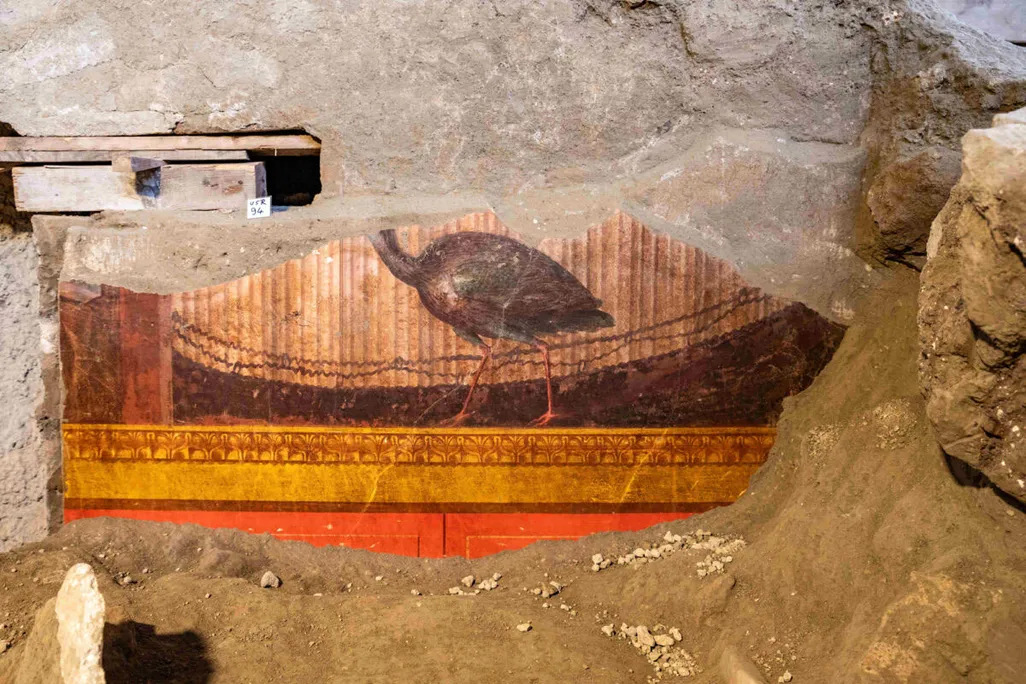
Archaeologists unearthed a fresco depicting a peahen that mirrors a peacock found on another part of the same wall.
When Mount Vesuvius erupted in 79 C.E., ash and volcanic debris blanketed Pompeii, freezing the ancient Roman city in time for centuries to come. Yet the destruction extended well beyond Pompeii itself, as smoke, gases, and pumice spread across the wider Campania region of Italy.
Archaeologists have continued to advance their work in the areas surrounding Pompeii, with recent excavations concentrating on an opulent residential villa near the modern town of Torre Annunziata, just south of Naples. According to a statement from the Archaeological Park of Pompeii, this site has become the latest focus of intensive study.
Known as the Villa of Poppaea, the residence may once have belonged to Poppaea Sabina, the second wife of the Roman emperor Nero. Constructed in the mid–first century B.C.E., the villa featured lavish decoration, private thermal baths, and expansive gardens. Offering sweeping views of the Bay of Naples, the complex was enlarged around the middle of the first century C.E. to include a swimming pool, winter gardens, guest apartments, and additional rooms. Situated in Oplontis, a fashionable seaside retreat for Rome’s elite, the villa was likely unoccupied when Vesuvius erupted.
In a spacious and refined room known as an oecus, archaeologists recently uncovered richly decorated frescoes showing a peahen and a theatrical mask. The peahen mirrors a peacock depicted elsewhere on the same wall. The mask represents a character from Atellan Comedy, a form of improvised farce popular in ancient Rome. Specifically, it portrays Pappus, a stock figure described as an aging fool who attempts to appear youthful but is inevitably ridiculed. This comic image stands in contrast to the other masks found in the room, which appear to draw their inspiration from Roman tragic theatre.
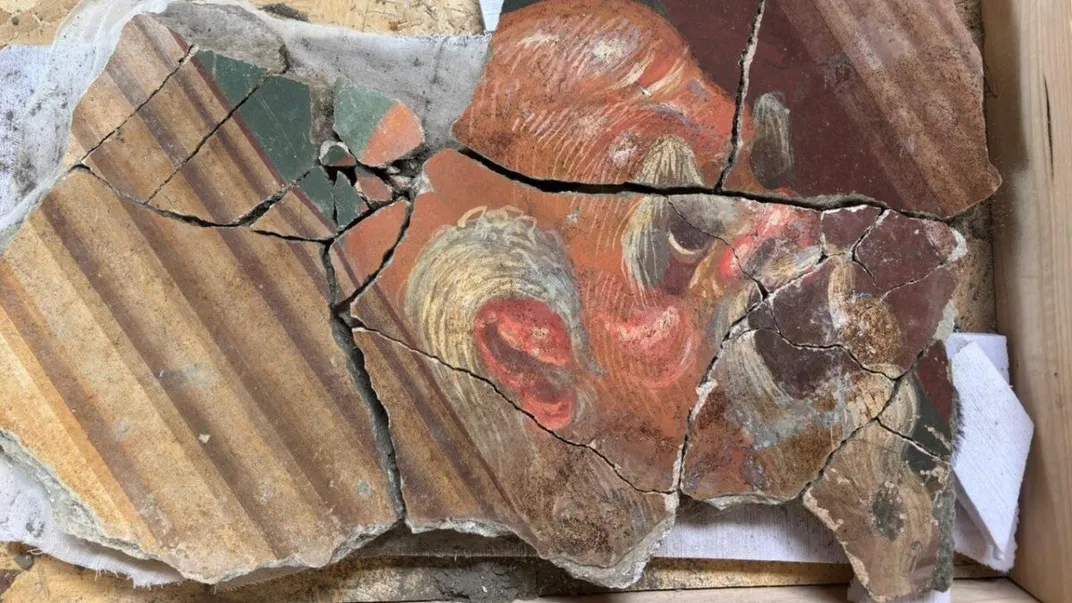
Researchers unearthed a theater mask from a Roman comedy of a character called Pappus.
Archaeologists have examined the villa’s oecus in the past, but its exact layout—and that of the surrounding spaces—remained uncertain. According to Gabriel Zuchtriegel, director of the archaeological park, the current phase of research may help resolve these questions while also uncovering new decorative elements with exceptional detail and colour, of which only an intriguing glimpse has so far been revealed.
The excavations have led to the discovery of four additional rooms, including one that may have formed part of a bathing complex, raising the total number of identified rooms in the villa to 103. Researchers also uncovered traces of a seasonal stream, believed to have developed after the eruption of Vesuvius in 1631.
By using plaster casts, the team was able to identify the positions of trees that once lined the villa’s garden. These plantings followed a carefully planned ornamental scheme that echoed the rows of columns supporting the south portico. Comparable garden layouts have been documented in the residences of Pompeii’s elite.
As Zuchtriegel notes, the early findings open up valuable new opportunities to deepen understanding of the villa’s overall design, as well as the long-term relationship between human habitation and the surrounding natural landscape.
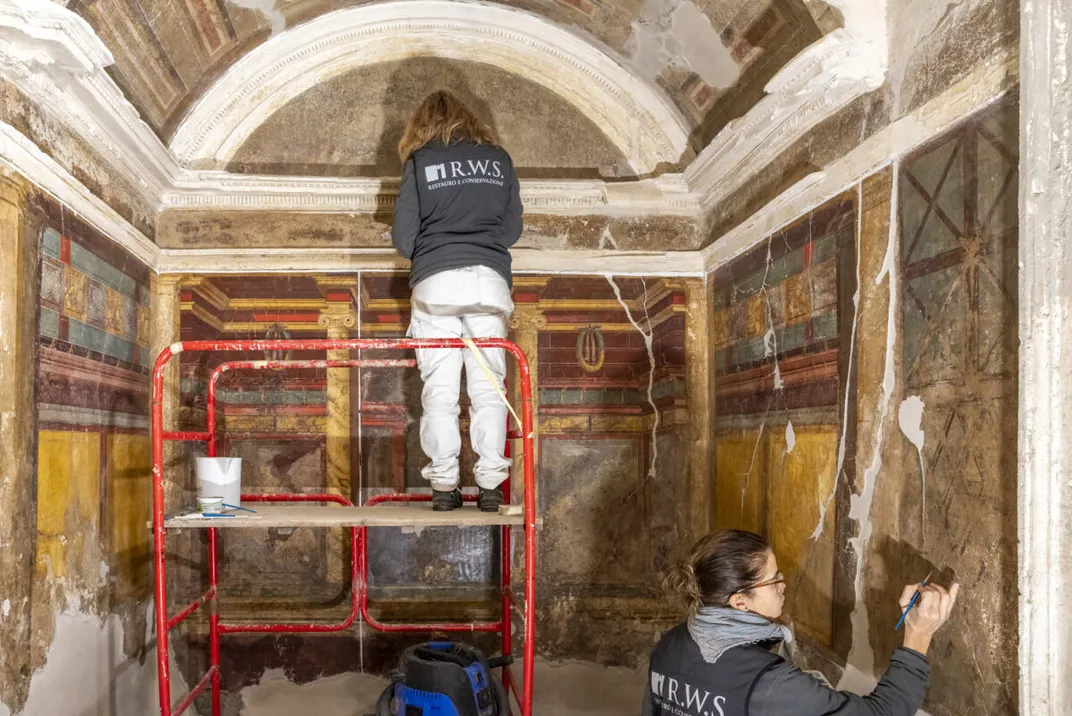
While excavations continue, workers are also restoring two small bedrooms at the villa.
As excavations continue, restoration teams have also been working to conserve two small bedrooms overlooking the southwest section of the villa. These rooms are richly decorated, featuring stucco work, frescoes, mosaic floors, and painted vaulted ceilings in a vibrant palette that includes Egyptian blue.
One of the bedrooms appears to have been in the midst of renovation when Vesuvius erupted, showing multiple stages of work, some left unfinished. Its more restrained decorative programme remains incomplete and includes floral designs set against plain, monochromatic backgrounds, according to Artnet’s Jo Lawson-Tancred.
Researchers have created plaster casts of the shutters that once covered the doors and windows, preserving impressions of the original wooden elements. The ongoing restoration—which involves cleaning surfaces, removing damaged material, and retouching paint—has also brought to light colours and details that had previously gone unnoticed.