The history of cleaning practices provides valuable insight into the daily lives, technologies, and resource management of ancient societies. Although modern soap is commonly associated with industrial production and standardized chemical formulations, people in the ancient world also developed ways to remove dirt, grease, and unpleasant odors from their bodies, clothing, tools, and domestic spaces. These methods varied across cultures and periods, drawing on locally available plants, animal fats, oils, minerals, and alkaline materials. Archaeological evidence, particularly residues preserved in pottery and other containers, can help researchers investigate how ancient communities produced and used substances associated with cleaning.
Soap, in its chemical sense, is generally produced through a reaction between fats or oils and an alkaline substance. This process, known as saponification, transforms the fats into compounds that can help disperse grease in water. Ancient people did not need to understand the underlying chemistry to discover that certain mixtures were effective for cleaning. Through repeated experimentation, they could identify useful combinations of ingredients and refine their preparation methods over generations. However, not every ancient cleaning mixture was technically soap. Some substances may have functioned as detergents, abrasives, fragrances, or treatments for textiles rather than as products created through saponification.
One of the challenges in studying ancient cleaning practices is that the materials involved do not always survive clearly in the archaeological record. Organic fats and oils can degrade through exposure to oxygen, moisture, microorganisms, and changes in soil chemistry. Nevertheless, some residues become trapped in the pores of pottery, allowing traces of their original contents to survive long after the vessel itself has been discarded. These residues can be examined using chemical techniques designed to identify surviving lipid compounds.
Lipid analysis is particularly useful because different fats and oils can contain characteristic combinations of fatty acids and other molecular compounds. Researchers extract small samples from archaeological materials and analyze them using methods such as gas chromatography and mass spectrometry. The resulting chemical profiles can help distinguish broad categories of animal fats, plant oils, and other organic substances. In favorable circumstances, researchers may identify evidence consistent with the heating, mixing, or processing of particular materials.
Yet identifying a fatty residue does not automatically establish that a vessel contained soap. Animal fat and plant oil were used for many purposes, including cooking, food storage, lighting, lubrication, medicine, cosmetics, and craft production. A container holding an oily residue could have served several functions during its lifetime. Archaeologists must therefore interpret chemical findings alongside the vessel's shape, manufacturing characteristics, location, associated artifacts, and the broader archaeological context.
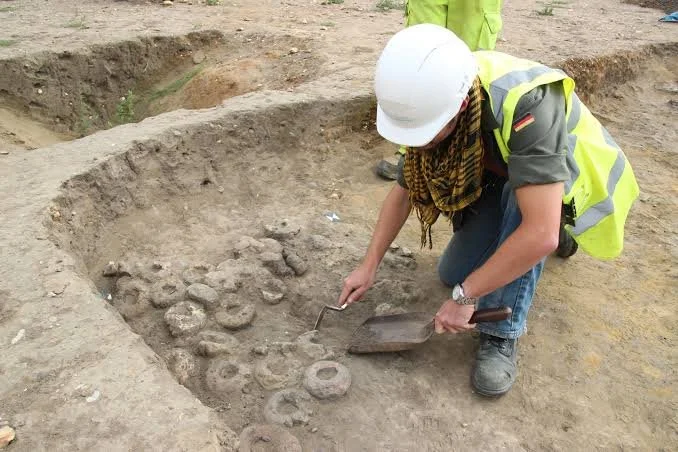
Alkaline substances provide another important part of the investigation. Historically, ash from burned plants could supply alkaline compounds when processed with water. Certain mineral materials could also contribute to cleaning mixtures, depending on their chemical composition. Researchers studying a possible soap-making site may examine hearths, ash deposits, mixing vessels, heating installations, and evidence of repeated production. However, ash alone is not proof of soap manufacture because it can result from cooking, heating, metalworking, and many other activities.
The distinction between personal hygiene and textile cleaning is also significant. A substance used to wash wool or other fibers might not have been intended for washing the body. Similarly, materials applied to leather, household equipment, or working surfaces could contain fats and alkaline ingredients without serving as personal soap. Residue studies become more informative when several types of evidence suggest a specific activity rather than a general association with oils or cleaning.
Ancient written sources, where available, can help researchers understand how people described cleansing substances and their uses. Historical texts may refer to oils, plant preparations, mineral powders, or substances used in washing and grooming. Such records can guide archaeological interpretation, but they must be treated carefully because the meaning of a term may change over time, and written instructions may not represent everyday practice across an entire population.
Experimental archaeology can further investigate how plausible ancient recipes might have worked. Researchers can prepare candidate mixtures using historically appropriate ingredients and compare their chemical characteristics with archaeological residues. These experiments may reveal which processes are chemically feasible and which traces are likely to survive. Nevertheless, a successful modern reconstruction does not prove that an identical recipe was used in antiquity. It demonstrates possibility, not historical certainty.
The study of ancient soap recipes ultimately reveals how chemistry, craft knowledge, and domestic life intersected in the past. Lipid residues can provide clues about the materials people processed, while pottery, production installations, and written evidence help establish how those materials may have been used. By combining these sources, archaeologists can distinguish probable cleaning practices from other activities involving fats and oils, offering a more detailed picture of everyday technology in ancient societies.